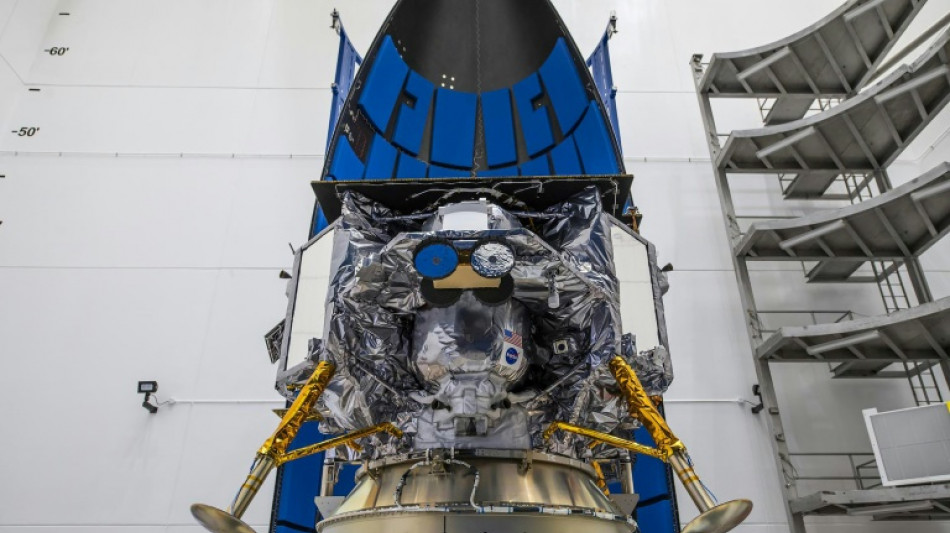
Rocket carrying American lunar lander rolls to launchpad / Photo: - - NASA/AFP/File

 Vessel operator seeks witnesses after Vancouver grounding

 Shrini Srivastava joins crew of Varanasi-Delhi Vande Bharat Sleeper service

 Nearly Half of Australian Workers Overqualified, Survey Finds

 RBI eases export-declaration compliance for individual service exporters

 Reliance shares remain in focus after near-12% surge

 Coal India prepares possible $1 billion Mahanadi Coalfields listing

 Capital-markets shares rally as Motilal Oswal and Angel One lead gains

 Reliance rally puts historical one-year return pattern in focus

 Saudi Aramco quarterly profit climbs 34.6% amid elevated oil prices

 Australia raises benchmark rate to highest level in 18 years

 Asian stocks retreat as AI worries outweigh steep oil-price drop

 Hamad International Airport stages emergency drills during WATAN 2026
Final preparations were underway Friday for the launch of the first American spacecraft to attempt a lunar landing in more than 50 years, under a new partnership between NASA and private industry.
United Launch Alliance's Vulcan rocket was rolling out to the launchpad at Cape Canaveral Space Force Station, preparing for its maiden flight set to blast off on Monday at 2:18 am local time (7:18 GMT).
Hitching a ride is the Peregrine Lander, built by Pittsburgh-based Astrobotic, which if all goes to plan should land at the mid-latitude region of the Moon called Sinus Viscositatis, or Bay of Stickiness, in mid-February.
If successful, it would be the first American lander on the Moon since the Apollo 17 mission in 1972, and the first under NASA's Commercial Lunar Payload Services (CLPS) program, which has paid Astrobotic and another company planning an imminent mission, Intuitive Machines, just shy of $80 million to ship the agency's hardware.
It is the first time the private sector is attempting a feat few countries have achieved: the Soviet Union was first, in 1966, then the United States, and since then China and India. Japan and Israel's recent attempts failed, as has Russia's.
On board Peregrine are a suite of scientific instruments that will probe the lunar environment, helping to pave the way for the return of astronauts under the banner of the NASA-led Artemis program, later this decade.
But it also contains more colorful cargo, including a physical bitcoin, sculptures by the artist Jeff Koons, and, somewhat controversially, DNA and human remains, including those of Star Trek creator Gene Roddenberry and the legendary sci-fi author and scientist Arthur C. Clarke.
"This whole task is not easy -- landing on the moon is extremely difficult," Chris Culbert, CLPS program manager said. "The surface of the Moon holds many robotic spacecraft that were not able to land softly and complete their mission."
Making matters more fraught is the fact it is the first launch for ULA's Vulcan, though the company boasts of a 100 percent success rate in its more than 150 prior launches.
U.Ndiaye--CPN