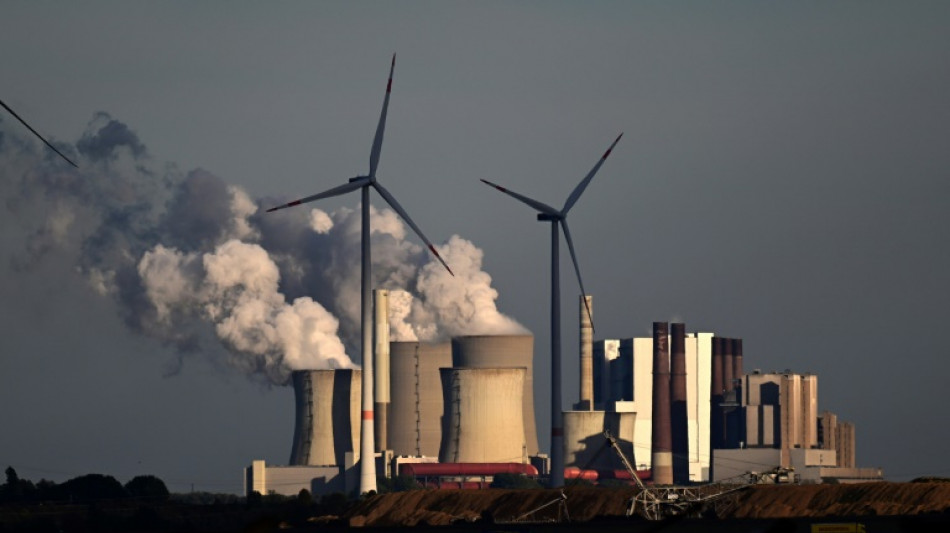
German emissions at 70-year low as coal use drops / Photo: INA FASSBENDER - AFP/File

 Vessel operator seeks witnesses after Vancouver grounding

 Shrini Srivastava joins crew of Varanasi-Delhi Vande Bharat Sleeper service

 Nearly Half of Australian Workers Overqualified, Survey Finds

 RBI eases export-declaration compliance for individual service exporters

 Reliance shares remain in focus after near-12% surge

 Coal India prepares possible $1 billion Mahanadi Coalfields listing

 Capital-markets shares rally as Motilal Oswal and Angel One lead gains

 Reliance rally puts historical one-year return pattern in focus

 Saudi Aramco quarterly profit climbs 34.6% amid elevated oil prices

 Australia raises benchmark rate to highest level in 18 years

 Asian stocks retreat as AI worries outweigh steep oil-price drop

 Hamad International Airport stages emergency drills during WATAN 2026
German emissions were at their lowest point in around 70 years, as Europe's largest economy managed to reduce its dependence on coal faster than expected, a study published Thursday showed.
Europe's biggest economy emitted 673 million tonnes of the greenhouse gases last year, 73 million tonnes fewer than in 2022, according to the energy think tank Agora Energiewende.
The figure was at its lowest point "since the 1950s", Agora said in a statement, while warning that Germany had work to do to further reduce its emissions.
The drop was "largely attributable to a strong decrease in coal power generation", Agora said.
Germany resorted to the fuel in the wake of the Russian invasion of Ukraine, when Moscow cut off gas supplies to the European giant. But since then, Berlin has managed to pare back its use significantly.
Electricity generation from renewable sources was over 50 percent of the total in 2023 for the first time, while coal's share dropped to 26 percent from 34 percent, according to figures published by the federal network agency on Wednesday.
The cut in coal use accounted for a reduction of 46 million tonnes in CO2 emissions, the think tank estimated.
The renewables record brought Germany closer to its target to produce 80 percent of its electricity from wind and solar by 2030, Agora chief Simon Mueller said.
"When it comes to the generation of electricity, we are on a very good path," Economy Minister Robert Habeck said in a statement.
The reduction in emissions however also reflected the frailty of German industry, while economic growth has hovered around zero.
Industrial emissions fell by 20 million tonnes, as production in energy-intensive industries dropped sharply.
The decrease was however "not a sustainable development", Mueller said.
"The crisis-related slump in production weakens the German economy. If emissions are subsequently relocated abroad, then nothing has been achieved for the climate," he said.
In all, the think tank estimated that only 15 percent of the reduction in 2023 constituted a "permanent emissions savings".
To hit its climate targets, Germany needs a "barrage of investments" to modernise industry and reduce the carbon footprint from heating, Mueller said.
D.Goldberg--CPN