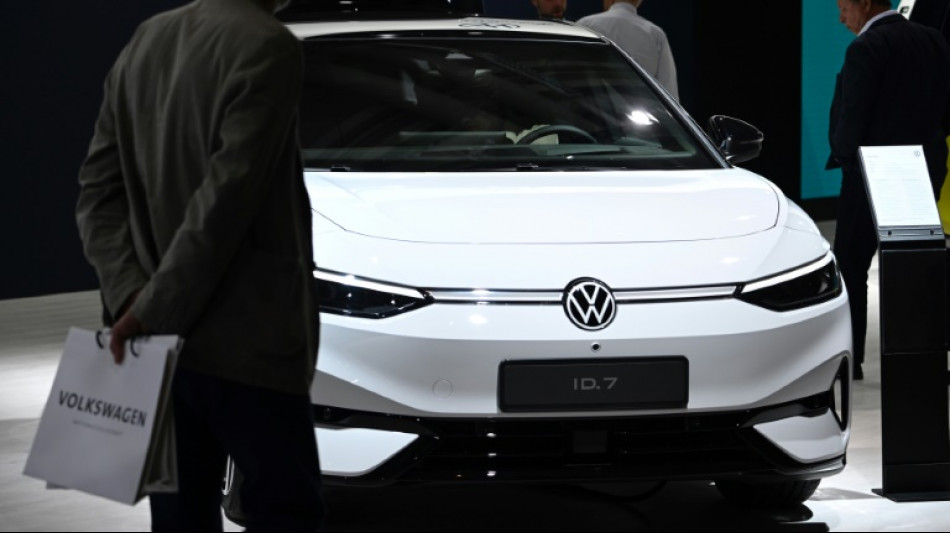
German car sales up in 2023 but electric models lose ground / Photo: Tobias SCHWARZ - AFP/File

 Vessel operator seeks witnesses after Vancouver grounding

 Shrini Srivastava joins crew of Varanasi-Delhi Vande Bharat Sleeper service

 Nearly Half of Australian Workers Overqualified, Survey Finds

 RBI eases export-declaration compliance for individual service exporters

 Reliance shares remain in focus after near-12% surge

 Coal India prepares possible $1 billion Mahanadi Coalfields listing

 Capital-markets shares rally as Motilal Oswal and Angel One lead gains

 Reliance rally puts historical one-year return pattern in focus

 Saudi Aramco quarterly profit climbs 34.6% amid elevated oil prices

 Australia raises benchmark rate to highest level in 18 years

 Asian stocks retreat as AI worries outweigh steep oil-price drop

 Hamad International Airport stages emergency drills during WATAN 2026
Sales of new cars in Germany increased in 2023, official data showed Thursday, but an end to government subsidy programmes saw electric vehicles lose ground on fossil-fuel models.
A total of 2.8 million new cars hit the road in Europe's largest economy last year, an increase of 7.3 percent on 2022, according to the KBA federal transport authority.
Among the different engine types, sales of petrol vehicles increased most, up 13.3 percent on 2022 to 979,000.
The strong rise meant that altogether, petrol and diesel-powered cars saw their market share increase after years of relative decline.
By comparison, battery-powered vehicle sales increased by a more modest 11.4 percent to 524,000, while sales of plug-in hybrids more than halved to 176,000.
Customers raced to buy the latter at the end of 2022 to take advantage of government incentives for hybrids before they were phased out.
Subsequently, the government allowed corporate subsidies for fully-electric vehicles to expire at the beginning of September 2023, and abruptly pulled the plug on a consumer support scheme in mid-December.
The end to the subsidy programmes has further taken the wind out of the electric car market, with sales of battery models down in recent months.
The lack of state support "will lead to a decline in new electric vehicle registrations this year", EY analyst Constantin Gall said.
"The market for electric cars is not yet standing on its own two feet, but depends on government subsidies," Gall said.
Germany's crucial auto industry has staged a modest recovery following the upheaval of pandemic-related shutdowns and supply chain woes in recent years, as companies worked through a backlog of orders.
But sales remain below pre-pandemic levels and the outlook has darkened as high inflation pushes up manufacturing costs and erodes households' purchasing power, cooling demand.
Expected weak economic growth meant that 2024 could be another "lost year" for the auto industry, Gall said.
M.Mendoza--CPN