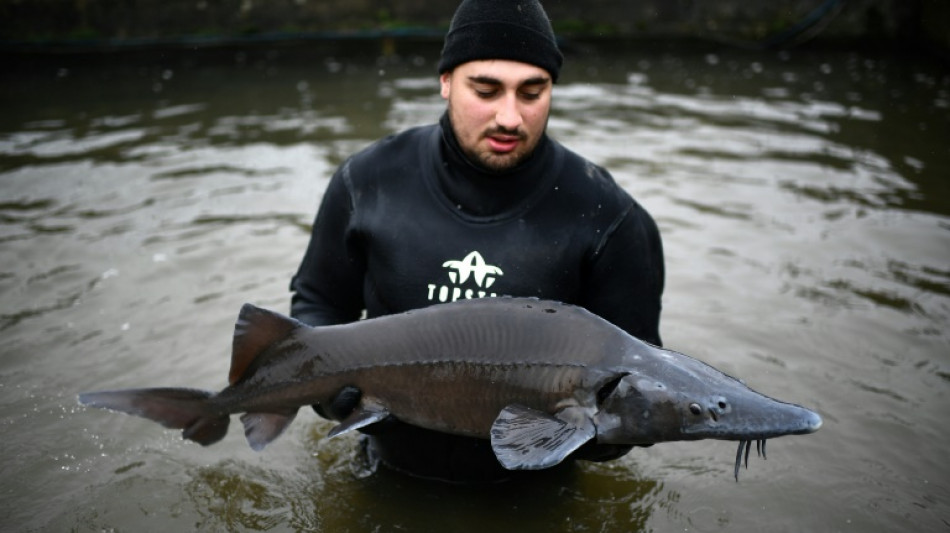
French caviar farms look forward to EU label of origin / Photo: Christophe ARCHAMBAULT - AFP

 Vessel operator seeks witnesses after Vancouver grounding

 Shrini Srivastava joins crew of Varanasi-Delhi Vande Bharat Sleeper service

 Nearly Half of Australian Workers Overqualified, Survey Finds

 RBI eases export-declaration compliance for individual service exporters

 Reliance shares remain in focus after near-12% surge

 Coal India prepares possible $1 billion Mahanadi Coalfields listing

 Capital-markets shares rally as Motilal Oswal and Angel One lead gains

 Reliance rally puts historical one-year return pattern in focus

 Saudi Aramco quarterly profit climbs 34.6% amid elevated oil prices

 Australia raises benchmark rate to highest level in 18 years

 Asian stocks retreat as AI worries outweigh steep oil-price drop

 Hamad International Airport stages emergency drills during WATAN 2026

 Qatar solar expansion opens scope for technical performance gains
At a French caviar factory this week, a worker used tiny pliers to carefully line up black sturgeon fish eggs against a ruler.
"I'm measuring the eggs to be able to classify them. Above a certain size, they're premium," said Magdalena Puaud, wearing a hair net and face mask.
The fish roe, once sorted and left to mature in small tins for several months, will be sold in France and abroad for 2,000-10,000 euros ($2,200-11,000) a kilo (2.2 pounds).
Caviar was first introduced to France around a century ago by Russian aristocrats who had fled their home country after the 1917 revolution.
The southwestern region of Aquitaine, which is naturally home to sturgeons, started to produce the delicacy in the 1920s and is today home to four caviar farms that make up 90 percent of all French production.
After a decade of lobbying, Aquitaine's farms are looking forward to their caviar finally receiving an EU certificate of origin in the new year.
According to the European Union, "geographical indications" protect products against misuse or imitation of the registered name and guarantee their true origin to customers.
"We have nothing to hide," said Laurent Dulau, the managing director of the biggest of Aquitaine's farms in Saint-Fort-sur-Gironde, which produces 20 tonnes of fish roe a year.
He and fellow producers hope the EU stamp of approval will allow them to stand out in a market nowadays dominated by China and awash with opaque labelling.
"We're going to guarantee total traceability -- origin, environmental responsibility and sustainability, and no genetically modified organisms or antibiotics," he said.
Last week, in the runup to Christmas, French authorities seized and destroyed 17 kilos of caviar worth some 35,000 euros ($38,000) for not following health and safety guidelines, including not identifying its country of origin.
- 'Quality, not quantity' -
Near the sturgeon pools in Saint-Fort-sur-Gironde, employees fished out females and examined them one by one, a man rolling an ultrasound over their plump white bellies.
"Caviar," he shouted when he saw semi-circles on his monitor, indicating the fish was ready to be sliced open.
When the eggs were not yet big enough or too mature, the fish was sent shooting down a slide back into the water.
The label "validates the way we work," said fish production manager Nicolas Proust.
Dulau said the certificate of origin would help French producers compete against huge quantities of cheap Chinese caviar.
"There are 600 tonnes of caviar produced in the world, and China alone produces 250 tonnes, while France produces just 50 tonnes," he said.
Francoise Boisseaud, who buys up French caviar and mostly sells it abroad, agreed the new EU guarantee was good news.
"France is a small country," she said. "We are forced to bank on quality, not quantity. It's strategic."
P.Kolisnyk--CPN