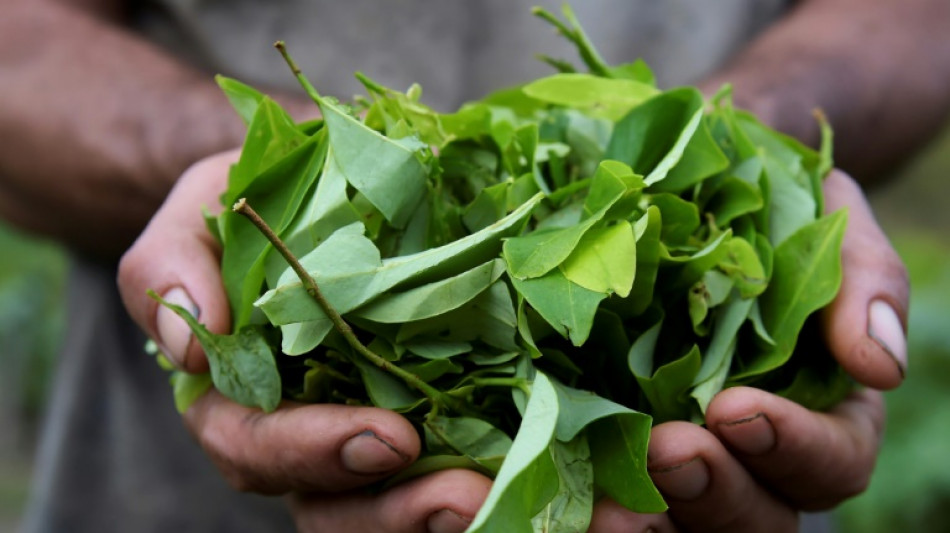
Cocaine market sees new players, bananas and Amazon submarines: report / Photo: Schneyder Mendoza - AFP/File

 Vessel operator seeks witnesses after Vancouver grounding

 Shrini Srivastava joins crew of Varanasi-Delhi Vande Bharat Sleeper service

 Nearly Half of Australian Workers Overqualified, Survey Finds

 RBI eases export-declaration compliance for individual service exporters

 Reliance shares remain in focus after near-12% surge

 Coal India prepares possible $1 billion Mahanadi Coalfields listing

 Capital-markets shares rally as Motilal Oswal and Angel One lead gains

 Reliance rally puts historical one-year return pattern in focus

 Saudi Aramco quarterly profit climbs 34.6% amid elevated oil prices

 Australia raises benchmark rate to highest level in 18 years

 Asian stocks retreat as AI worries outweigh steep oil-price drop

 Hamad International Airport stages emergency drills during WATAN 2026

 Qatar solar expansion opens scope for technical performance gains
The global cocaine market is changing.
Colombia is still the biggest producer of the drug, but other actors are taking an ever bigger role in manufacturing and distributing it, according to a report based on thousands of Colombian prosecutor's files leaked by hackers.
A group of around a hundred journalists has deciphered some seven million emails and 38,000 files leaked by the Guacamaya hacktivist group which in 2022 broke into the computer systems of security agencies and armies from Mexico, Chile, Peru, Salvador and Colombia.
The so-called "Narcofiles" report outlines the networks of cocaine production and trafficking around the world.
"The market is changing," Nathan Jaccard, Latin America editor for the Organized Crime and Corruption Reporting Project (OCCRP), a consortium of investigative journalists which accessed the files, told AFP.
Colombia cultivated a record 230,000 hectares of coca leaf in 2022, and produced 1,738 tonnes of cocaine, according to the United Nations.
However, the country's cocaine trade has been hard hit by falling coca leaf prices and the emergence of new, synthetic drugs such as fentanyl.
The "Narcofiles" report shows that Mexican, Albanian, Brazilian, Ecuadorian and Israeli groups are starting to gain power in the global drug trade.
"Colombia no longer plays a leading role in the international drug trafficking chain," explains Elizabeth Dickinson, an analyst at Crisis Group.
A leaked memorandum between Colombia and Israel describes a "significant increase" in crimes committed in the South American country by Israelis attracted by sex tourism and linked, according to local authorities, to cocaine trafficking.
- Bananas and submarines -
The "Narcofiles" also revealed the growing role of the banana industry in the export of cocaine, and an increase in trafficking along routes such as the Amazon River, from which more and more submarines loaded with cocaine head to the Atlantic.
According to the European Commission, 70 percent of drug seizures in Europe take place at ports. Traffickers use banana shipments to hide their goods, as fresh produce passes customs checks more quickly.
Another new hotspot in the cocaine market is the triple border point where Peru, Colombia and Brazil meet in the Amazon.
This region was "relatively calm 15 years ago", said Jaccard.
The report also reveals that coca leaf plantations have multiplied in Central America and Mexico, while coca paste is increasingly being processed in laboratories in Europe.
"Drug traffickers are deciding to move closer to the markets" to reduce costs and risks, while maximizing profits, Jaccard explained.
Some of the changes mean that Colombian cartels and their kingpins, the likes of Pablo Escobar, no longer "run the show," said Dickinson.
Although large criminal structures such as the Clan del Golfo, the world's leading producer of cocaine, continue to operate in the country, "we are witnessing a process of atomization of groups" which reduces their power, said Jaccard.
P.Schmidt--CPN