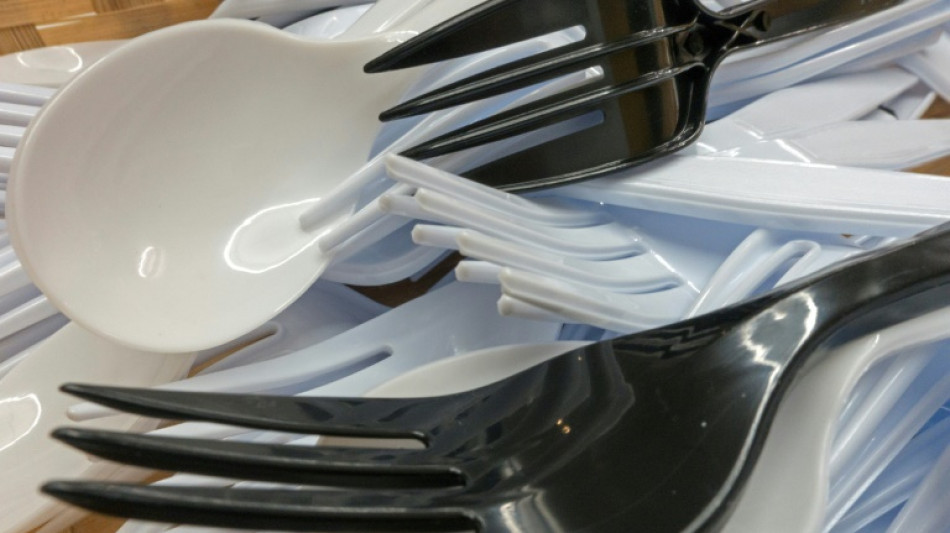
Canada bids farewell to plastic straws, cutlery and checkout bags / Photo: PAUL J. RICHARDS - AFP/File

 Vessel operator seeks witnesses after Vancouver grounding

 Shrini Srivastava joins crew of Varanasi-Delhi Vande Bharat Sleeper service

 Nearly Half of Australian Workers Overqualified, Survey Finds

 RBI eases export-declaration compliance for individual service exporters

 Reliance shares remain in focus after near-12% surge

 Coal India prepares possible $1 billion Mahanadi Coalfields listing

 Capital-markets shares rally as Motilal Oswal and Angel One lead gains

 Reliance rally puts historical one-year return pattern in focus

 Saudi Aramco quarterly profit climbs 34.6% amid elevated oil prices

 Australia raises benchmark rate to highest level in 18 years

 Asian stocks retreat as AI worries outweigh steep oil-price drop

 Hamad International Airport stages emergency drills during WATAN 2026

 Qatar solar expansion opens scope for technical performance gains
Canadian restaurants and cafes were no longer permitted as of Wednesday to offer plastic straws, food containers, checkout bags or cutlery to customers -- despite a court ruling that such restrictions are unconstitutional.
The regulation banning single-use plastics was introduced last year and was to be phased in as part of Ottawa's commitment to achieve zero plastic waste by 2030.
But it hit a snag in November when a Canadian court ruled in a case brought by oil and chemical companies that it was "unreasonable and unconstitutional."
The government went ahead anyway, asking the court to stay an order quashing the ban while it appeals the decision, and the prohibition against the manufacture, sale or in-store distribution of single-use plastics came into force.
Charles Desgens, 29, was having lunch at a restaurant in Saint-Jean-sur-Richelieu, a short drive from Montreal, as eating establishments were scrambling to get rid of the last of their plastic inventory.
"I find it very good that the law requires store owners to do it. I don't think everyone would have done it straight away or it would have taken a lot of time," he explained.
"It's sometimes simpler if it's disposable, but the little extra effort is worth it," echoed Helene Boulanger, a 32-year-old engineer.
Still, some like Emile Doucet, of the Parma sandwich restaurant in this small town of 100,000 inhabitants, lament that it is "not yet very easy to find alternatives" to plastic.
According to Ottawa, Canadians throw away three million tonnes of plastic waste each year -- including a staggering 15 billion bags annually. Only nine percent of it is recycled.
The government has said it aims to hike that to 90 percent, in line with European targets for 2029.
"The science is clear: plastic pollution is everywhere, and it harms wildlife and damages the environment. It is found across Canada and the world," Environment Minister Steven Guilbeault said in a statement.
A survey by environmental group Oceana Canada found Canadians overwhelmingly support the plastics ban, which comes as 50 other nations have also adopted laws to combat plastic pollution.
The world must halve single-use plastics and massively boost the reuse and recycling of plastics while rolling out alternatives in order to stop this rampant pollution, the United Nations Environment Program (UNEP) said in May.
In 2019, 353 million tonnes of plastic waste were produced worldwide, 22 percent of which ended up in landfills, burned or discarded into nature.
L.K.Baumgartner--CPN