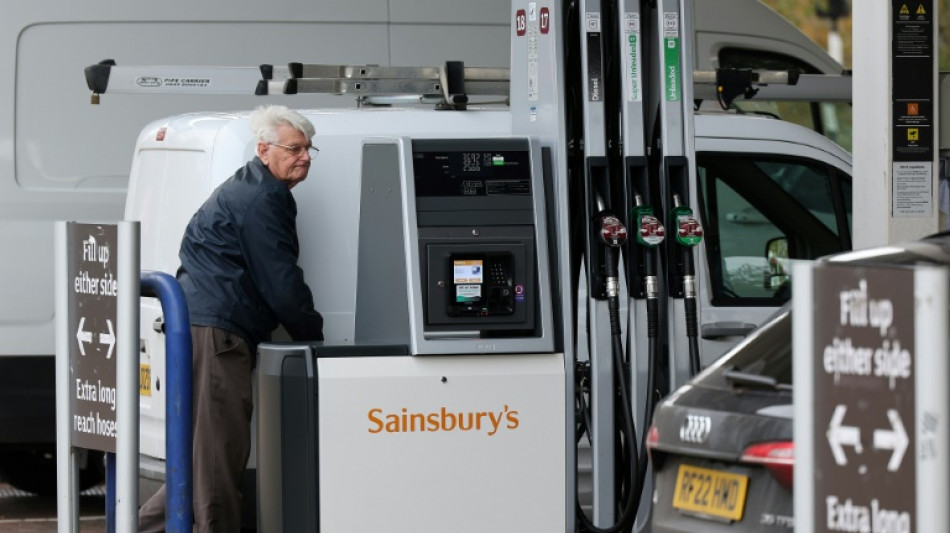
UK inflation hits lowest level in more than two years / Photo: Adrian DENNIS - AFP/File

 Vessel operator seeks witnesses after Vancouver grounding

 Shrini Srivastava joins crew of Varanasi-Delhi Vande Bharat Sleeper service

 Nearly Half of Australian Workers Overqualified, Survey Finds

 RBI eases export-declaration compliance for individual service exporters

 Reliance shares remain in focus after near-12% surge

 Coal India prepares possible $1 billion Mahanadi Coalfields listing

 Capital-markets shares rally as Motilal Oswal and Angel One lead gains

 Reliance rally puts historical one-year return pattern in focus

 Saudi Aramco quarterly profit climbs 34.6% amid elevated oil prices

 Australia raises benchmark rate to highest level in 18 years

 Asian stocks retreat as AI worries outweigh steep oil-price drop

 Hamad International Airport stages emergency drills during WATAN 2026

 Qatar solar expansion opens scope for technical performance gains
British inflation has slowed sharply to the lowest level in more than two years on falling petrol prices, official data showed Wednesday, easing a cost-of-living crisis after aggressive interest-rate hikes.
The Consumer Prices Index hit 3.9 percent in November from 4.6 percent in the previous month, attaining the weakest rate since September 2021, the Office of National Statistics said.
The news handed a further boost to embattled Conservative Prime Minister Rishi Sunak after inflation had already achieved his goal of falling below five percent in October.
Finance minister Jeremy Hunt welcomed the news but conceded that Britons were still struggling with elevated consumer prices.
"With inflation more than halved we are starting to remove inflationary pressures from the economy," said Hunt.
"We are back on the path to healthy, sustainable growth. But many families are still struggling with high prices so we will continue to prioritise measures that help with cost of living pressures."
Sunak is currently seen as unlikely to win next year's general election, as his governing Conservatives trail Keir Starmer's main opposition Labour party.
- Rate freeze -
November marked a sharper slowdown than expectations of 4.3 percent, but the rate is nevertheless almost double the Bank of England's official target of 2.0 percent.
"Inflation eased again to its lowest annual rate for over two years, but prices remain substantially above what they were before the invasion of Ukraine," said ONS chief economist Grant Fitzner.
"The biggest driver for this month's fall was a decrease in fuel prices after an increase at the same time last year. Food prices also pulled down inflation, as they rose much more slowly than this time last year."
The news comes one week after the BoE froze its key interest rate at a 15-year peak of 5.25 percent -- but warned that it will remain elevated to tackle stubbornly high consumer prices.
Inflation had surged to a 41-year peak at 11.1 percent in October 2022, stoked by spiking energy prices after the invasion of Ukraine by major oil and gas producer Russia and sparking a cost-of-living squeeze in Britain.
- Still too high -
Wednesday's data sparked speculation the BoE could now decide to start cutting borrowing costs next year.
However, core inflation -- which strips out food and energy costs -- eased only slightly to stand at 5.2 percent in November from 5.6 percent in October.
"The sharper-than-expected fall in inflation in November is good news, pointing to a continued easing in price pressures," noted Deloitte senior economist Debapratim De.
"Those hoping that this allows the Band of England to soften its relatively hawkish stance on interest rates might be disappointed though.
"Measures of underlying pricing strength, such as core and services inflation, have eased further but still remain at elevated levels."
The BoE had stated last week that monetary policy would need to be "restrictive for an extended period of time" in order to return inflation to its target level.
And its governor, Andrew Bailey, cautioned that there was "still some way to go" in policymakers' efforts to dampen inflationary pressures.
Y.Ponomarenko--CPN