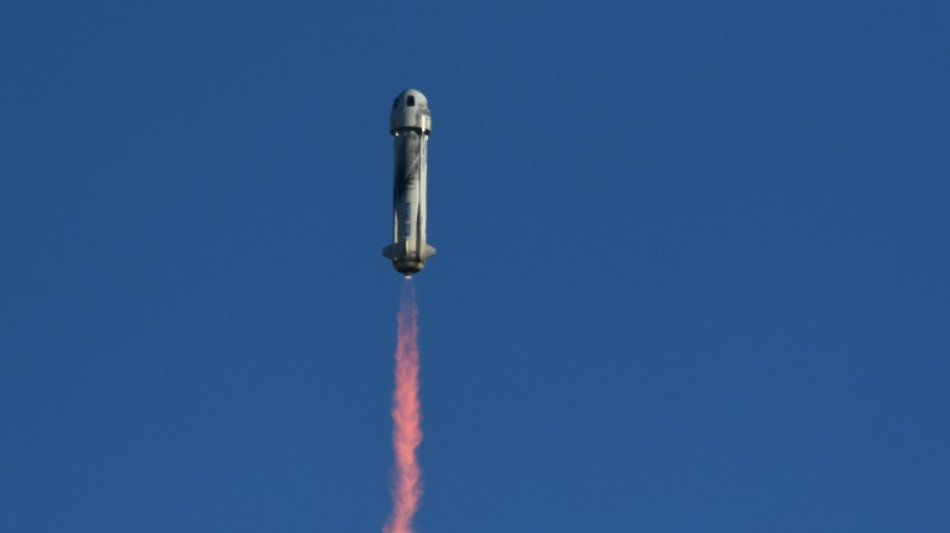
Blue Origin returns to space after yearlong hiatus / Photo: Patrick T. FALLON - AFP/File

 Vessel operator seeks witnesses after Vancouver grounding

 Shrini Srivastava joins crew of Varanasi-Delhi Vande Bharat Sleeper service

 Nearly Half of Australian Workers Overqualified, Survey Finds

 RBI eases export-declaration compliance for individual service exporters

 Reliance shares remain in focus after near-12% surge

 Coal India prepares possible $1 billion Mahanadi Coalfields listing

 Capital-markets shares rally as Motilal Oswal and Angel One lead gains

 Reliance rally puts historical one-year return pattern in focus

 Saudi Aramco quarterly profit climbs 34.6% amid elevated oil prices

 Australia raises benchmark rate to highest level in 18 years

 Asian stocks retreat as AI worries outweigh steep oil-price drop

 Hamad International Airport stages emergency drills during WATAN 2026

 Qatar solar expansion opens scope for technical performance gains
Blue Origin launched its first rocket in more than a year on Tuesday, reviving the US company's fortunes with a successful return to space following an uncrewed crash in 2022.
Though mission NS-24 carried a payload of science experiments, not people, it paves the way for Jeff Bezos' aerospace enterprise to resume taking wealthy thrill-seekers to the final frontier.
The New Shepard suborbital rocket blasted off from the pad at Launch Site One, near Van Horn, Texas, at 10:43 am local time (1643 GMT).
After separating from the booster, the gumdrop-shaped capsule attained a peak altitude of 66.5 miles (107 kilometers) above sea level, well above the internationally-recognized boundary of space known as the Karman line, which is 62 miles high.
The booster then successfully landed vertically on the launchpad, against the majestic backdrop of the Sierra Diablo mountains, followed a few minutes later by the capsule floating serenely to the desert floor on three giant parachutes.
"There it is, touchdown for NS-24," said an announcer.
The science experiments onboard included one to demonstrate the operation of hydrogen fuel cell technology in microgravity, and another showing how water and gas move in a weightless environment. Future applications could include monitoring water quality for astronauts in space.
- Long break -
On September 12, 2022, a Blue Origin rocket became engulfed in flames shortly after launch. The capsule, fixed to the top of the rocket, successfully initiated an emergency separation sequence and floated safely to the ground on parachutes.
The accident prompted a yearlong probe by the Federal Aviation Administration (FAA), which found it was caused by the failure of an engine nozzle that experienced higher-than-expected engine operating temperatures.
The regulator issued a set of corrective actions Blue Origin had to undertake before it could resume flying, including the redesign of certain engine parts. It confirmed Sunday it had approved Blue Origin's application to fly again.
In all, Blue Origin has flown six crewed flights -- some passengers were paying customers and others flew as guests -- since July 2021, when Bezos himself took part in the first flight.
While Blue Origin has been grounded, rival Virgin Galactic, the company founded by British billionaire Richard Branson, has pressed on, flying five commercial flights this year.
The two companies compete in the emerging space tourism sector, operating in suborbital space.
- Reusable rocket, no carbon emissions -
While Blue Origin launches a small rocket vertically, Virgin Galactic uses a large carrier plane to gain altitude and then drop off a smaller, rocket-powered spaceplane that completes the journey to space.
In both cases, passengers enjoy a few minutes of weightlessness and can view the curvature of the Earth through large windows.
Virgin Galactic tickets were sold for between $200,000-$450,000; Blue Origin does not disclose its ticket prices publicly.
Blue Origin can boast of the fact that nearly all of its rocket platform is re-used, including the booster, capsule, engine, landing gear and parachutes.
Its engine meanwhile is fueled by liquid oxygen and hydrogen, meaning the only byproduct during flight is water vapor, with no carbon emissions.
Blue Origin is also developing a heavy rocket for commercial purposes called New Glenn, with the maiden flight planned for next year.
This rocket, which measures 98 meters (320 feet) high, is designed to carry payloads of as much as 45 metric tons into low Earth orbit.
X.Wong--CPN