Muslims face frugal Ramadan as Ukraine war drives up food prices

 Kenya's economy faces climate change risks: World Bank

 Mixed US auto sales in Q2 amid high gas prices

 'Gus' the T. rex presented in New York ahead of auction

 Mixed US auto sales in 2nd quarter amid high gas prices

 Record heat broils US east coast amid World Cup, July Fourth events

 Portugal braces for high temperatures in new heatwave

 Planned 1.7 million satellites 'devastating' for astronomy: study

 Canada to join Eurovision Song Contest

 Chinese firm sells hyper-real, 'always loyal' humanoid robots
 Trump earned over $1 bn from crypto ventures in 2025

 The Afghan women farmers keeping their village alive

 After 250 years, the 'American dream' is tarnished but alive
 No corn dogs? Trump's 'Great American State Fair' threatens to be a flop

 CIA boss compares cutting-edge AI to nuclear weapons

 Taps run dry in Hungarian village as heatwave bites

 Inflation slows in top eurozone economies as ECB ponders next move

 Data centres emitting more CO2 than thought: study

 Thousands march to demand illegal migrants leave South Africa

 Stocks climb, yen stays near 40-year low against dollar
 Over 1 million migrants apply for Spain's mass regularisation: PM

 NASA robot mission aiming to rescue space telescope

 Affiliate of Pacific Avenue Capital Partners Completes Acquisition of ESE World from Amcor

 Extreme heat warning issued for World Cup host Kansas City
 Tech rebound lifts Dow to record, yen hits 40-year low against dollar

 Europe's deadly heatwave scorches east, Slovakia hits record

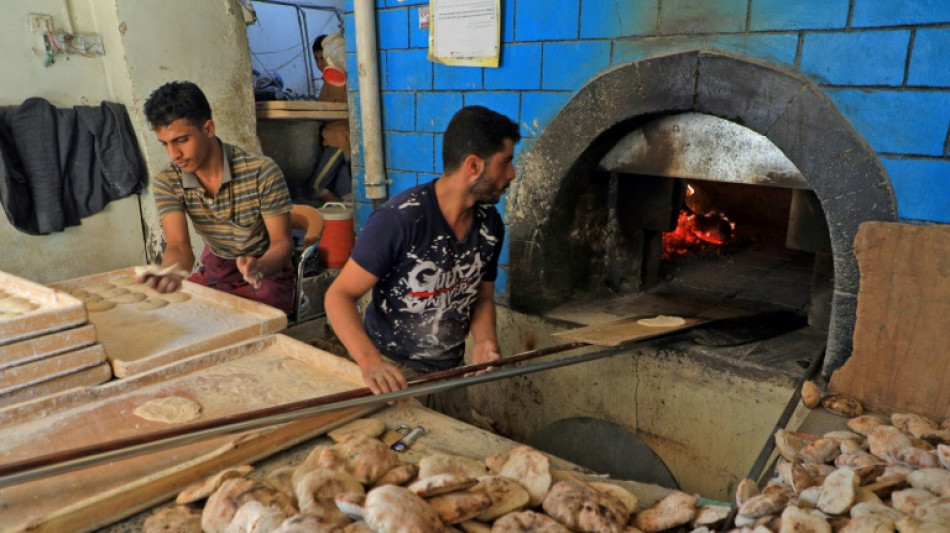
Russia's Ukraine invasion, which has already exacerbated food woes in parts of Africa and the Middle East, is marring preparations for the holy month of Ramadan and forcing a turn to frugal iftar sunset meals.
From Lebanon to Tunisia and Somalia, Muslims who traditionally break a dawn-to-dusk fast with lavish family meals, are now struggling to secure even the most basic staples in light of skyrocketing food and fuel prices.
"High prices affect and spoil the spirit of Ramadan," said Sabah Fatoum, a resident of the Israeli-blockaded Gaza strip, where consumer goods prices have climbed by up to 11 percent, according to Palestinian authorities.
"We hear that prices will rise even more... it's a burden for people," the 45-year-old told AFP ahead of the holy month that starts this weekend with the sighting of the crescent moon.
Russia and Ukraine, with vast grain-growing regions that are among the world's main breadbaskets, account for a huge share of the globe's exports in several major commodities such as wheat, vegetable oil and corn.
The disruption in export flows resulting from Russia's invasion and international sanctions has spurred fears of a global hunger crisis, especially across the Middle East and Africa, where the knock-on effects are already playing out.
The toll is most evident in countries such as Yemen, the Arab world's poorest, where a devastating war since 2014 has sparked one of the world's worst humanitarian crises.
Food prices there have doubled since last year and the fact that Ukraine supplies nearly a third of Yemen's wheat imports has heightened fears of a deepening famine.
Mohsen Saleh, a resident of the capital Sanaa, said that every year prices shoot up ahead of Ramadan, "but this year, they have increased in a crazy way, people can't take it".
"The economic situation is very difficult," the 43-year-old told AFP. "Most people in Yemen are poor and exhausted."
- 'One dish' -
In Syria, where a conflict since 2011 has plunged nearly 60 percent of the population into food insecurity, Ramadan to many has become a painful reminder of better, bygone days.
Cooking oil has more than doubled in price since the start of the Ukraine war and is sold in limited quantities.
The Syrian government, not spared by its status as a staunch Moscow ally, is also rationing wheat, sugar and rice.
"I thought last Ramadan was going to be our most frugal," said Basma Shabani, a 62-year-old Damascus resident, looking back at a year also marred by the Covid pandemic.
"But it seems that this year we will remove even more dishes from our spread.
"We can't afford more than one type of dish on our table anymore and I am worried that in the future even this one dish will be beyond our reach."
In Tunis, Ramadan traditions have also been put to the test.
Food donations, a common custom during the holy month, have dropped to a trickle, with former benefactors now struggling to source basics for themselves.
Mohamed Malek, a 20-year-old student volunteer, has been collecting Ramadan food donations for years.
"Our donation cart is usually full within the hour but this year this is not the case," he told AFP.
"Some people are even telling us 'let us find food for ourselves first'."
In Lebanon, too, local charity networks are unravelling as the Ukraine crisis piles more pressure on a population hit hard by an unprecedented economic crisis since 2019.
"The strong solidarity which comes into action especially in months like Ramadan will be dramatically tested this year," said Bujar Hoxha, Lebanon director for Care International.
"Hyperinflation and soaring food prices in local markets make the long-awaited Ramadan month for many Lebanese challenging," he told AFP.
Many will "struggle to bring iftar meals to the table".
- 'Big problem' -
In Egypt, a leading importer of wheat from the former Soviet states, Muslims are tightening their purse strings ahead of Ramadan -- a time when spending usually rises.
President Abdel Fattah al-Sisi in March ordered a price cap on unsubsidised bread after the Russian invasion triggered a 50 percent rise.
The local currency also lost 17 percent of its value that same month.
"If someone used to buy three kilos of vegetables, now they're only buying one," said Om Badreya, a street vendor in western Cairo.
Somalia, which is grappling with an Islamist insurgency and its worst drought in 40 years, is also gearing up for a grim Ramadan as rising prices slash the purchasing power of the 15-million strong population.
Ramadan "will be much different as fuel and food prices are skyrocketing", said Mogadishu resident Adla Nur.
Even oil-rich Saudi Arabia is feeling the pinch.
"Everything is getting more expensive... every time I pay around 20-30 riyals ($5-$8) more for the same products," said Ahmad al-Assad, a 38-year-old private sector employee.
Qatar, however, has emerged as an exception with the government decreasing food prices ahead of Ramadan in a symbolic gesture.
"Prices of more than 800 commodities have been reduced in coordination with major outlets in Qatar, starting from Wednesday, March 23 until the holy month of Ramadan," said Qatar's commerce and industry ministry.
burx-ho/jmm/fz
L.Peeters--CPN