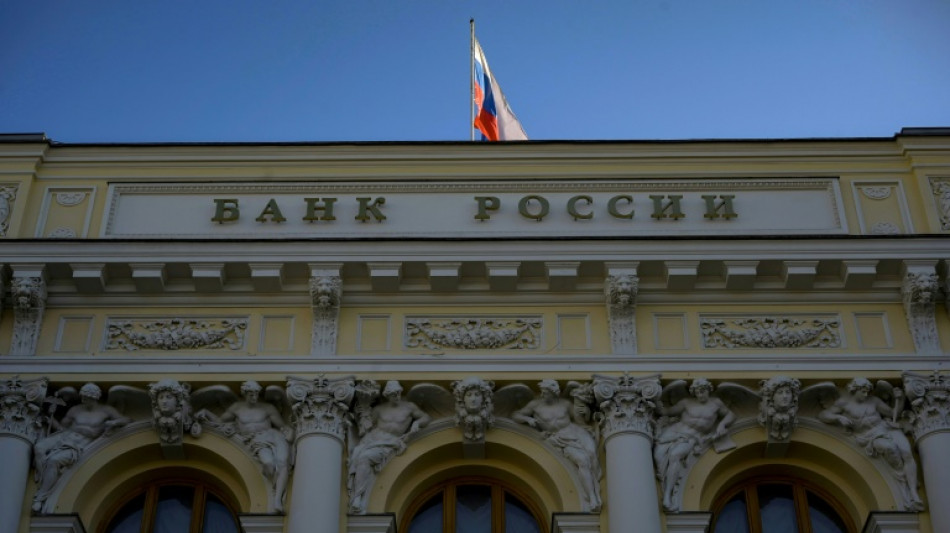
Russian central bank raises key interest rate to 16% to counter inflation / Photo: Natalia KOLESNIKOVA - AFP/File

 Vessel operator seeks witnesses after Vancouver grounding

 Shrini Srivastava joins crew of Varanasi-Delhi Vande Bharat Sleeper service

 Nearly Half of Australian Workers Overqualified, Survey Finds

 RBI eases export-declaration compliance for individual service exporters

 Reliance shares remain in focus after near-12% surge

 Coal India prepares possible $1 billion Mahanadi Coalfields listing

 Capital-markets shares rally as Motilal Oswal and Angel One lead gains

 Reliance rally puts historical one-year return pattern in focus

 Saudi Aramco quarterly profit climbs 34.6% amid elevated oil prices

 Australia raises benchmark rate to highest level in 18 years

 Asian stocks retreat as AI worries outweigh steep oil-price drop

 Hamad International Airport stages emergency drills during WATAN 2026

 Qatar solar expansion opens scope for technical performance gains
Russia's central bank on Friday raised its key interest rate to 16 percent, announcing a fifth hike since summer in a bid to fight accelerating inflation.
The central bank has been grappling with the economic fallout of the offensive in Ukraine that includes Western sanctions, a surge in government military spending and the call-up of hundreds of thousands of men.
"Current inflationary pressures remain high. Annual inflation for 2023 is expected to be close to the upper bound of the 7.0–7.5 percent forecast range," the Bank of Russia said in a statement explaining its decision.
Higher interest rates are designed to sap demand by making it more expensive to borrow money and encouraging consumers and businesses to save, not spend.
Analysts expected the increase as the central bank repeatedly stated its priority to fight inflation, which accelerated to 7.5 percent in November.
The Bank said it was anticipating "that tight monetary conditions will be maintained in the economy for a long period."
The exchange rate is seen as a key barometer of Russia's economic health by politicians, businesses and the population.
Central bank chief Elvira Nabiullina said that Moscow's economy was working "almost at full capacity", warning of a risk of "overheating."
"Business lending is showing early signs of slowing, but is still growing at a record pace," she warned, as the bank is seeking to limit subsidised loads believed to be driving inflation.
The decision to raise the interest rate comes a week after Russian President Vladimir Putin announced plans to run in tightly-controlled polls in 2024 to stay in the Kremlin until at least 2030.
At his end-of-year press conference Thursday Putin hailed the 2.9 percent unemployment rate "at an all time low", calling it "a very good indicator of the state of the economy."
But analysts say the low employment rate is not a healthy sign but instead shows a shortage of recruits, with various sectors struggling to fill posts.
The mobilisation of hundreds of thousands of men took them off the job market, while prompting many of the most educated parts of the population to flee the country.
The lack of manpower is driving up the wages, as employers are forced to offer more attractive salaries in order to recruit.
While this has created a cycle of rising wages and prices, a rapid rise in military spending has pushed the government into a deficit.
D.Goldberg--CPN