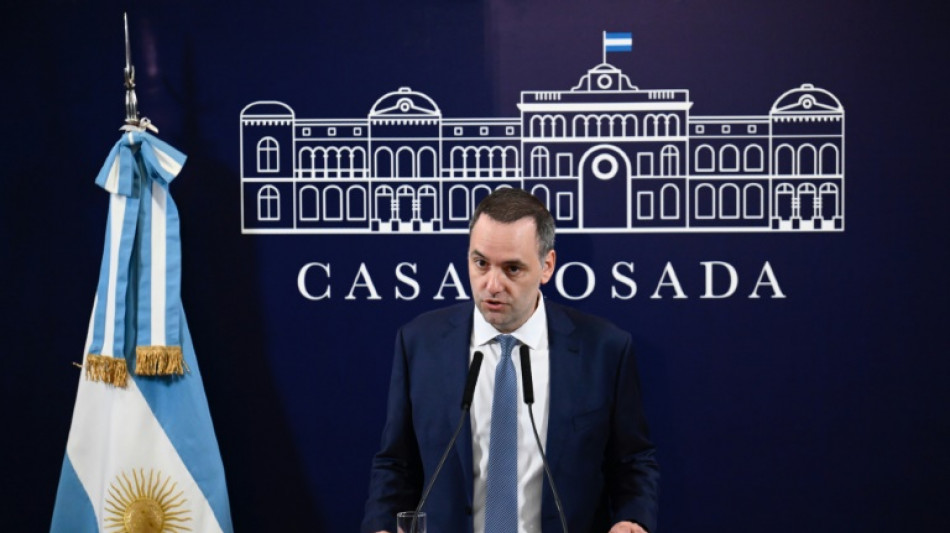
Argentine government to unveil measures to avoid 'hyperinflation' / Photo: Luis ROBAYO - AFP

 Vessel operator seeks witnesses after Vancouver grounding

 Shrini Srivastava joins crew of Varanasi-Delhi Vande Bharat Sleeper service

 Nearly Half of Australian Workers Overqualified, Survey Finds

 RBI eases export-declaration compliance for individual service exporters

 Reliance shares remain in focus after near-12% surge

 Coal India prepares possible $1 billion Mahanadi Coalfields listing

 Capital-markets shares rally as Motilal Oswal and Angel One lead gains

 Reliance rally puts historical one-year return pattern in focus

 Saudi Aramco quarterly profit climbs 34.6% amid elevated oil prices

 Australia raises benchmark rate to highest level in 18 years

 Asian stocks retreat as AI worries outweigh steep oil-price drop

 Hamad International Airport stages emergency drills during WATAN 2026

 Qatar solar expansion opens scope for technical performance gains
President Javier Milei's new government will on Tuesday unveil a set of emergency measures to avoid "hyperinflation" that are expected to deliver a shock to the country's ailing economy.
The 53-year-old libertarian and self-described "anarcho-capitalist" took office on Sunday vowing to slash public spending, warning the situation was likely to get a lot worse before it gets better.
"We are immersed in one of the deepest crises in history and we are also heading towards hyperinflation. The decision is to avoid it," government spokesman Manual Adorni said Tuesday.
Annual inflation is currently at 140 percent and poverty levels at 40 percent in Latin-America's third-biggest economy.
Milei has vowed to cut spending by five percent of gross domestic product and has already slimmed the government from 18 ministries to nine.
The former television panelist who entered politics only two years ago won over voters furious at decades of economic decline and instability.
The new measures will be revealed by Economy Minister Luis Caputo in a pre-recorded message after the markets close.
"The inflation that we are going to avoid will surely be much more devastating than the hyperinflation in 1989 and 1990," said Adorni, referring to years when inflation soared to over 3,000 percent.
Argentines also remain haunted by the country's economic implosion in 2001, accompanied by protests and looting that left almost 40 dead.
The country once again finds itself heavily indebted and analysts say foreign reserves are in the red.
- 'Significant spending cuts' -
Recent governments have been heavy on intervention in prices and currency controls, welfare handouts and subsidies of fuel and transport -- bus tickets cost only a few dollar cents.
All of these could fall prey to Milei's chainsaw, which he took with him on the campaign trail to symbolize spending cuts.
Nicolas Saldias, a senior analyst with the Economist Intelligence Unit told AFP that aside from "significant spending cuts" there could be a devaluation of the peso from its current 400 to the dollar, to around 650.
"The question mark will be how they will manage the currency afterwards," he said, after years of expensive intervention in the exchange rate.
Currency controls introduced in 2019 have birthed a multitude of dollar exchanges in the country, with greenbacks on the black market selling for more than double the official rate.
Saldias said the government's emergency measures would "at least for a short period of time, lead to much higher levels of inflation as prices normalize."
More structural reforms around import controls, privatizations, and the liberalization of trade, would need to go before Congress, he added.
During his campaign Milei's main vow was to ditch the peso for the US dollar and shut down the Central Bank.
However, with little power in Congress he has been forced to ally with the center-right opposition and has watered down some of his more fiery stances.
M.García--CPN