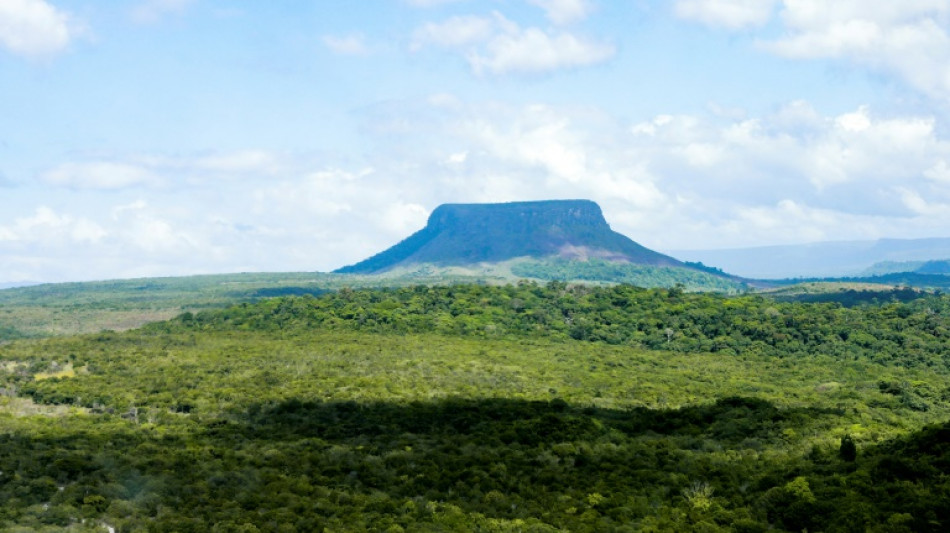
'This is Guyana': Essequibo residents anxious over Venezuela claim / Photo: Roberto CISNEROS - AFP

 Vessel operator seeks witnesses after Vancouver grounding

 Shrini Srivastava joins crew of Varanasi-Delhi Vande Bharat Sleeper service

 Nearly Half of Australian Workers Overqualified, Survey Finds

 RBI eases export-declaration compliance for individual service exporters

 Reliance shares remain in focus after near-12% surge

 Coal India prepares possible $1 billion Mahanadi Coalfields listing

 Capital-markets shares rally as Motilal Oswal and Angel One lead gains

 Reliance rally puts historical one-year return pattern in focus

 Saudi Aramco quarterly profit climbs 34.6% amid elevated oil prices

 Australia raises benchmark rate to highest level in 18 years

 Asian stocks retreat as AI worries outweigh steep oil-price drop

 Hamad International Airport stages emergency drills during WATAN 2026

 Qatar solar expansion opens scope for technical performance gains
A freshly planted Guyanese flag flaps on the summit of a table-top mountain rising from thick forests in a remote region near the Venezuelan border.
The 2,300-metre (7,550-foot) mountain -- known as a tepui -- looms over the tiny village of Arau, whose residents reject a claim from Caracas that their land belongs to Venezuela, which has sparked fears of a potential conflict.
"On that mountain, there is our flag. Every morning we look at it and we feel happy and proud," said Jacklyn Peters, a 39-year-old health worker and one of the 280 residents of the village.
With tensions rising over the disputed territory of Essequibo -- which makes up more than two-thirds of Guyana -- President Irfaan Ali in November took a helicopter to the top of the tepui where he raised Guyana's red, gold, and green flag known as the Golden Arrowhead.
With his hand on his chest, Ali recited the national pledge of allegiance.
"Our president himself put it there to show we all belong to Guyana. This is Guyana," insisted Peters.
- 'Scared, terrified' -
The village lies less than 10 kilometers (six miles) from the Venezuelan border.
It boasts an austere white Adventist church, with no sculptures or paintings, and a school where a flag flies at half-mast in honor of the five soldiers killed nearby in a military helicopter crash last week.
Wooden houses stand on stilts among cashew trees, with hammocks strung up all over: in one a father naps with his daughter, in another four children play on cellphones.
The growing tensions with Venezuela have seeped into this peaceful community.
"We are scared, terrified," said Peters, who has six children.
She accuses Venezuelan soldiers of "mistreating" locals when they try and use the Cayuni river bordering the country, saying they were patrolling the region "by boat and helicopter."
"We don't want war. There are children, pregnant women, where would we take them?" she added. "We want peace."
Thomas Devroy, 59, a former village chief, said Essequibo was "the land of the Akawaio" Indigenous people who live across Guyana, Venezuela, and Brazil.
"This is our land. Before the Spaniards were here, since time immemorial. For us there are no borders but with the politics now there is one. And Essequibo belongs to Guyana," he told AFP.
"We don't want no war."
- 'We don't want Maduro' -
Venezuela's Nicholas Maduro has revived a long-dormant decades-old dispute over Essequibo since the discovery of vast oil deposits in its waters.
The land dispute is before the International Court of Justice (ICJ) in The Hague.
However, Maduro's government held a controversial referendum early this month in which 95 percent of voters supported declaring Venezuela the region's rightful owner, according to official results.
He has since started legal maneuvers to create a Venezuelan province in Essequibo and ordered the state oil company to issue licenses for extracting crude in the region.
Essequibo is home to 125,000 people.
Devroy said the area had welcomed Venezuelans fleeing poverty in their crisis-stricken nation.
"We don't want Maduro here. We don't want no corruption, no poverty."
- 'Struggling to live' -
However, life in Arau is not easy and residents are still waiting to see the oil riches roll in.
"We are struggling to live," said Lindon Cheong, 53, a descendent of Chinese immigrants, bemoaning the lack of roads and plain rice served to schoolchildren.
"Where is the money?"
Like many, he mines for gold in the region, a resource he says is "getting scarce."
Since September, the Venezuelan military has taxed boats traveling down the Cayuni to supply the village, leading to an explosion in prices.
A small plane brings in goods a few times a week, but a bottle of Coca-Cola now costs $10.
High fuel prices mean less electricity from generators.
Despite the tough times, Cheong vows: "The Venezuelan flag will never fly here in Arau."
Ng.A.Adebayo--CPN