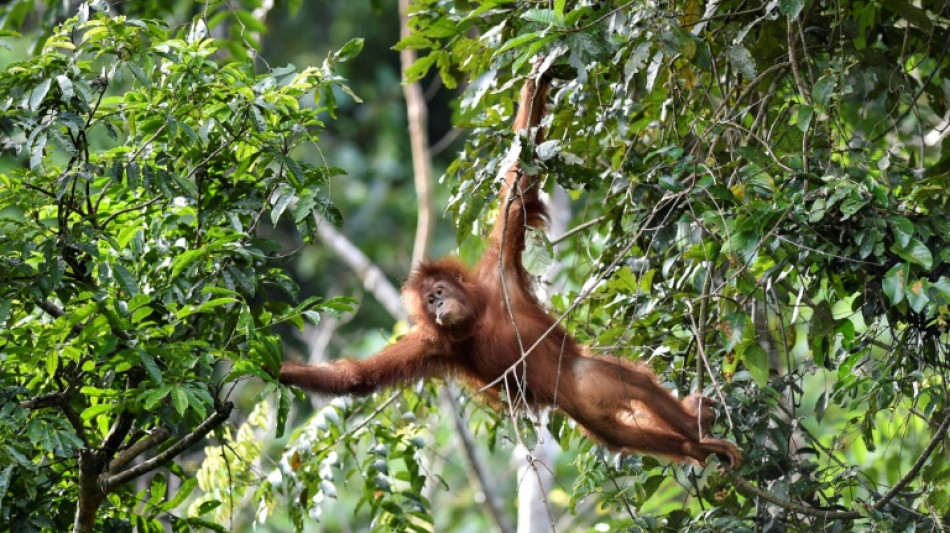
Saving nature: Conserving 30% of the land, sea just the start

 Kenya's economy faces climate change risks: World Bank

 Mixed US auto sales in Q2 amid high gas prices

 'Gus' the T. rex presented in New York ahead of auction

 Mixed US auto sales in 2nd quarter amid high gas prices
 Record heat broils US east coast amid World Cup, July Fourth events
 Portugal braces for high temperatures in new heatwave
 Planned 1.7 million satellites 'devastating' for astronomy: study

 Canada to join Eurovision Song Contest

 Chinese firm sells hyper-real, 'always loyal' humanoid robots

 Trump earned over $1 bn from crypto ventures in 2025

 The Afghan women farmers keeping their village alive

 After 250 years, the 'American dream' is tarnished but alive

 No corn dogs? Trump's 'Great American State Fair' threatens to be a flop

 CIA boss compares cutting-edge AI to nuclear weapons
 Taps run dry in Hungarian village as heatwave bites

 Inflation slows in top eurozone economies as ECB ponders next move

 Data centres emitting more CO2 than thought: study

 Thousands march to demand illegal migrants leave South Africa

 Stocks climb, yen stays near 40-year low against dollar

 Over 1 million migrants apply for Spain's mass regularisation: PM

 NASA robot mission aiming to rescue space telescope
 Affiliate of Pacific Avenue Capital Partners Completes Acquisition of ESE World from Amcor

 Extreme heat warning issued for World Cup host Kansas City
 Tech rebound lifts Dow to record, yen hits 40-year low against dollar

 Europe's deadly heatwave scorches east, Slovakia hits record

Expanding nature reserves to cover at least 30 percent of the planet by 2030 is the flagship proposal of high-stakes talks to rescue Earth's animals and plants from human destruction.
But experts agree that a new target is the easy part and will be ineffective without funding and rigorous monitoring.
Negotiators from across the world are meeting in Geneva to discuss a draft text of the so-called global biodiversity framework to be adopted at the UN COP15 meeting in Kunming, China, later this year.
A global commitment to set aside at least 30 percent of both land and oceans as protected zones by the end of the decade has the support of a broad coalition of countries.
"I think the whole world is pretty convinced that conserving nature is essential for the future of the planet, even big business and industry," said Trevor Sandwith, director of the International Union for Conservation of Nature (IUCN) Centre for Conservation Action.
But while a percentage goal is "easy to aim at, easy to measure", it only tells part of the story, he said.
The world failed almost entirely to reach a similar set of 10-year objectives set in 2010 under the UN's Convention on Biological Diversity.
To avoid past mistakes, Sandwith said that equity and effectiveness will be key in the way protected areas are governed and managed.
That is of particular concern to indigenous peoples, who will play a decisive role in meeting the 30 percent goal.
They steward land home to 80 percent of Earth's remaining biodiversity, according to a recent landmark UN report on climate change impacts.
A more flexible approach to conservation within the UN process -- known as "other effective area-based conservation measures" (OECMs) -- allows for the inclusion of lands that have human activity and are not solely set aside for nature.
But after years of marginalisation and displacement, indigenous representatives want assurances that communities will have consent over whether their lands become protected areas.
"The whole notion of fortress conservation has not been good for indigenous people," said Jennifer Tauli Corpuz, of the non-profit Nia Tero, which is part of the indigenous caucus to the CBD.
- 'Emergency' -
Global momentum has grown in the last two years, with more than 90 world leaders signing up to a pledge to reverse nature loss by 2030, stating that the interconnected threats of biodiversity loss and climate change are a "planetary emergency".
Despite this, the Geneva talks are expected to draw to a close on Tuesday without having fully discussed the 30-percent target.
A representative from a northern hemisphere delegation told AFP that both South Africa and China, which holds the COP15 presidency, remain nervous about the goal.
"I am optimistic but there is a long way to go," the delegate said.
One breakthrough was the decision by India to throw its support behind the target.
"Conservation can only happen when you provide species with some space to live," said Vinod Mathur, who heads India's National Biodiversity Authority.
While the 30-percent goal is global, India is already looking at adding to the 22 percent of its territory already conserved in national parks and tiger reserves.
But Mathur told AFP that expanding existing protected areas would be "very difficult".
His department has spent months scouring the country to find candidates to fit the more flexible criteria, including swathes of land owned by private firms.
"It is changing the narrative," he said.
- '100 percent' -
According to the most recent Protected Planet report by the UN Environment Programme's World Conservation Monitoring Centre, the world met its target of protecting 17 percent of land habitats by 2020.
But it missed the 10-percent target for marine and coastal areas, with just over seven percent conserved.
OECMs were formally defined in 2018 and are "already making a huge difference" in the statistics, said Heather Bingham, who leads the Protected Planet initiative.
But she said in the future the measurement of success must go beyond just the size and location of conserved territory.
"It's a big challenge. We have a good sense of where protected areas are but we don't have a good sense of how well they are performing," she said.
New monitoring methods could include technology like satellites, as well as more robust local reporting over time.
Linda Krueger of The Nature Conservancy said there needs to be a "sniff test": "We have to see that biodiversity is maintained and or improving."
And a 30-percent target must not distract from efforts to nurture biodiversity everywhere, she said, from increasing green spaces in cities to cutting pesticide use in agriculture.
"We need 100 percent really. We've already lost too much nature," Krueger said.
H.Meyer--CPN