How Ukraine war left China's 'Nickel King' on hook for billions

 Kenya's economy faces climate change risks: World Bank
 Streamex is making digital gold accessible
 US stocks retreat to open Q3 ahead of June jobs data
 Oppressive heat broils US during World Cup, July Fourth
 Rufus the hawk patrolling Wimbledon tennis club

 US Fed chair says committed to combatting 'too high' prices

 England breaks record for warmest June: Met Office
 Trump defends earning more than $1bn on crypto
 Swedish court orders Google pay $1.46 bn for favouring its price comparisons
 China imposes 'national security' rules on overseas investments
 Indian sailors fear returning to Gulf after Middle East war

 Fear and anger brew inside Meta amid AI frenzy
 World Bank to phase out lending to China by 2031
 Tepid outlook weighs on Nike despite tariff refund boost
 Football brings joy to Venezuelan kids displaced by quakes
 German rail regulator backs Italian firm in competition spat
 Record number of 'new millionaires' in 2025, says UBS
 Ride-share group BlaBlaCar taps AI for 20-country expansion
 MEXC Lists Ondo's Tokenized Strategy Preferred Stock on Spot Market
 Germany's labour market dilemma: rising unemployment despite vacancies
 New Oxford academic centre symbolises UK's big-donor era
 Taiwan's ageing seaweed harvesters hope younger women wade in
 HUNTING/HER Headhunter Talk with EnBW Board Member & CHRO Colette Rückert-Hennen

 World Bank drops climate finance targets in renewed action plan
 US Supreme Court rules on dragnet searches of cellphone location data
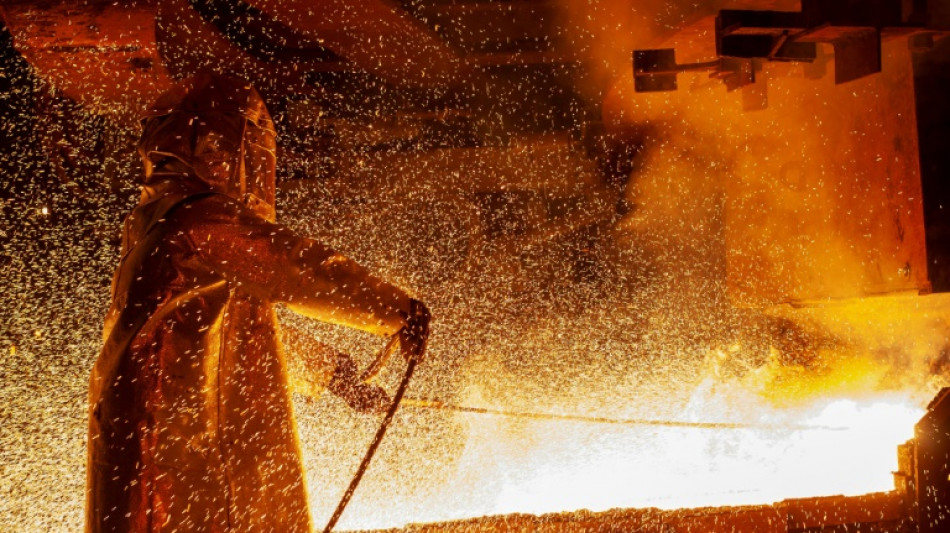
The play by Xiang Guangda, China's "Nickel King", was to use his influential market position to short the metal, wait for the price to drop, then soak up the rewards when the value bounced back.
But then Russian President Vladimir Putin invaded Ukraine and things got complicated -- fast.
Russia is one of the world's biggest producers of nickel ore, a key component of batteries for electric vehicles.
As concussive Western sanctions over the invasion struck, the price of the silver-white metal rocketed to a record above $100,000 per tonne.
That was too high for Xiang and the entire metals sector, forcing the 145-year-old London Metals Exchange (LME) to suspend trading for a week and leaving nickel-reliant manufacturers struggling to digest the spike in costs.
Stuck in its positions -- reports estimate it was holding at least 100,000 tonnes -- Xiang's company Tsingshan Holdings Group was suddenly on the hook for billions of dollars.
Tsingshan, the world's biggest nickel producer, has been forced to buy back a large number of nickel contracts at higher prices to reduce its exposure.
A Bloomberg News report estimates the buy-back has contributed to a loss of $8 billion, suggesting the firm may need a possible bailout by Chinese authorities.
"Xiang is a shrewd player, but he was caught off guard with the Russian issue," Li Bin, a nickel trader in Shanghai said.
When nickel trading resumed last week prices plunged to about $37,200 a tonne -- still 50 percent higher than in February -- as volatility courses through the market.
"After the historic squeeze, nickel is still struggling to find a price," Susan Zou, senior metals analyst at Rystad Energy said.
- Self-made tycoon -
The market for nickel, essential to make batteries for EVs and a key alloy in stainless steel, is dominated by a handful of players.
Those include Tsingshan, headquartered on China's eastern seaboard.
It was founded by Xiang, a self-made billionaire who is known among Chinese nickel traders as the "Nickel King" and "Big Shot".
Xiang started his career as a mechanic in a state fishery and now owns two sprawling nickel manufacturing hubs in Indonesia.
Those include the Morowali industrial park that spans 2,000 hectares with 44,000 workers and its own airport and is seen as a guarantee a cheap supply of ore for Tsingshan's China-side furnaces.
After his short went wrong, Tsingshan has to either pay off its debts or prove it has sufficient deliverable nickel to repay in kind.
"We are closely watching his next move because it could still roil markets," said Li, the Shanghai nickel trader.
Those rising costs are already being felt by makers of EVs including Tesla and 20 other Chinese rivals such as Xpeng and BYD, which have all hiked vehicle prices over the past two weeks citing a rise in raw material costs.
"The price and supply shocks have pushed major battery makers to look for alternative metals to power electric vehicles," analyst Zou said.
- Beijing to the rescue? –
Beijing could step in to rescue Tsingshan, Chinese media including financial news site Yicai reported, citing sources familiar with the matter.
There are discussions over allowing the company to swap its low-grade nickel products that do not meet LME's quality standards with a purer form of the metal held in state stockpiles to settle its claims, Yicai said.
China is estimated to hold around 100,000 tonnes of nickel in state reserves, according to official data. Tsingshan and China's state reserves administration did not respond to requests for comment.
Xiang has moved markets before, most notably in 2018 when he released large volumes of nickel pig iron, a cheap alternative to pure nickel, that can be used to make stainless steel.
"Xiang has always believed that because he is one of the world's biggest players with ultra-low costs, he could keep the nickel price under his thumb," said a former employee at Tsingshan, who declined to be named.
"He has always bet on nickel prices falling because his production cost in Indonesia is as low as $10,000 per tonne."
Now Xiang has to decide whether to slowly unwind his wager and at what price.
On March 14, Tsingshan said it had reached an agreement with banks to hold on to the company's nickel positions, signalling the billionaire was digging in his heels to ride out the crisis.
That could beat the LME further and lead to more price uncertainty for nickel, trader Li said, and create challenges for battery producers trying to replace petrol cars.
Ch.Lefebvre--CPN