Away from bombs, Ukrainians make new home in German town

 Kenya's economy faces climate change risks: World Bank

 Streamex is making digital gold accessible

 US stocks retreat to open Q3 ahead of June jobs data

 Oppressive heat broils US during World Cup, July Fourth

 Rufus the hawk patrolling Wimbledon tennis club
 US Fed chair says committed to combatting 'too high' prices
 England breaks record for warmest June: Met Office

 Trump defends earning more than $1bn on crypto

 Swedish court orders Google pay $1.46 bn for favouring its price comparisons

 China imposes 'national security' rules on overseas investments

 Indian sailors fear returning to Gulf after Middle East war
 Fear and anger brew inside Meta amid AI frenzy
 World Bank to phase out lending to China by 2031

 Tepid outlook weighs on Nike despite tariff refund boost
 Football brings joy to Venezuelan kids displaced by quakes
 German rail regulator backs Italian firm in competition spat

 Record number of 'new millionaires' in 2025, says UBS

 Ride-share group BlaBlaCar taps AI for 20-country expansion

 MEXC Lists Ondo's Tokenized Strategy Preferred Stock on Spot Market

 Germany's labour market dilemma: rising unemployment despite vacancies
 New Oxford academic centre symbolises UK's big-donor era

 Taiwan's ageing seaweed harvesters hope younger women wade in

 HUNTING/HER Headhunter Talk with EnBW Board Member & CHRO Colette Rückert-Hennen

 World Bank drops climate finance targets in renewed action plan

 US Supreme Court rules on dragnet searches of cellphone location data
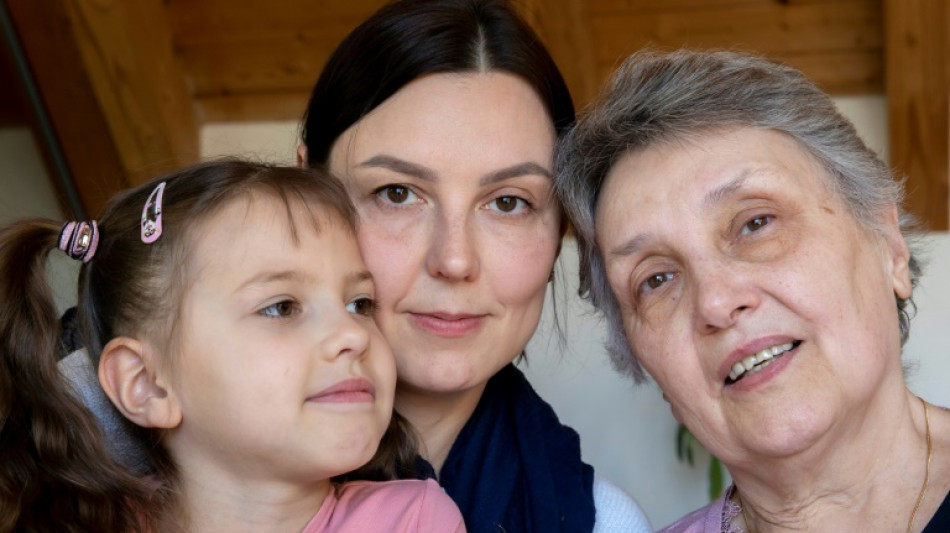
When Katrin Bilger heard about Russia's invasion of Ukraine, her nine-year-old daughter and 10-year-old son found her crying at the breakfast table.
"They understood that it was something very serious," said Bilger, 37, a single mother who lives in the German hillside town of Kronberg, near Frankfurt.
"And then pretty quickly all three of us understood that we were going to help any way we could," she said.
The family opened their home to Tanja Bila, 40, her mother Svetlana and her daughter Anastasia, seven, Ukrainian refugees who had fled Russia's invasion of their country.
"When the bombing started, it was frightening, we didn't sleep all night. We realised we had to leave. Leave everything and go," said Svetlana, 69.
Many of the over three million people who have fled Ukraine have sought refuge in neighbouring Poland.
But some have chosen to head westwards.
And many who have landed up in Germany have found themselves taken in by German families like Bilger's, who have opened their homes to help Europe's biggest economy cope with a huge influx.
Almost 240,000 Ukrainians have registered with the authorities so far, but the real number could be much higher since there are no official controls at Germany's EU borders.
- One million refugees -
The German government is eventually expecting up to a million Ukrainians.
According to the authorities, around two in three of the refugees who have arrived so far are being accommodated in private homes.
Kronberg, a town with a population of around 18,000 located within the Frankfurt commuter belt, has set up accommodation for 400, with around 80 more being housed privately.
On a recent Saturday, Tanja, her mother and daughter prepared a traditional Ukrainian lunch of soup and dumplings for the two families to enjoy together.
After lunch, the mothers and their children played games together around a coffee table before taking the family dog for a walk through the town's cobbled streets.
Little Anastasia has already enrolled in a local school and started German classes.
But Tanja, also a single mother who was a financial specialist for a German company in Kyiv, feels uncertain about what the future holds.
"Will our home be safe? Will it be bombed so we don't have a place to return? Maybe we have to live here and learn the German language and to start a new life in a new place? I don't know. Now we have no idea," she said.
- Donation centre -
Kronberg is holding regular rallies in the town centre to inform residents about the situation and recruit volunteers.
"We will try to create as many additional spaces as possible. I think we will definitely manage 50 to 100 and then we have to see," town mayor Christoph Koenig told AFP.
The town has also set up a donation centre where residents can bring food, clothes and medicines.
In one room, shelves upon shelves are packed with folded clothes and shoes, while a hanging rail in the centre has been reserved for children's jackets.
Tanja has visited the donation centre several times to help with translations and pick up clothes for her own family.
"We went here with winter clothes, and we have nothing to wear when it's getting warmer," she said.
Volunteer Mariana, wearing a blue and yellow ribbon pinned to her coat, was born in Ukraine but has lived in Kronberg for 20 years.
"This terrible war brings people together... It's great that this big disaster brings us together, that's how it should be," she said.
L.K.Baumgartner--CPN