UN labour agency: where workers' rights are set in concrete

 Kenya's economy faces climate change risks: World Bank
 Streamex is making digital gold accessible
 US stocks retreat to open Q3 ahead of June jobs data
 Oppressive heat broils US during World Cup, July Fourth
 Rufus the hawk patrolling Wimbledon tennis club
 US Fed chair says committed to combatting 'too high' prices
 England breaks record for warmest June: Met Office
 Trump defends earning more than $1bn on crypto

 Swedish court orders Google pay $1.46 bn for favouring its price comparisons

 China imposes 'national security' rules on overseas investments
 Indian sailors fear returning to Gulf after Middle East war
 Fear and anger brew inside Meta amid AI frenzy
 World Bank to phase out lending to China by 2031
 Tepid outlook weighs on Nike despite tariff refund boost
 Football brings joy to Venezuelan kids displaced by quakes
 German rail regulator backs Italian firm in competition spat
 Record number of 'new millionaires' in 2025, says UBS
 Ride-share group BlaBlaCar taps AI for 20-country expansion
 MEXC Lists Ondo's Tokenized Strategy Preferred Stock on Spot Market
 Germany's labour market dilemma: rising unemployment despite vacancies
 New Oxford academic centre symbolises UK's big-donor era
 Taiwan's ageing seaweed harvesters hope younger women wade in
 HUNTING/HER Headhunter Talk with EnBW Board Member & CHRO Colette Rückert-Hennen
 World Bank drops climate finance targets in renewed action plan
 US Supreme Court rules on dragnet searches of cellphone location data
The International Labour Organization, which chooses its next leader on Friday, is a UN agency born in the aftermath of World War I to promote workers' rights and social protection.
Founded in 1919, the ILO is the United Nations' oldest specialised agency, with 187 member states, which are, uniquely in the UN system, represented equally by governments, employers and workers.
Headquartered in Geneva, the ILO aims to promote rights at work, encourage good employment opportunities, enhance social protection and strengthen dialogue on work-related issues.
- A century of history -
The organisation was created in the Treaty of Versailles, the senior peace treaty that ended World War I.
It was founded, the ILO says, "to reflect the belief that universal and lasting peace can be accomplished only if it is based on social justice".
Its constitution was drafted by representatives from Belgium, Britain, Cuba, Czechoslovakia, France, Italy, Japan, Poland and the United States.
The International Labour Office -- the ILO's secretariat, comprising some 2,700 officials from more than 150 nations -- formulates international labour standards through legally-binding conventions, or guideline recommendations.
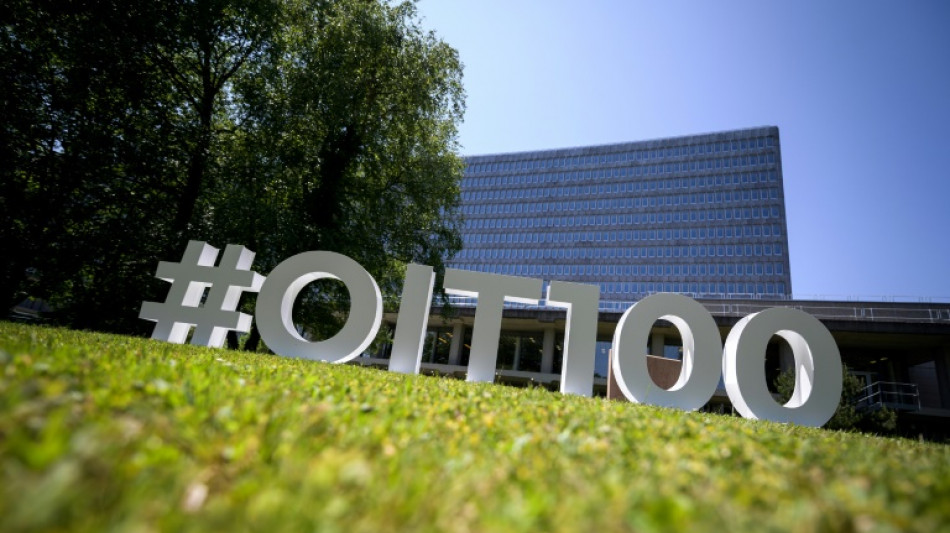
The organisation used to occupy the grand 1920s, classical Florentine-style Centre William Rappard on Lake Geneva -- now home to the World Trade Organization -- but moved to new-built offices in 1974 -- a vast, rationalist rectangular block made of grey concrete and steel.
The ILO won the Nobel Peace Prize on its 50th anniversary in 1969, and claims to have played a key role in the Great Depression, decolonisation, Poland's Solidarity movement and the fall of apartheid in South Africa.
Its logo dates back to 1968, showing the ILO letters in a cog wheel divided, like the organisation itself, into three parts, surrounded by the UN olive leaves.
Its working languages are English, French and Spanish.
- Laying down the law -
Thus far, 190 conventions, six protocols and 206 recommendations have been adopted, including eight "fundamental conventions".
These cover freedom of association and the effective recognition of the right to collective bargaining; the elimination of all forms of forced or compulsory labour; the effective abolition of child labour; and the elimination of discrimination.
The convention banning the worst forms of child labour in 2020 became the ILO's first convention ever to be universally ratified.
The International Labour Conference, held each June at the Geneva headquarters, is the supreme body where treaties on working conditions are adopted and major social issues debated.
Workplace harassment, asbestos, night shifts, forced labour, maternity leave, occupational diseases, and the conditions of domestic workers are some of the topics thrashed out.
Recently the ILO has turned its focus on work during the Covid-19 pandemic, which triggered an economic crisis and saw millions shift to working from home.
The ILO also churns out statistics on the world of work, and provides technical help in the field, especially in developing countries.
- Investigations -
The organisation can also launch investigations, as it did in 2018 on Venezuela after the Venezuelan employers' union accused the government of imposing wage changes and economic measures without any consultation.
Fourteen such commissions of inquiry have been triggered throughout its history.
In addition, a UN committee of labour law experts evaluates the implementation of ILO conventions each year, country by country.
In its latest report published in February, the panel expressed deep concern over the treatment of ethnic and religious minorities in China, particularly in Xinjiang, and urged Beijing to change its ways.
The ILO has asked China for further information, and this year's International Labour Conference will study the issue, a spokeswoman said this week.
Ng.A.Adebayo--CPN