Some wins for US labor, but big picture stays tough

 Kenya's economy faces climate change risks: World Bank
 EU top court to rule on record 4.1 bn euro Google fine
 Streamex is making digital gold accessible
 US stocks retreat to open Q3 ahead of June jobs data

 Oppressive heat broils US during World Cup, July Fourth
 Rufus the hawk patrolling Wimbledon tennis club
 US Fed chair says committed to combatting 'too high' prices

 England breaks record for warmest June: Met Office

 Trump defends earning more than $1bn on crypto

 Swedish court orders Google pay $1.46 bn for favouring its price comparisons

 China imposes 'national security' rules on overseas investments
 Indian sailors fear returning to Gulf after Middle East war

 Fear and anger brew inside Meta amid AI frenzy
 World Bank to phase out lending to China by 2031
 Tepid outlook weighs on Nike despite tariff refund boost
 Football brings joy to Venezuelan kids displaced by quakes
 German rail regulator backs Italian firm in competition spat

 Record number of 'new millionaires' in 2025, says UBS

 Ride-share group BlaBlaCar taps AI for 20-country expansion
 MEXC Lists Ondo's Tokenized Strategy Preferred Stock on Spot Market
 Germany's labour market dilemma: rising unemployment despite vacancies
 New Oxford academic centre symbolises UK's big-donor era
 Taiwan's ageing seaweed harvesters hope younger women wade in

 HUNTING/HER Headhunter Talk with EnBW Board Member & CHRO Colette Rückert-Hennen
 World Bank drops climate finance targets in renewed action plan
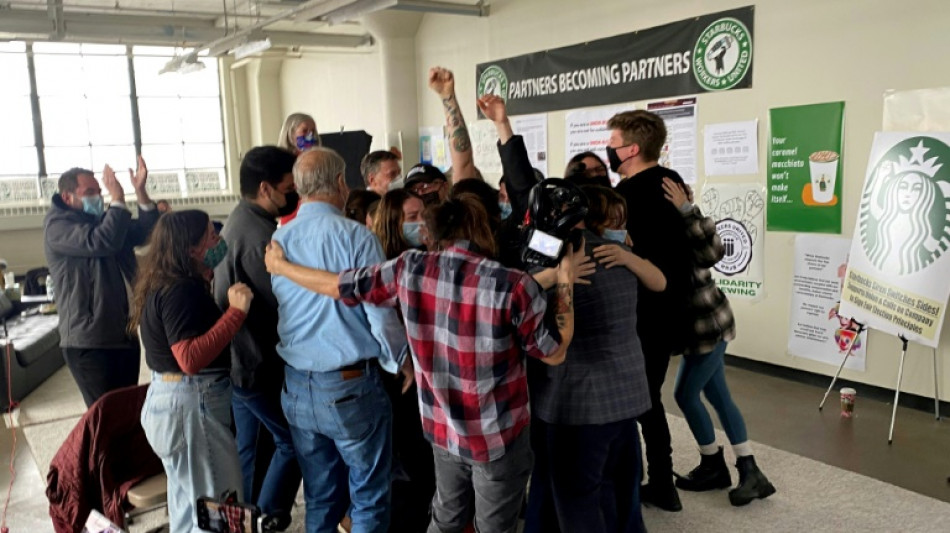
Lauded by President Joe Biden and bolstered by recent triumphs at Starbucks, the US labor movement has had reasons to cheer as attention focuses on upcoming unionization votes at Amazon.
But those bright spots do not change an overall picture that is no better than mixed in an economy that has seen unions' share of the American workforce steadily diminish in recent decades.
"Some of the president's statements are symbolically very important," Rebecca Givan, a labor relations expert at Rutgers University, said of Biden.
Biden, who has famously declared himself "a union guy," tapped a former union official, Marty Walsh, to lead the Department of Labor and staffed the National Labor Relations Board with key appointees favorable to unionization.
The US president has also shown clear favoritism for unionized companies, most notably in the automobile industry, where Biden has repeatedly highlighted electric car investments by General Motors and Ford, while essentially snubbing Tesla, where employees are not represented by the United Auto Workers.
"These are incremental steps that do make a difference," said Givan, adding that US law on labor campaigns still broadly favors industry over unions.
Polling shows that 68 percent of Americans have favorable opinions of unions, according to Gallup, the highest level since 1965.
But the rate of unionization in the private sector fell again in 2021, all the way down to 6.1 percent.
At Amazon, workers at a Bessemer, Alabama warehouse last year overwhelmingly voted against a unionization push supported by the Retail, Wholesale and Department Store Union.
But the NLRB later called for a redo of the vote, citing what it called interference by Amazon.
The e-commerce behemoth also faces a pair of votes in New York, where a group of former and current employees at two different warehouses have led a campaign that will culminate in votes in late March and late April.
The referenda were called after union backers secured signatures from the 30 percent minimum of staff to qualify for an NLRB vote.
But to make Amazon a union shop, supporters of organized labor now must win majority backing, a more daunting hurdle given that the company can makes its case against the labor group at company meetings that employees must attend.
- Supporters young and college-educated -
At Starbucks, a movement to shift labor dynamics at a large US chain began with two cafes in upstate New York voting in December to unionize. Since then, more than 150 restaurants are at various stages of union campaigns.
The Starbucks campaign was led mostly by younger and college-educated workers who are broadly reflective of the current wave of newer labor supporters.
Union campaigns have also had recent success at museums, NGOs, media companies and universities.
But beyond those sectors, labor unions have struggled to gain a foothold, particularly in southern and some western states, whose percentage of unionized workers are less than one-third or one-fourth of those in California and New York.
Legislation sought by unions would make it an unfair labor practice to require workers to attend meetings designed to discourage union membership. The "PRO Act" would also protect workers who report labor law violations to an enforcement agency.
Biden backs the legislation, but it has stalled in the Senate.
Shifting presidential administrations "is a roller coaster ride," said Julie Pinkham, executive director of the Massachusetts Nurses Association.
"It takes time to get things implemented and the administration can only do what it can do from the executive branch," she said.
Pinkham said organizing workers "has gotten much harder," but added, "we're not going to stop."
The nurses' group needed three years at St. Luke's hospital in New Bedford before forming a union and negotiating a collective bargaining agreement.
And nurses at St. Vincent's hospital in Worcester, who voted in favor of a contract after a 301-day strike, then voted again to keep their union after some nurses sought to disband the group.
Still, unions are struggling at companies like Uber and Lyft that are fighting to classify their workforce as "independent contractors" instead of employees that could be unionized.
But backers of organized labor see an opening in the current environment.
"A lot of workers saw how little their employers cared about them during the pandemic," said Givan.
"On top of that, we're also seeing a very tight labor market. So the workers who are organizing know that they can also leave and go and get another job somewhere nearby easily."
Y.Ponomarenko--CPN