Plastic pollution cuts power in DR Congo

 Kenya's economy faces climate change risks: World Bank

 Budding chefs cook up new career at China's BBQ academy

 'Job forever': trade schools are all the rage in the AI era

 Mixed US auto sales in Q2 amid high gas prices

 'Gus' the T. rex presented in New York ahead of auction

 Mixed US auto sales in 2nd quarter amid high gas prices

 Record heat broils US east coast amid World Cup, July Fourth events

 Portugal braces for high temperatures in new heatwave

 Planned 1.7 million satellites 'devastating' for astronomy: study

 Canada to join Eurovision Song Contest

 Chinese firm sells hyper-real, 'always loyal' humanoid robots

 Trump earned over $1 bn from crypto ventures in 2025

 The Afghan women farmers keeping their village alive
 After 250 years, the 'American dream' is tarnished but alive

 No corn dogs? Trump's 'Great American State Fair' threatens to be a flop

 CIA boss compares cutting-edge AI to nuclear weapons
 Taps run dry in Hungarian village as heatwave bites

 Inflation slows in top eurozone economies as ECB ponders next move

 Data centres emitting more CO2 than thought: study

 Thousands march to demand illegal migrants leave South Africa

 Stocks climb, yen stays near 40-year low against dollar

 Over 1 million migrants apply for Spain's mass regularisation: PM

 NASA robot mission aiming to rescue space telescope

 Affiliate of Pacific Avenue Capital Partners Completes Acquisition of ESE World from Amcor

 Extreme heat warning issued for World Cup host Kansas City

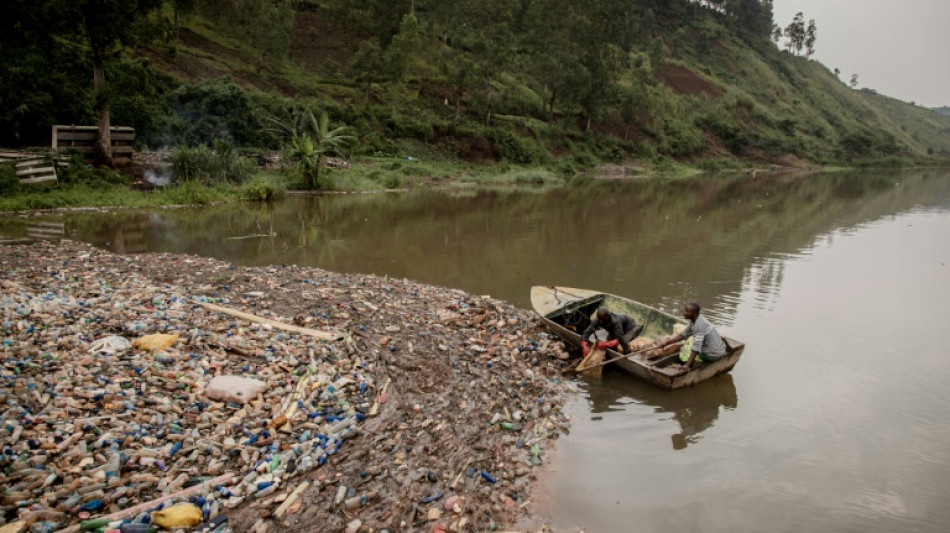
Among rolling hills around the southern tip of majestic Lake Kivu, huge layers of plastic waste ride the water and block the turbines of the largest hydroelectric plant in eastern Democratic Republic of Congo.
The Ruzizi dam is polluted by thousands of bottles, cans and other objects thrown into the lake, which stretches 90 kilometres (56 miles) along the border between DR Congo and Rwanda.
"Since the lake flows towards the Ruzizi River, all the waste thrown into it comes here little by little," Lievin Chizungu, production manager at the dam's power station, told AFP.
The mountainous terrain and rainy climate around lakeside Bukavu, capital of South Kivu province, do not help.
"The rainwater carries the waste into the lake and then into the river," Jovy Mulemangabo, an engineer for the national electricity company (SNEL) in south Kivu, told AFP.
Chizungu says piles of waste can "reach a depth of 14 metres" (almost 46 feet). Divers clean the river bed to keep debris from clogging the turbines. If waste gets trapped, towns in the area are deprived of power.
Other employees clean the surface, using barges.
"I have been doing this job for 13 years," Byunanine Mubalama told AFP. "Every day there is garbage I have to clean up.”
— ’The impact is huge’ —
But it is not enough. One of the four units in the plant was damaged by debris at the end of January, and it is still down.
"The impact is huge. We have a deficit of 6.3 megawatts out of 30 total MW that we must produce not only for South Kivu, but also for neighbouring North Kivu province and for Burundi," Chizungu said.
Garbage also caused an alternator to fail at the Ruzizi 2 power plant about 25 km south of Bukavu. With the damage at both plants, they are 20 MW short, Chizungu said.
This has provoked "many power outages in Bukavu and Uvira".
Nicole Menemene, 29, collects plastic waste on the lake's shores to make baskets, flowerpots, stools and nightstands.
She runs a private company called Plastycor that transforms trash into "beautiful and useful" objects.
"We do the work by hand," Menemene said.
The company has 10 employees, but her goal is to "industrialise" their work. With her project and other local efforts, Menemene hopes to see a "90 percent reduction of Lake Kivu's pollution".
— ‘We have to teach people’ —
Education is a crucial first step in reducing the lake's plastic pileup, Chizungu said.
"First, we have to teach people that they cannot dump waste in the lake," he said, adding that authorities should crack down on people tossing garbage in the waters.
But for some local residents, it is not so simple.
"Our houses are crammed together on small plots. There is no way to manage garbage," Mathilde Binja said. "I have no choice but to throw it into Kawa river, which dumps into the lake".
The city does offer garbage collection and disposal services for $3 to $5 (2.70 to 4.50 euros) per month, Malgache Malyanga, director of Bukavu Household Waste Management Program (PGDM), told AFP.
This could be either from ignorance or lack of funds to pay for waste removal services, he added.
To combat the plague of plastic waste filling the world's lakes, oceans and lands, the United Nations launched negotiations in March in Kenya for a global treaty against plastic pollution.
C.Peyronnet--CPN