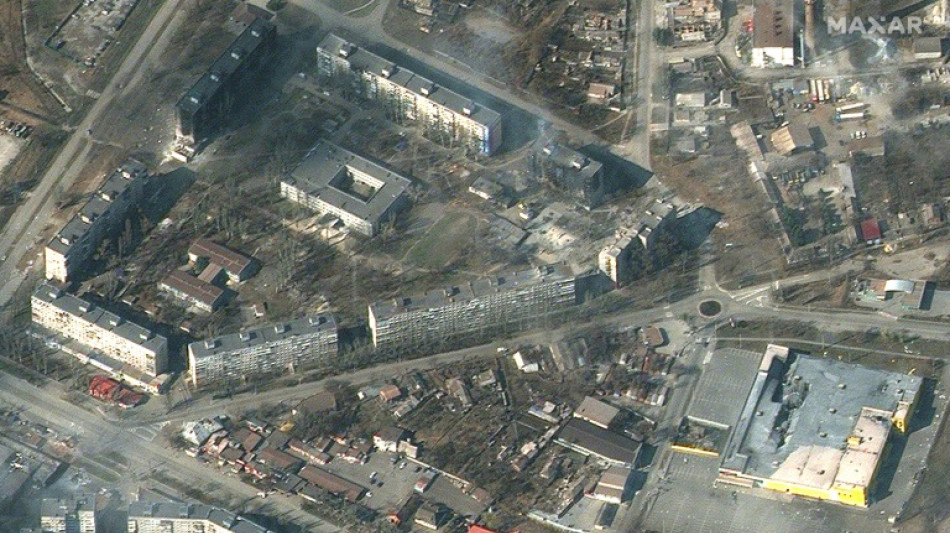
Aid agencies struggle to reach Ukraine's 'besieged' cities

 Three killed by storm in southern India

 Two hundred 'Cruise for life' passengers stranded in Cambodia

 Billionaire Ambani's Jio jumps 21% in market debut after record India IPO

 Sri Lanka's Tamil farmers fight to reclaim land after civil war

 'They don't care about us': Trump food aid cuts leave Americans struggling and angry

 Palestinian activist Khalil returns to Columbia after US detention

 Youths testify about 'despair' in unprecedented Canadian climate trial

 Storied Paris department store seeks bankruptcy protection

 Boeing shares tumble after it releases cautious growth forecast

 Boeing reports smaller loss as it aims for stable output growth

 Dangote, Nigeria's oil tycoon rewriting Africa's story

 Kane says Ballon d'Or win 'feels like a dream' as tributes pour in

 Mercedes-Benz cuts 2026 profit outlook on tough China market

Aid agencies are struggling to reach people trapped in Ukrainian cities ringed by Russian forces, the UN's World Food Programme said Saturday, including hundreds of thousands of women and children.
"The challenge is to get to the cities that are encircled or about to be encircled," emergency coordinator Jakob Kern told AFP, describing the situation as "dire".
Lack of humanitarian access is making it almost impossible to deliver emergency food supplies to the besieged port city of Mariupol, the northeastern city of Kharkiv and the northeastern city of Sumy.
It was a tactic that was "unacceptable in the 21st century", Kern said.
The Rome-based WFP has had to start the mission to stock up Ukraine's warehouses "from zero", and replacing broken food supply chains amidst bitter fighting is a "mammoth task", he said.
The agency hopes to reach 3.1 million people in Ukraine, but efforts to move supplies such as pasta, rice and canned meat around are hampered by difficulties in finding willing truck drivers.
"The closer you go to these cities, the more worried they are about their safety," Kern said.
"And that means we're not able to reach these people in Mariupol, Sumy, Kharkiv, in the cities that are almost encircled by now -- or completely in the case of Mariupol," he added.
More than 3.25 million refugees have fled Ukraine, but many people have remained trapped, including "hundreds of thousands of women and children. They cannot come out and we cannot reach them."
- 'Not forgotten' -
Kern, who worked for WFP for three years in Syria during the war, said the siege tactics being used in Ukraine were similar, but the fallout was even greater as the besieged cities were larger.
"Two days ago a convoy with a few trucks made it into Sumy with enough food for about 3,000 people for a few days, but it's small scale and these are big cities, it needs regular access and a much bigger scale".
"Here you'd almost need a convoy every day to keep a population of half a million or a million supplied with basic foods. That calls for basically a permanent humanitarian corridor into these cities," he said.
Nonetheless, in Ukraine, just as in Syria, even a little aid can psychologically boost those trapped in terrible conditions, for "it means a lot for the people inside that they see they have not been forgotten".
Historically, Ukraine has been a grain-exporting breadbasket for the world, and WFP bought nearly half of its global wheat supplies from it before the war.
Now, with Ukrainian ports closed and Russian grain deals on pause because of sanctions, 13.5 million tons of wheat and 16 million tons of maize are currently frozen in Russia and Ukraine.
A toxic mix of rising food and energy prices -- exasperated by the Kremlin's invasion -- has increased WFP's global operations by $70 million (63.3 million euros) a month and it is urgently seeking donations.
M.Anderson--CPN
