'Iron army' of grocery runners feeds Shanghai as Covid hits

 Three killed by storm in southern India

 Two hundred 'Cruise for life' passengers stranded in Cambodia

 Billionaire Ambani's Jio jumps 21% in market debut after record India IPO

 Sri Lanka's Tamil farmers fight to reclaim land after civil war

 'They don't care about us': Trump food aid cuts leave Americans struggling and angry

 Palestinian activist Khalil returns to Columbia after US detention

 Youths testify about 'despair' in unprecedented Canadian climate trial

 Storied Paris department store seeks bankruptcy protection
 Boeing shares tumble after it releases cautious growth forecast
 Boeing reports smaller loss as it aims for stable output growth
 Dangote, Nigeria's oil tycoon rewriting Africa's story
 Kane says Ballon d'Or win 'feels like a dream' as tributes pour in
 Mercedes-Benz cuts 2026 profit outlook on tough China market
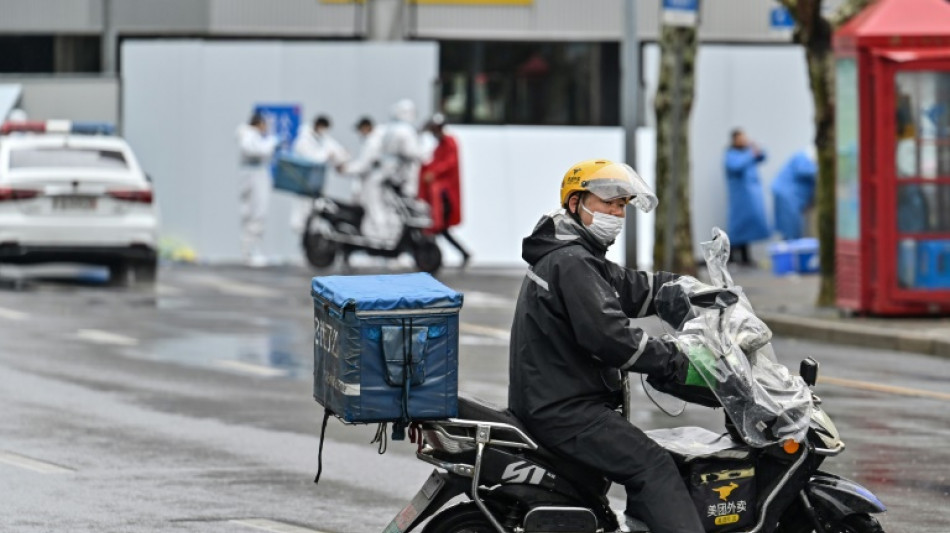
As many Shanghai residents shelter from Covid at home, a common sight on the megacity's suddenly subdued streets is the racing, swerving scooters of food-delivery riders.
Firms including Meituan, Alibaba-owned Ele.me, Pinduoduo and Dingdong Maicai are struggling to keep up with a rush of orders from sequestered citizens in need of groceries and disinfectants.
At a sorting centre in central Shanghai run by Dingdong Maicai, staff are working overtime to handle double the demand of a week ago, when the metropolis of 25 million people began battening down the hatches.
Shanghai has so far avoided a citywide lockdown but authorities have closed school campuses, sealed off some residential compounds and launched a rigorous round of mass testing.
Dingdong Maicai has hired 300 additional staff across the city in recent days, some of them restaurant workers left idle by closures.
China's hordes of scooter delivery drivers were hailed as national heroes two years ago when they kept untold millions fed during huge lockdowns when the virus first emerged.
The lessons learned from 2020 -- and no small amount of bravado -- have helped companies stay on top of the crush this time around.
"We are an iron army. Whatever artillery fire we face, we react quickly," said Zhang Yangyang, manager of the bustling yet tidy Dingdong sorting depot.
Since its initial outbreak faded two years ago, China has largely kept the virus under control through a tough zero-Covid strategy.
Although its national daily case number -- 4,365 reported Friday -- is unremarkable globally, it represents the country's worst uptick in infections since the start of the pandemic.
With the highly transmissible Omicron variant spreading, authorities have imposed stay-at-home orders or other restrictions in several cities.
But unclear messaging about their plans has sowed public confusion, helping to fuel binge-buying and the resulting burden on business managers like Zhang.
"I don't have a weekend," Zhang said.
China has one of the world's biggest and most developed ready-meal and grocery delivery sectors.
Slick smartphone apps enable users to place one-click orders from virtually any restaurant or food store within a several-kilometre radius, with the apps even displaying the delivery rider's body temperature.
Food runners report they are currently making up to 100 deliveries a day, which are often left outside housing complexes to avoid human contact.
Dingdong Maicai staffer Li Yawu has found himself suddenly working up to 15 hours a day, after which he goes home to "soak my feet".
"It would be untrue to say I wasn't scared in the beginning," he said of delivering to neighbourhoods where Covid has taken hold.
"But when you deliver food into a user's hands and there is that much gratitude in their eyes... I don't feel scared anymore."
L.K.Baumgartner--CPN
