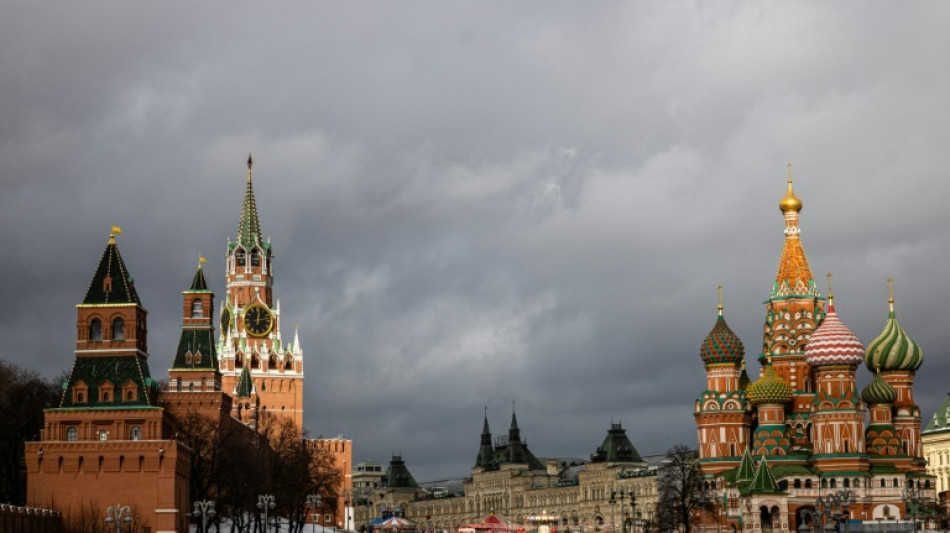
Russia faces default fears as debt payment due

 Three killed by storm in southern India

 Two hundred 'Cruise for life' passengers stranded in Cambodia

 Billionaire Ambani's Jio jumps 21% in market debut after record India IPO

 Sri Lanka's Tamil farmers fight to reclaim land after civil war

 'They don't care about us': Trump food aid cuts leave Americans struggling and angry

 Palestinian activist Khalil returns to Columbia after US detention

 Youths testify about 'despair' in unprecedented Canadian climate trial

 Storied Paris department store seeks bankruptcy protection

 Boeing shares tumble after it releases cautious growth forecast

 Boeing reports smaller loss as it aims for stable output growth

 Dangote, Nigeria's oil tycoon rewriting Africa's story

 Kane says Ballon d'Or win 'feels like a dream' as tributes pour in

 Mercedes-Benz cuts 2026 profit outlook on tough China market
Russia is due to pay interest on its foreign debt Wednesday as sanctions over the Ukraine conflict have raised concerns that Moscow could face its first default in decades.
Moscow said it has asked an American bank to process the payments totalling $117 million (107 milion euros) for two dollar-denominated bonds but was still waiting to hear if they had gone through.
Sanctions over Russia's operation in Ukraine have targeted $300 billion of its foreign currency reserves held abroad.
Without access to these funds, concern has mounted that Russia could find itself forced to default.
Finance Minister Anton Siluanov told state media Wednesday that whether or not Russia defaulted was up to the United States.
"The question of fulfilling our obligations in foreign currency does not depend on us," he told the RT network.
"We have the money. We made the payment. Now the ball is in the court of the American authorities," he said, noting that the bank was negotiating with the US Treasury Department's Office of Foreign Assets Control.
Earlier this week, Siluanov accused the West of pushing the country towards an "artificial default" and warned that Russia was prepared to service the debt in rubles if necessary.
While Russia's foreign currency government bonds issued since 2018 contain provisions for repayment in rubles, it is not the case for the interest payments due Wednesday.
A payment in rubles would constitute a default at the end of a 30-day grace period, according to Fitch Ratings.
Russia last defaulted on foreign currency-held debt in 1918, when Russian revolution leader Vladimir Lenin refused to recognise the debts of the tsar deposed by the uprising.
Russia defaulted on domestic, ruble-denominated debt in 1998.
Western sanctions have crippled the Russian banking sector and financial system and precipitated a collapse of the ruble.
- Dollar payment possible? -
Analysts at JPMorgan have said that US sanctions should not directly restrict Russia's ability to service its debt.
According to the US Treasury, interest payments to American entities "are permissible through May 25," on bonds issued by Russia's central bank, finance ministry or national wealth fund before March 1.
After that date, they would need authorisation to continue receiving these payments.
A default cuts a state off from the financial markets and a potential return is unlikely for several years.
Fitch also said Tuesday that it understands that the foreign investors did not receive interest payments on domestic bonds due on March 2 because of restrictions imposed by the central bank.
"This will constitute a default if not cured within 30 days of the payments falling due," said the debt ratings agency.
Ipek Ozkardeskaya, a senior analyst at Swissquote bank, said a default would be "a blow" to stocks of banks exposed to Russian debt.
"The good news is, though an eventual Russian default will give a shake to the financial markets, it is not a systemic threat to the global economy," she said in a note.
J.Bondarev--CPN
