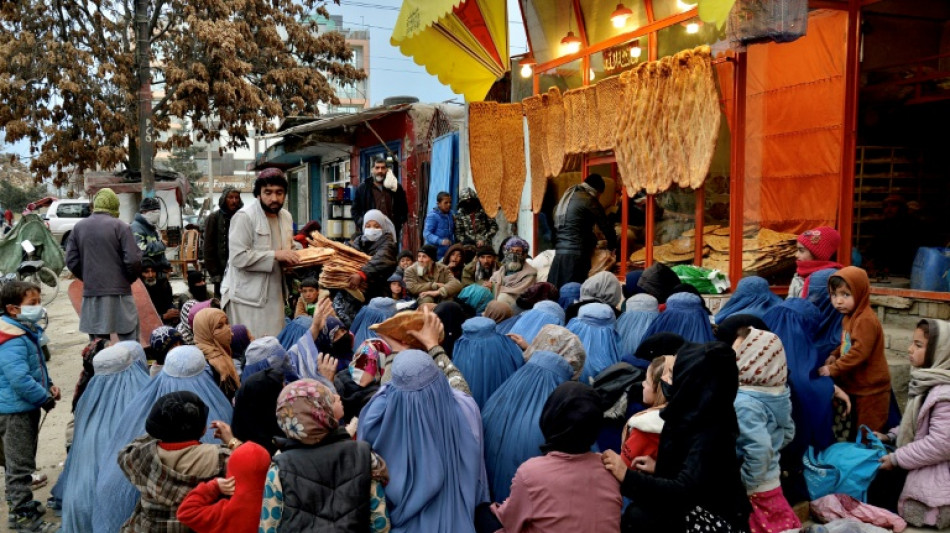
Food security worsens in Afghanistan as wages fall: World Bank

 Three killed by storm in southern India

 Two hundred 'Cruise for life' passengers stranded in Cambodia

 Billionaire Ambani's Jio jumps 21% in market debut after record India IPO

 Sri Lanka's Tamil farmers fight to reclaim land after civil war

 'They don't care about us': Trump food aid cuts leave Americans struggling and angry

 Palestinian activist Khalil returns to Columbia after US detention

 Youths testify about 'despair' in unprecedented Canadian climate trial

 Storied Paris department store seeks bankruptcy protection

 Boeing shares tumble after it releases cautious growth forecast

 Boeing reports smaller loss as it aims for stable output growth

 Dangote, Nigeria's oil tycoon rewriting Africa's story

 Kane says Ballon d'Or win 'feels like a dream' as tributes pour in

 Mercedes-Benz cuts 2026 profit outlook on tough China market

Food security in Afghanistan has deteriorated sharply since the Taliban took power in August, while wages have fallen "dramatically" for more than two-thirds of workers, a World Bank survey said Tuesday.
The report found 70 percent of the households surveyed said they were unable to meet their basic needs for food and other essentials, twice as many as in a previous survey conducted in May 2021.
There also was a "significant" decrease in both the quality and quantity of food consumed.
"The results suggest that while the Afghan population is still able to find work and access some key public services, the situation is quite fragile," according to the report, which was based on data gathered by telephone between October and December 2021 of nearly 5,000 Afghan households.
The World Bank warned "that an imminent and dramatic decline in welfare outcomes and access to services could occur unless salaries, at least for key services, can be restored and food security improved."
Afghanistan has been gripped by an economic crisis since the Taliban takeover after countries cut off development programs and froze its foreign reserves, though some humanitarian aid flows have resumed.
Wages have declined markedly across industries and regions, and more Afghans are looking for work in both urban and rural areas than a year and a half ago, the survey said.
The quantity of available jobs has increased in the countryside, but has decreased in the cities and suburbs.
The share of public sector jobs shrank, and a larger proportion of households reported being self-employed, according to the data.
However, more Afghan children are attending school, and more girls are attending class than in the previous survey on the subject conducted two years ago, though their enrollment remains lower than boys and has not improved in urban areas, especially for secondary school.
"While disparity in overall school attendance by gender remains high, data indicate that at the primary level, more girls are in school, with attendance levels overall higher for both boys and girls, compared to the situation in the fall of 2019," the report said
"The share of households reporting sending their girls to school also increased by 10 percentage points in the same time period, but there are large differences between rural and urban areas."
Girls also are leaving school earlier, since in urban areas, "the share of households sending their girls to both primary and secondary school declined."
The survey also found 94 percent of people were able to obtain medical attention over the period surveyed, with little difference between gender or location.
P.Schmidt--CPN
