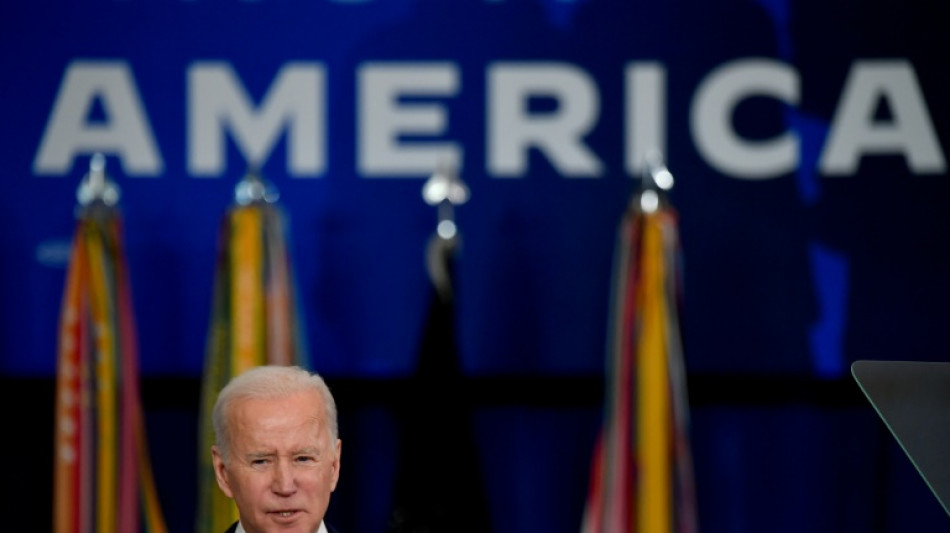
Joe Biden's perilous oil diplomacy

 AI chip giant SK hynix posts seven-fold surge in quarterly operating profit

 S.African activists push back on data centre rush

 Billionaire Ambani's Jio to debut after record India IPO

 UK set for cautious budget as borrowing costs climb

 US Fed expected to hold rates steady ahead of key midterm elections

 AI chip giant SK hynix says quarterly operating profit soars 630%

 Charles tackles thorny legacy of slavery on Caribbean trip

 UN nuclear watchdog chief urges Iran to grant access
 Boeing releases cautious growth plan as shares fall sharply
 Tech firms gain on Anthropic IPO optimism; HSBC slumps in London
 Tech firms track Wall St rally on mixed day for stock markets

 HSBC profit jumps on higher rates, lower costs

 Reparations calls follow Charles on tough Caribbean trip

 China brands drop Mbappe for 'offending national sentiments'

How far should Joe Biden go to limit soaring US gas prices? The US president has launched an oil diplomacy gambit to compensate for banning Russian petroleum, but he risks accusations of propping up authoritarian leaders and undermining his own battle for democracy.
Amid the war unleashed by Russia in Ukraine, a recent American mission to energy-rich Caracas was intended to be discreet.
And for good reason: US government emissaries met with Venezuela's controversial leader Nicolas Maduro, a sworn enemy of Washington which disputes his legitimacy as president.
But news of the meeting leaked and the Biden administration was left scrambling to explain why it was engaging with an authoritarian regime.
Biden could certainly boast of a success, as Caracas on Tuesday released two Americans detained in Venezuela. But the trip clearly had other motives.
With the rise in crude prices brought on by the Ukraine war and Washington's decision to block all imports of Russian oil and gas, there is an urgent need to find other supply sources.
"What we are doing is going all around the world, working with partners and organizations and entities, to try to increase the amount of oil on the market" and stabilize prices, the State Department's number three diplomat, Victoria Nuland, said Tuesday.
There are just a handful of countries which produce the "heavy fuel" that Russia was exporting, "so frankly we've got to look everywhere that we can," she said, without ruling out that Washington could buy Venezuelan crude.
- Maduro 'piggy bank' -
The new posture is quite an about face for Washington, considering that since 2019 the US has imposed an oil embargo on the Latin American nation, which remains a close ally to Russia's Vladimir Putin.
In the short term, there is no assurance the visit changes the game.
The embargo remains in place and has caused "structural damage" to Venezuela's oil industry, former US diplomat Aaron David Miller told AFP.
Maduro, for his part, "is exploring the idea" of reciprocal concessions, but that "does not mean he is abandoning Putin," said Mariano de Alba, a Latin America advisor with the International Crisis Group.
Any mutual Washington-Caracas thaw would be a "long," uncertain and "very risky" process, he added.
The Biden administration in any case has been showered with criticism.
At a congressional hearing this week, Nuland was not only bludgeoned by opposition Republicans, she was not spared by some in the president's own Democratic camp.
Buying Venezuelan oil would have "an insignificant impact on the US economy," Republican Senator Marco Rubio told her. But "it would be millions of dollars for (Maduro's) personal piggy bank."
Bob Menendez, the lead Democrat on the Senate Foreign Relations Committee, was equally forceful: "The democratic aspirations of the Venezuelan people, much like the resolve and courage of the people of Ukraine, are worth more than a few thousand barrels of oil."
Miller, now an expert at the Carnegie Endowment for International Peace, believes if Washington is willing to risk such an outcry, it's because the administration "is trying to pursue any number of avenues."
Biden is "trying to balance the national interests on one hand, and then taking care of his narrower political interests on the other," Miller added.
It is a "tricky" ploy, because he is seeking to preserve "American values" while limiting rising inflation which is likely to "cost the president politically" in November's midterm elections, Miller said.
- Human rights -
The situation is all the more delicate given Biden's promise to put human rights at the center of a foreign policy that he now says is marked by a "battle between democracy and autocracy."
His top diplomat Antony Blinken said Wednesday that the United States could ensure "the stability of global energy supplies" without sacrificing its focus on human rights.
But each of Washington's steps has come under the microscope.
"It is imperative that we do not replace Russia's heavy crude with supplies from dictators in Iran and Venezuela," warned Republican Senator Jim Risch, noting the controversial negotiations to revive the Iran nuclear deal.
Above all, the US government is on the back foot in its ties with oil-rich Gulf monarchies.
The White House on Wednesday was forced to deny a Wall Street Journal report which said the crown princes of Saudi Arabia and the United Arab Emirates had declined to accept calls by the US president.
At the same time, news site Axios raised the prospect of a Biden trip to Riyadh in the spring in a bid to convince the kingdom to pump more oil.
"At a minimum he's going to have to talk with MBS," the Saudi Crown Prince Mohammed bin Salman, Miller said, even as Biden has so far refused to engage with the man he has accused of masterminding the murder of journalist and Riyadh critic Jamal Khashoggi.
Criticism, meanwhile, has emerged from the left wing of the president's camp.
"Our response to Putin's immoral war shouldn't be to strengthen our relationship with the Saudis," progressive congresswoman Ilhan Omar said on Twitter.
A.Zimmermann--CPN