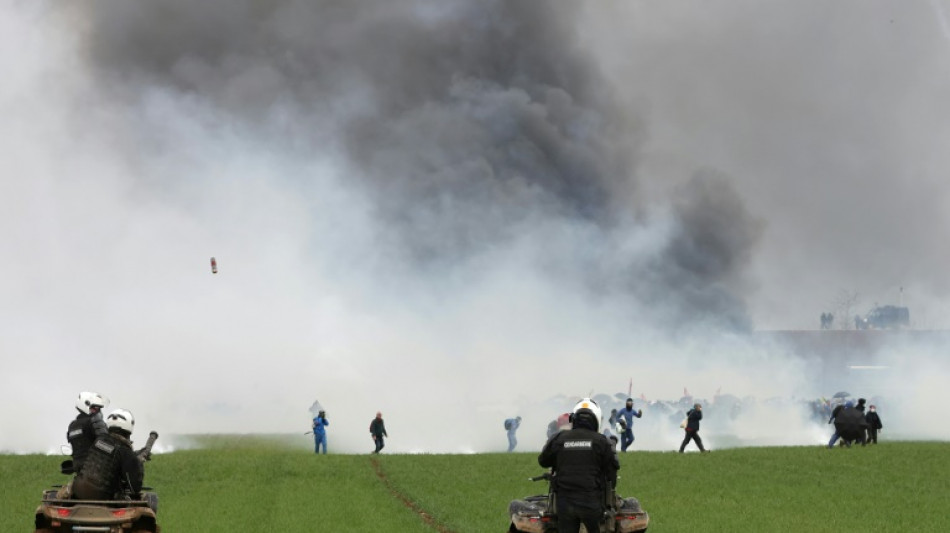
France probes case of man gravely injured at water protest / Photo: Thibaud MORITZ - AFP/File

 UK PM 'open' to slavery apology but not reparations
 Complaints upheld against Swiss TV commentary on Israeli bobsleigher
 Canada, EU launch new alliance with deals on Ukraine, minerals, AI
 EU and Canada to 'withstand shocks together' with new alliance

 'Life in the old dog': German economy grows more than expected
 Italy inflation surges to 5.4% as economy stalls

French prosecutors said Wednesday they were probing the case of a man seriously wounded at a demonstration over access to water, after his family filed a criminal complaint.
The 32-year-old has been fighting for his life in a coma since Saturday's thousands-strong environmental protest against a new "mega-basin" gathering water for irrigation in the western Deux-Sevres region.
The probe was prompted by his parents, who filed a complaint alleging attempted murder as well as the prevention of access by first responders.
Protest organisers said Tuesday that the man, from the southwestern city Toulouse, was seriously wounded when he was struck in the head by a tear gas grenade fired by police.
"People close to him are determined to bear witness and uncover the truth about what happened," they added.
The case is being investigated by military prosecutors in western city Rennes who have jurisdiction over France's gendarmes -- police officers belonging to the armed forces.
Warlike scenes of Saturday's clashes between around 5,000 protesters and 3,200 police in the open fields made headlines over the weekend.
Fielding helicopters, armoured vehicles and water cannon, security forces fired thousands of tear gas grenades and dozens of other projectiles in a response the DGGN police authority described as "proportionate to the level of threat".
Authorities say officers were faced with "an unprecedented explosion of violence" and targeted with Molotov cocktails and fireworks.
- Ambulance access -
But Human Rights League (LDH) observers on the scene said police made "unrestrained and indiscriminate use of force" against all the demonstrators, rather than targeting violent groups or individuals.
AFP journalists saw police begin using tear gas as soon as the marchers arrived.
Prosecutors in nearby Niort counted 47 wounded police and seven demonstrators requiring medical aid, including two in danger for their lives -- one of whose condition has since improved.
Protest organisers complained of 200 wounded, 40 seriously including one person who lost an eye.
In an audio recording published by daily Le Monde, a member of the ambulance service told the LDH that "commanders on the ground" were holding them back from the scene, without identifying individuals.
The service said on Twitter Tuesday that "sending an ambulance with oxygen into an area with clashes is not recommended given the risk of explosion".
Deux-Sevres' prefect -- the top government official in the region -- wrote in a Tuesday report to the interior ministry that it was "very difficult" for ambulances to reach wounded demonstrators as "the clashes had not stopped or were starting again".
Interior Minister Gerald Darmanin has responded to the clashes by vowing to ban one of the associations that organised the protests.
M.Mendoza--CPN