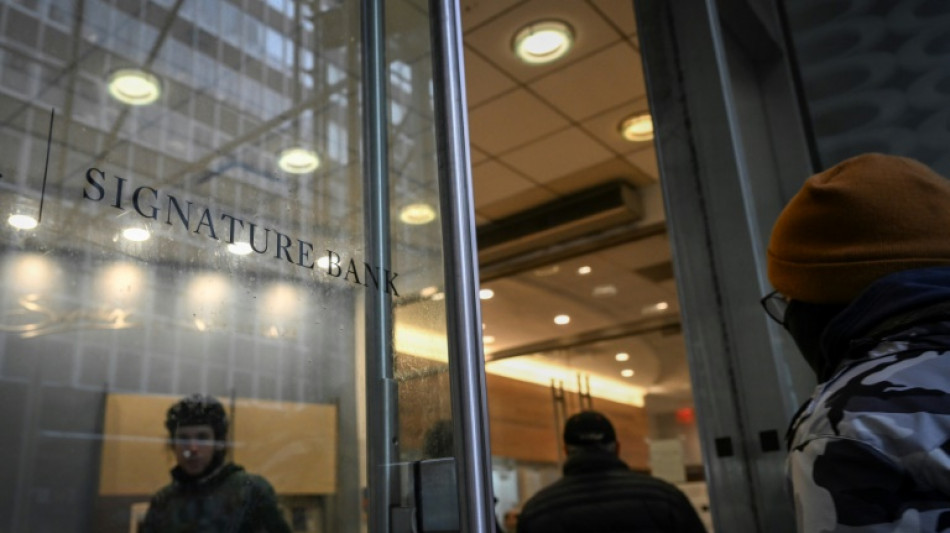
Crypto-linked bank failures fuel regulation debate / Photo: Ed JONES - AFP/File

 British king reflects on colonial atrocities in Guyana

 Monaco taken off global money-laundering 'grey list'
 Tears, fear, anger: relatives of Spain train crash dead await fate
 Wall Street tech rout deepens on doubts over AI spending

 Relatives' anguish grows as Spain identifies train crash dead

 Markets lashed by tech rout as earnings fan AI fears

 Tech sell-off deepens as earnings fan AI fears

 BP net profit quadruples as Mideast war lifts oil prices

 Drugs giant AstraZeneca reveals higher profits, savings plan

The global cryptocurrency industry has been slammed by setbacks, scandals and high-profile failures in recent months, sparking a regulatory rush to protect consumers from fraud and scams.
Global finance was rocked by the collapse of Silicon Valley Bank last week, and the digital currency sector was hit hard by the demise of US crypto lenders Silvergate and Signature -- just months after the bankruptcy of troubled crypto exchange trading platform FTX.
Regulators are increasingly keen for oversight of a sector which boomed during the Covid pandemic when many people were stuck at home.
The global crypto market stands at more than $1 trillion and has risen sharply in recent months, although it remains far below its 2021 peak of $3 trillion.
- 'Huge risks' -
The number of crypto customers "grew during the Covid lockdowns", Martin Walker, head of banking at the Dutch-based Center for Evidence-Based Management, told AFP.
"They joined an unregulated market, investing with huge risks but not realising they were investing in unregulated and not (always) legal assets," said Walker, who organised a London conference last year of cryptocurrency critics.
He argued that trading platforms were conflicted by their unique position.
"They do have conflict of interests (...) as owners are at the same time both taking risk positions in crypto and selling these assets to their consumers," Walker added.
"People do not realise this is not allowed in conventional finance."
Regulators also want oversight of such platforms because they hook up customers, regardless of experience or knowledge, with the complex world of cryptocurrency.
Such trading platforms are the "link between what would be a very technically complex world, both in terms of finance and technology, with a population that's untrained and not very well informed", Bourgogne University economics professor Ludovic Desmedt told AFP.
Added to the picture, cryptocurrencies can experience volatile price swings and their value is not determined via transparent markets -- as is the case with traditional currencies, stocks or commodities.
As a result, illicit transactions using cryptocurrencies more than doubled last year to almost $21 billion, according to specialist crypto firm Chainalysis.
However, this estimate does not include some illegal uses such as drug trafficking.
- Crackdown -
In the United States, officials are working on a framework to oversee crypto firms, but in September the White House asked regulators to use similar regulatory rules that are applied to other financial service providers.
As a result, the Securities and Exchange Commission (SEC) markets regulator took legal action against crypto lenders Genesis and Gemini.
And in February, the SEC ordered crypto firm Paxos Trust to stop issuing dollar-pegged cryptocurrency BUSD, a stablecoin, for the world's biggest trading platform Binance.
European Union draft laws, scheduled to take effect next year, will compel crypto platforms to be more rigorous and transparent in their operations.
In Britain, the government launched a consultation this year to establish a regulatory framework for the sector as it seeks to avoid falling behind the EU and United States.
M.P.Jacobs--CPN