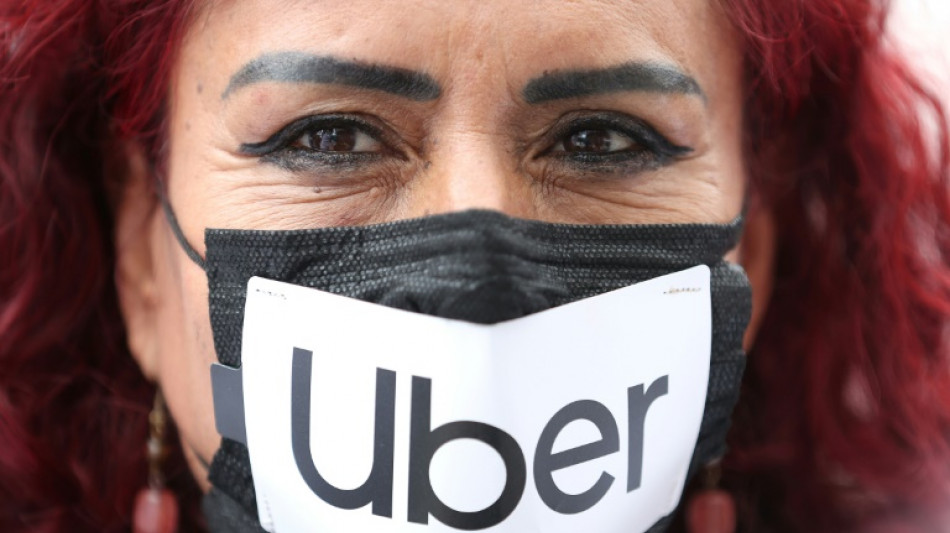
California court upholds Uber drivers being contractors / Photo: JUSTIN SULLIVAN - GETTY IMAGES NORTH AMERICA/AFP

 British king reflects on colonial atrocities in Guyana

 Monaco taken off global money-laundering 'grey list'

 Tears, fear, anger: relatives of Spain train crash dead await fate

 Wall Street tech rout deepens on doubts over AI spending

 Relatives' anguish grows as Spain identifies train crash dead

 Markets lashed by tech rout as earnings fan AI fears

 Tech sell-off deepens as earnings fan AI fears

 BP net profit quadruples as Mideast war lifts oil prices

 Drugs giant AstraZeneca reveals higher profits, savings plan

 French economy 'headed for a wall' as GDP shrinks

 South Korea to prosecute students cheating with smart glasses
A California appeals court on Monday upheld a state law letting Uber, Lyft and other app-based, on-demand companies treat drivers as independent contractors rather than employees.
The ruling came as a victory for ride-share firms and food-delivery app platforms that backed a measure called Proposition 22 ahead of its passage in the state in 2020.
"We're pleased that the court respected the will of the people, and that Prop 22 will remain in place, preserving independence for drivers," Uber chief legal office Tony West told AFP.
The California voter-approved referendum that lets many gig workers be treated as independent contractors was ruled unconstitutional in August of 2021, setting up more legal fights over the controversial measure.
The labor legislation heavily backed by Uber, Lyft and other app-based, on-demand services effectively overturned a California law requiring them to reclassify their drivers and provide employee benefits.
A state judge later ruled the law violated California's state Constitution because the power to make laws about worker compensation belonged to legislators.
The appeals court, however, ruled that Prop 22 "does not intrude on the Legislature’s workers’ compensation authority."
The proposition has remained in effect as the litigation played out.
Under the proposition, drivers remained independent contractors but Uber and Lyft were to pay them a number of benefits including a minimum wage, a contribution to health care and other forms of insurance.
Labor groups fighting the initiative argued that it would erode worker rights and benefits.
The victory for the gig economy in California was expected to echo across the United States, in a boon for app-based services while igniting fears that big business is rewriting labor laws.
Prop 22 does guarantee some support such as pay topping the minimum wage and supplemented health care coverage -- but it designates drivers as self-employed, meaning they do not have the right to some regular employee benefits such as collective bargaining.
A.Leibowitz--CPN