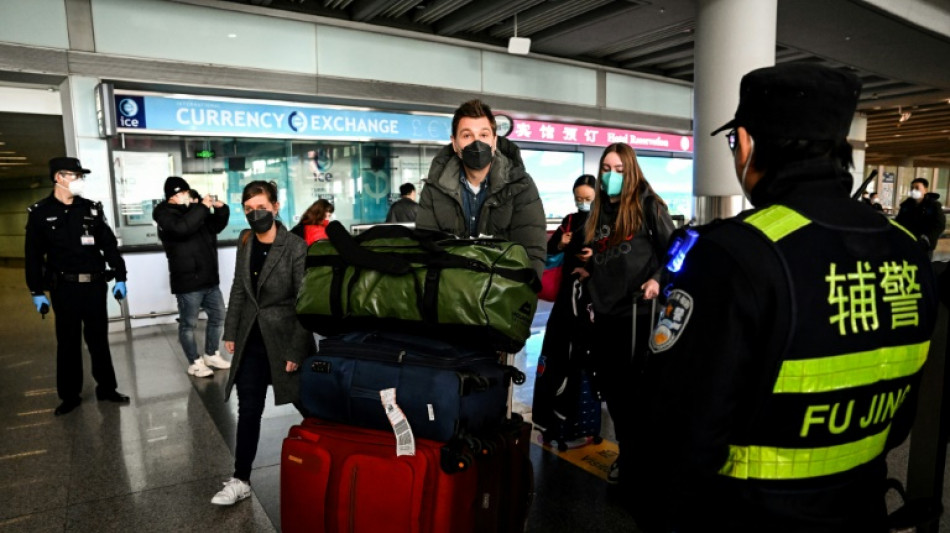
China lifts sweeping visa curbs on foreigners / Photo: Noel CELIS - AFP/File

 British king reflects on colonial atrocities in Guyana

 Monaco taken off global money-laundering 'grey list'
 Tears, fear, anger: relatives of Spain train crash dead await fate
 Wall Street tech rout deepens on doubts over AI spending

 Relatives' anguish grows as Spain identifies train crash dead

 Markets lashed by tech rout as earnings fan AI fears

 Tech sell-off deepens as earnings fan AI fears

 BP net profit quadruples as Mideast war lifts oil prices

 Drugs giant AstraZeneca reveals higher profits, savings plan

 French economy 'headed for a wall' as GDP shrinks

 South Korea to prosecute students cheating with smart glasses
China will once again start issuing a range of visas to foreigners as of Wednesday, the country's embassy in Washington said, a major easing of travel restrictions in force since the outbreak of the Covid-19 pandemic.
The move marks the latest step towards reopening China to the outside world, as Beijing gradually breaks with the strict zero-Covid strategy that defined its pandemic response until a few months ago.
In addition to new travel documents being reviewed and approved, visas issued before March 28, 2020 that are still valid will once again allow entry to China, said the embassy notice posted Monday, translated by AFP from Chinese.
The updated policy will also allow for the resumption of visa-free travel for those arriving in cruise ships to Shanghai, as well as for certain tourist groups from Hong Kong, Macau and countries within the ASEAN regional grouping, the notice said.
China received 65.7 million international visitors in 2019, according to data from the UN World Tourism Organization, before the pandemic led the country to seal itself off from the rest of the world.
While most other countries began fully reopening their economies and welcoming international travelers earlier, China only began emerging from its strict Covid containment policies in late 2022, after rare demonstrations against President Xi Jinping's signature zero-Covid strategy broke out across the country.
Those protests in late November expanded into calls for more political freedoms, with some even calling for Xi to resign, turning into the most widespread opposition to communist rule since the 1989 democracy uprising that the military crushed.
- Reversal -
In early December, Chinese authorities effectively ended the regime of mass testing, lockdowns and long quarantines -- but the abrupt reversal led to a sudden spike in Covid cases.
Beijing announced in late December that inbound travelers to the country beginning January 8 would no longer need to quarantine, but kept in place visa restrictions on foreigners.
At the time, Beijing said it would "continue to adjust its visa policy for foreigners visiting China in a scientific and dynamic manner in accordance with... the epidemic situation."
It also then resumed issuing Chinese passports for "tourism" or "overseas visits of friends."
With cases surging in China around the New Year, several countries -- notably Japan and South Korea -- reimposed restrictions on Chinese visitors, provoking a tit-for-tat as Beijing issued its own limitations.
As cases waned in China, both sides subsequently eased those restrictions.
The announcement that China will resume issuing visas to foreigners comes as the country's rubber-stamp parliament wrapped up an important session in Beijing, during which Xi was confirmed to a third term as president and his close ally Li Qiang became premier.
Li on Monday admitted that achieving the country's economic growth target of "around five percent" would be "no easy task."
China posted just three percent growth last year, missing its stated target of around 5.5 percent by a wide margin as the economy strained under the twin impact of strict Covid policies and a property crisis.
A.Agostinelli--CPN