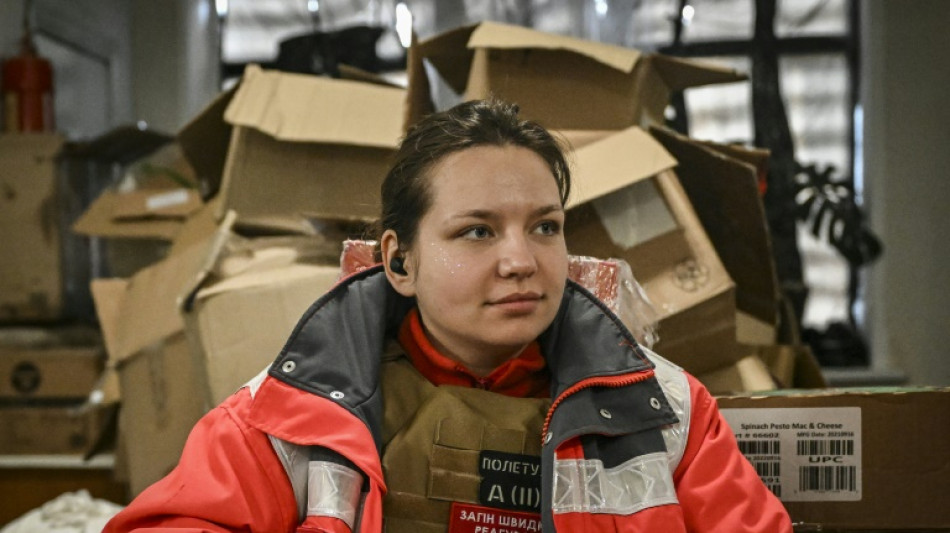
The women volunteers treating Ukraine's frontline troops / Photo: Aris Messinis - AFP

 British king reflects on colonial atrocities in Guyana
 Monaco taken off global money-laundering 'grey list'
 Tears, fear, anger: relatives of Spain train crash dead await fate
 Wall Street tech rout deepens on doubts over AI spending
 Relatives' anguish grows as Spain identifies train crash dead

 Markets lashed by tech rout as earnings fan AI fears

 Tech sell-off deepens as earnings fan AI fears
 BP net profit quadruples as Mideast war lifts oil prices

 Drugs giant AstraZeneca reveals higher profits, savings plan

 French economy 'headed for a wall' as GDP shrinks

 South Korea to prosecute students cheating with smart glasses
 Shock, vindication, regret: Scientists react to AI roiling life's work
At a trauma centre a dozen kilometres from Ukraine's front line, Tetyana still has glitter on her cheeks from taking part in a speech therapy course for children.
"I finished my online course just 20 minutes ago," said the 25-year-old, who works as a Red Cross volunteer at the centre near Siversk in eastern Ukraine.
"In my civilian life I am a speech therapist and teacher. I give daily courses in speech therapy," Tetyana told AFP, dressed in a red and white Red Cross jacket.
Tetyana is part of an ambulance team tasked with picking up wounded soldiers even closer to the front line to stabilise them and take them for treatment.
If the injuries are minor, the soldiers are treated at the centre where she works.
For serious problems, the soldiers are transferred to better equipped hospitals in the cities of Kramatorsk or Dnipro.
Since the start of Russia's invasion more than a year ago, many women like Tetyana have volunteered with non-governmental organisations to help wounded soldiers.
Each frontline military unit has its own centres with doctors, anaesthetists, surgeons and volunteer nurses.
"I have some basic knowledge which is useful to stabilise the patients and transport them," Tetyana said.
"Maybe I am not brave enough to join the army but I try to do my best to bring victory a little closer by helping those who protect us," she said.
Her message for International Women's Day on Wednesday? "Fight and you will win!"
- Close to the front line -
In the kitchen of a medical centre for another unit north of Siversk, eight kilometres (five miles) from the front line, 39-year-old Yulia and her 30-year-old sister Lilia were filling in treatment documents.
Yulia is a paediatrician who heads up the centre, while Lilia is a surgeon. Both volunteered in March 2022 -- just a few days after the invasion began.
"We handle daily treatment, mainly for patients who have nearly recovered," said Yulia, who was wearing a camouflage uniform. "Not all injuries require heavy treatment. Some can be treated here."
In the village, where civilians are a rare sight, outgoing Ukrainian artillery could be heard as well as the thuds of Russian bombs closer to the front line.
"We move a lot as the front line moves. We change base with our unit and now we are in an area that is quite dangerous as you can hear and see.
"We've been here two months," Yulia added.
At the entrance to the village stood an air-defence gun to shoot down the Russian drones that sometimes fly overhead.
"The hardest moments are those when we see dead soldiers..." said Yulia. "Our work is not just helping injured soldiers but also to examine the bodies and take them to the morgue."
The soldiers "really need us here. They respect us and trust us", she said.
Lilia's partner is a soldier, as is Yulia's husband -- but he has been missing since June 2 last year when he disappeared somewhere near the front line.
"We hope he is being held prisoner," Yulia said.
"We know our Ukrainian women are strong and beautiful. It is thanks to their strength and their beauty, and of course thanks to our men that we manage to stay alive".
M.P.Jacobs--CPN