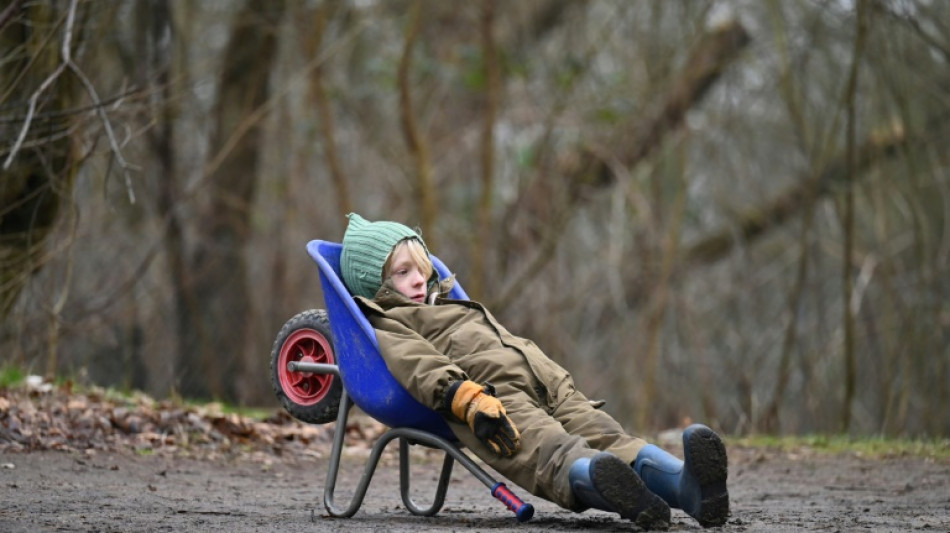
Wild education: the joy of Scandinavia's forest preschools / Photo: Sergei GAPON - AFP

 British king reflects on colonial atrocities in Guyana

 Monaco taken off global money-laundering 'grey list'

 Tears, fear, anger: relatives of Spain train crash dead await fate

 Wall Street tech rout deepens on doubts over AI spending

 Relatives' anguish grows as Spain identifies train crash dead

 Markets lashed by tech rout as earnings fan AI fears

 Tech sell-off deepens as earnings fan AI fears

 BP net profit quadruples as Mideast war lifts oil prices

 Drugs giant AstraZeneca reveals higher profits, savings plan

 French economy 'headed for a wall' as GDP shrinks

 South Korea to prosecute students cheating with smart glasses

 Shock, vindication, regret: Scientists react to AI roiling life's work
Come rain, sleet or snow, young children nap outside even in mid-winter all across Scandinavia, where outdoor preschools teach children a love of nature.
Sitting in the forest on a tarp laid out over the snow in Solna near Stockholm, Agnes and her friends -- all around five -- are lining up sticks.
"We use pieces of wood to show them that you can use anything you find in nature to do maths," said their preschool teacher Lisa Bystrom.
In a scene that would shock some parents elsewhere, the children whittle sticks with large knives, their teachers seemingly unperturbed.
"Once they get to school, they will sit down with a piece of paper and a pencil but here we think this is more fun," Bystrom said.
In Sweden and Denmark, school is mandatory from the age of six.
But before that most children attend daycare or preschool, with many parents opting for outdoor ones where children play in the woods and learn to appreciate nature.
"Technology today takes over most (things), so I think it's necessary to be in nature from a young age to learn how to behave and to respect nature," said Andreas Pegado, one of the educators whose daughter also attends the preschool.
Every day, the little ones eat lunch seated on wooden benches around a wood fire -- unless heavy rain forces them indoors.
After their meal, kids that are two and under settle down for a nap, bundled into sleeping bags under a canopy -- even when the temperature falls below zero.
"They get a lot of fresh air, (so) they sleep longer, they sleep better," said Johanna Karlsson, the head of the "Ur & Skur" (Come Rain or Shine) preschool, unbothered by the day's temperature of five degrees Celsius (41 Fahrenheit).
- 'Forest buses'-
In neighbouring Denmark, many preschools use "forest buses" to bring "asphalt kids" to nature areas.
Every day, a group from the Stenurten preschool -- one of 78 Copenhagen preschools that offer daily excursions like this -- leaves the Norrebro neighbourhood in the city centre on a 30-minute bus ride to the forest.
A little wooden house provides shelter if necessary, and a large field leads to the forest where the kids can run free.
In the open air, the educators can vary their pedagogical approaches and develop the children's independence.
"Their curiosity is a bit different here," said Iben Ohrgaard, one of the preschool staff.
- Snowsuits for all -
Everyone is kitted out in snowsuits, kids and adults alike. A popular Nordic saying goes: "There's no such thing as bad weather, only bad clothes."
But is it really reasonable to stay outside all day, even when it's minus 10 Celsius?
The educators all agree: young children who spend their days outside have better self-confidence and are sick less often.
In the 1920s, an Icelandic doctor recommended that babies sleep outdoors to strengthen their immune systems, a practice now common across the Nordic countries and which the medical community has never contradicted.
A study published in 2018 in the British Educational Research Journal suggested that outdoor preschools improve children's team working skills by encouraging kids to collaborate through play, among other things.
Outdoors "they try different solutions themselves," said Ohrgaard, helping limit conflicts.
"If they climb a bit too high in a tree, they know there are adults there. But they try a little more themselves. And they grow up with the feeling that 'I can do it,'" she explained.
"That gives them the strength to try once more before asking for help."
For parents, the days spent outdoors are a "gift".
"When you live in the city, in the capital Copenhagen, there's not really any nature. It's an enormous gift for the kids," said Line Folkhammar, mother of five-year-old Georg.
And the added bonus for parents? "He comes home tired," she said with a laugh.
H.Meyer--CPN