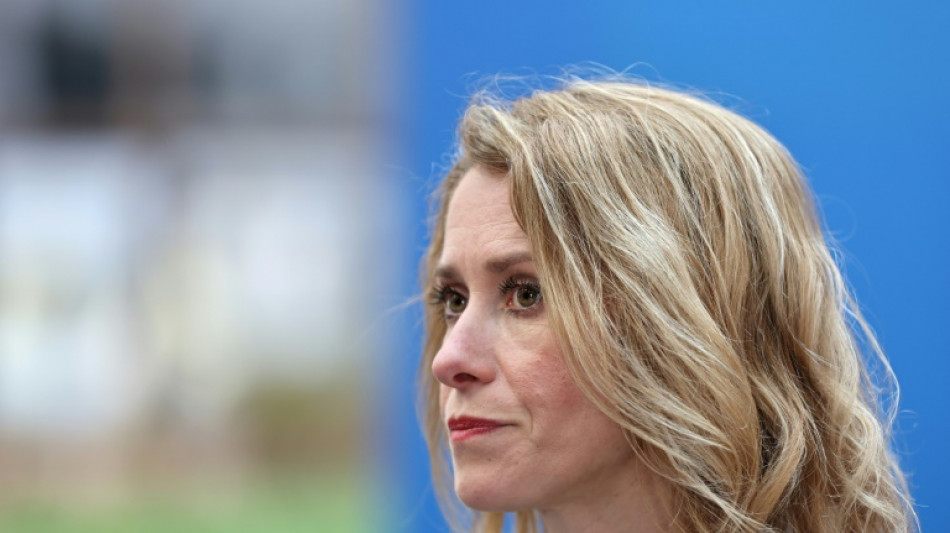
Russian minority shuns Estonia vote over Ukraine support / Photo: Aris Oikonomou - AFP/File

 British king reflects on colonial atrocities in Guyana

 Monaco taken off global money-laundering 'grey list'
 Tears, fear, anger: relatives of Spain train crash dead await fate
 Wall Street tech rout deepens on doubts over AI spending

 Relatives' anguish grows as Spain identifies train crash dead
 Markets lashed by tech rout as earnings fan AI fears

 Tech sell-off deepens as earnings fan AI fears
 BP net profit quadruples as Mideast war lifts oil prices

 Drugs giant AstraZeneca reveals higher profits, savings plan
 French economy 'headed for a wall' as GDP shrinks

 South Korea to prosecute students cheating with smart glasses

 Shock, vindication, regret: Scientists react to AI roiling life's work
Put off by the Estonian government's hawkish stance on Russia, many Russian speakers are expected to stay away from elections on Sunday even though they oppose the war in Ukraine.
Russian speakers, who make up a quarter of the population, are also concerned about the support of almost all the main parties for a new law for Estonian-only education in schools.
"A very big part of the Russian-speaking population of Estonia has definitely kept strong ties to Russia," said Rein Toomla, a political expert from the Johan Skytte Institute.
"They experience painfully Estonia's and the rest of the democratic world's current policy towards Russia," he said.
According to a recent survey by Kantar Emor, ahead of the election 35 percent of Russian-speaking voters were still undecided on whether to vote.
Estonia, which has a population of just 1.3 million, is a Baltic state which was part of the Soviet Union until 1991 and is now a member of the European Union and NATO.
According to the polls, the elections are set to be won by the Reform Party of Prime Minister Kaja Kallas, who has led international calls for increased military assistance to Ukraine.
In an interview with AFP last month, Kallas said that boosting Ukrainian forces was also helping to defend Estonia because "they are weakening the same enemy as we have".
She said Russia should be held accountable for its crimes "to break the cycle of Russia attacking their neighbours", calling it "the last imperialistic power... in the world".
Diplomatic relations between Russia and Estonia, which also have an unresolved border dispute, have plunged.
In January, Russia expelled Estonia's ambassador and Estonia responded by doing the same to the Russian ambassador.
- 'Risk' for Estonia? -
Kallas's approach is supported by most of the main parties with the exception of the far-right EKRE, which is second in the polls.
EKRE has called for a scaling down of military assistance to Ukraine in order not to antagonise Russia and for the Baltic state to stop taking in Ukrainian refugees.
The Kantar Emor survey showed the party had only 11 percent support among Russian-speaking voters
The highest proportion -- 45 percent -- preferred the centre-left Centre Party, which promises to continue to offer bilingual school education in Estonian and Russia for those who want it.
Recent government moves such as the removal of all Soviet-era World War II monuments have also angered many in the Russian-speaking community.
But not all Russian speakers are disillusioned with politics.
Andrei, a 39-year-old programmer who declined to give his surname, said he would be voting for the Reform Party.
"Any other choice would pose a risk for the very existence of our state," he said.
"As long as Ukraine is defending itself, there is no danger of war to Estonia. This is why we must continue supporting Ukraine until victory."
But Aleksandra Kivisalu, 49, a martial arts instructor, said she would not be voting.
"I wouldn't want to learn in a couple of years that I had voted for someone like Putin or Hitler. Most people don't know how to handle power."
M.Davis--CPN