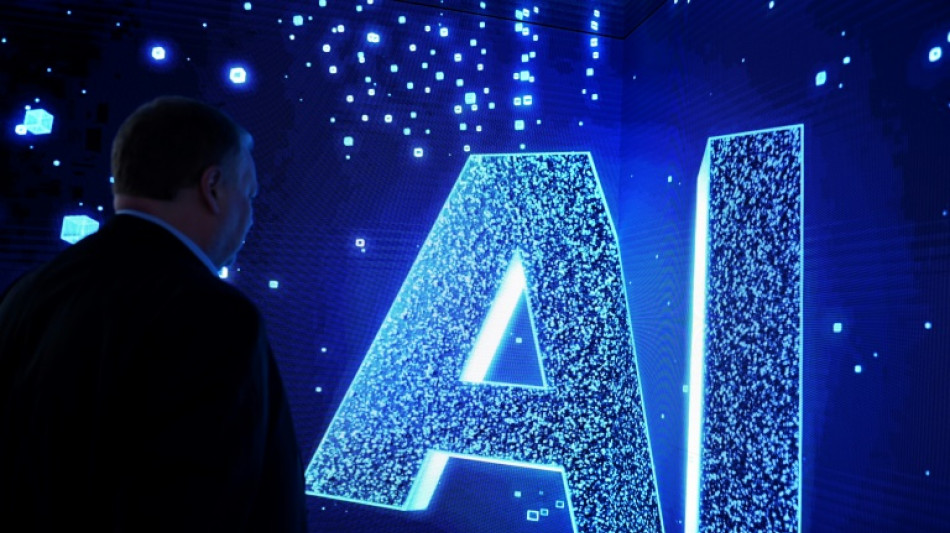
Europeans scramble in AI race / Photo: Josep LAGO - AFP

 British king reflects on colonial atrocities in Guyana

 Monaco taken off global money-laundering 'grey list'

 Tears, fear, anger: relatives of Spain train crash dead await fate

 Wall Street tech rout deepens on doubts over AI spending

 Relatives' anguish grows as Spain identifies train crash dead

 Markets lashed by tech rout as earnings fan AI fears

 Tech sell-off deepens as earnings fan AI fears

 BP net profit quadruples as Mideast war lifts oil prices

 Drugs giant AstraZeneca reveals higher profits, savings plan

 French economy 'headed for a wall' as GDP shrinks

 South Korea to prosecute students cheating with smart glasses

 Shock, vindication, regret: Scientists react to AI roiling life's work

 Britain's King Charles lands in ex-colony Guyana

Generative AI chatbots unveiled by US tech firms have captivated the world with their spectacular successes and failures in engaging in conversations.
But European firms focusing more on business applications are confident they won't be left in the dust in the rapidly developing field, even as they redouble their efforts.
"The launch of ChatGPT has changed everything. It has been a wake-up call for European firms," said Laurent Daudet at French startup LightOn.
"But the battle for generative AI isn't over," he added.
Artificial intelligence, or AI, has been increasingly present in everyday life for decades, but the November launch of the conversational robot ChatGPT from startup OpenAI marked a turning point in its perception by the public and investors.
Generative AI, of which ChatGPT is an example, wades through oceans of data to conjure up original content -- an image, a poem, a thousand-word essay -- in seconds on a simple request.
Despite still being prone to give incorrect answers and lead conversations in bizarre directions, firms are rushing to develop practical applications for the technology.
Microsoft has backed OpenAI financially and begun to integrate ChatGPT features into its Teams platform, with expectations that it will adapt the app to its Office suite and Bing search engine.
Google plans to rush out its own conversational chatbot named Bard, but Facebook-owner Meta is working with researchers before attempting another release after being forced to take its bot offline last November after it shared biased and incorrect results.
A number of US startups are also active in the space.
- European bots -
In Europe, dozens of startups are working on developing their own bots based on existing AI models or, more rarely, developing their own.
All of them are using open source code, at least in part, to build the corpus of knowledge fed into the bots, just as the US tech titans have.
Among the leading European startups is Germany's Aleph Alpha which is developing a multimedia chatbot.
In France, there is Bloom, a scientific language model being built by hundreds of researchers coordinated by a US-French startup called Hugging Face, with the support of France's national scientific research centre CNRS. Hugging Face recently struck a partnership with Amazon.
Others are pursuing more specialised bots, such as German firm Stable Diffusion with its text-to-image model released last year, and Swedish Sana Labs' AI, which manages information.
All have raised tens of millions in funding from investors, which leaves them far behind the billions spent by US tech giants.
- Competitive tech -
Nevertheless, European firms believe their technology is competitive and can take a slice of the emerging market.
Aleph Alpha founder and CEO Jonas Andrulis said its latest bot will be much more powerful than OpenAI's latest GPT-3 model which has captured global attention.
"We will release our 300 billion parameter model this year," Andrulis told AFP. The GPT-3 model has only 175 billion.
He said his firm was the only one so far to offer a model that can take both text and images as input prompts, which opens up the possibility of different applications.
Aleph Alpha is targeting high-value work at companies and Andrulis acknowledged they are rushing to compete against Microsoft.
"For these customers it's either Microsoft or us," he said.
Daudet, a co-founder of Paris-based LightOn, said their models were also as performant as GPT-3.
"The number of usages is phenomenal, conversation is one but we aren't going to fight on the ground on which the Americans excel," he said.
"We're going to offer solutions for companies: summarising documents or email exchanges, generating specialised content," he added.
- Multilingual -
Many European AI models are multilingual. Bloom's works in seven languages, including English, Chinese, Spanish and French.
Aleph Alpha's works in five.
This is an advantage as Europeans prefer tools in their native languages. But the quality depends on the volume of texts fed into them, and there English has had an advantage.
"Our clients prefer GPT-3 for English texts and our mode for German and French," said Aleph Alpha's Andrulis.
One concern is the future of open source code, upon which all current AI models are based. With competition heating up, companies may become less willing to share, inhibiting further innovation by startups.
Pablo Ducru, a French-educated researcher and entrepreneur who has moved to the United States to seek funding for his AI project, said European firms don't need large teams, but believes three other elements are important.
"First of all, calculating power, which is expensive. The access to data for training. And finally, talent, which raises the question of salaries," he said.
Another element which could make a difference is user feedback. With ChatGPT now interacting with over 100 million internet users, it could extend its lead.
D.Philippon--CPN