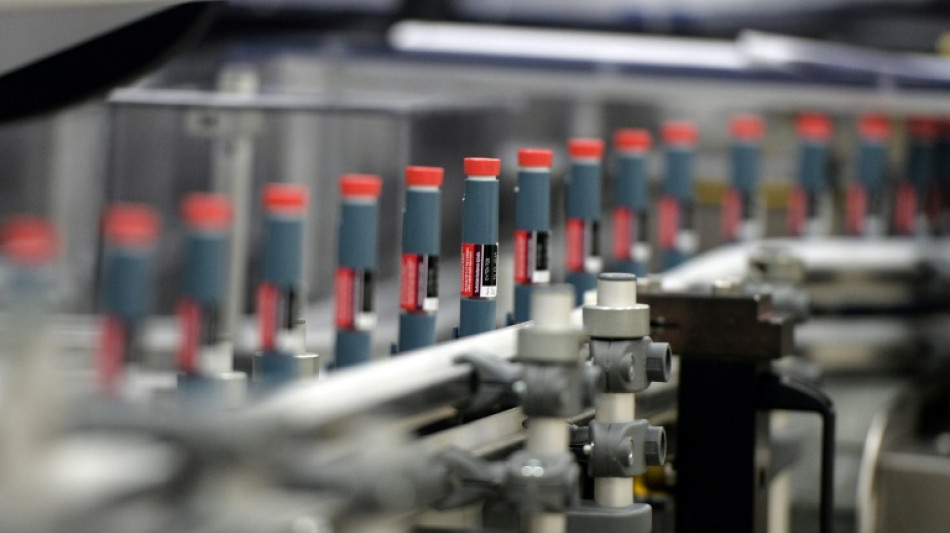
US drugmaker Eli Lilly says slashing insulin prices by 70% / Photo: FREDERICK FLORIN - AFP/File

 British king reflects on colonial atrocities in Guyana

 Monaco taken off global money-laundering 'grey list'
 Tears, fear, anger: relatives of Spain train crash dead await fate
 Wall Street tech rout deepens on doubts over AI spending

 Relatives' anguish grows as Spain identifies train crash dead

 Markets lashed by tech rout as earnings fan AI fears
 Tech sell-off deepens as earnings fan AI fears

 BP net profit quadruples as Mideast war lifts oil prices

 Drugs giant AstraZeneca reveals higher profits, savings plan

 French economy 'headed for a wall' as GDP shrinks
 South Korea to prosecute students cheating with smart glasses

 Shock, vindication, regret: Scientists react to AI roiling life's work

 Britain's King Charles lands in ex-colony Guyana

US pharmaceutical giant Eli Lilly announced Wednesday it was cutting the cost of its most commonly prescribed insulins by 70 percent after years of soaring prices that hit millions of Americans living with diabetes.
The announcement comes as the cost of insulin has surged in recent years, with demand increasing significantly as well.
"Lilly is taking these actions to make it easier to access Lilly insulin and help Americans who may have difficulty navigating a complex healthcare system," the Indianapolis-based drugmaker said in a statement.
The company added it would cut the price of its non-branded insulin to $25 a vial starting May 1.
It will also lower the price of Humalog, its most commonly prescribed insulin, and Humulin, by 70 percent starting in the fourth quarter of this year.
"While the current healthcare system provides access to insulin for most people with diabetes, it still does not provide affordable insulin for everyone and that needs to change," said Lilly CEO David Ricks.
The company also said Wednesday it would automatically cap out-of-pocket costs at certain retail pharmacies at $35, for people with commercial insurance using Lilly insulin.
Diabetes is one of the fastest-growing chronic diseases globally, according to a 2022 study.
- Soaring prices -
In recent decades, insulin prices have soared in the United States, costing over eight times more than in 32 comparable high-income countries, a 2020 Rand Corporation study found.
But the cost of producing insulin is relatively low compared to the sale price.
A survey by nonprofit T1International also showed that one in four respondents living with diabetes reported rationing their insulin because of the financial strain.
In his State of the Union address last month, President Joe Biden said: "Big Pharma has been unfairly charging people hundreds of dollars –- and making record profits. Not anymore."
While seniors on Medicare have the cost of insulin capped, millions of other Americans not on the federal health insurance program for the elderly need insulin to save their lives, he added.
"Let's finish the job this time. Let's cap the cost of insulin at $35 a month for every American who needs it," Biden said.
Diabetes is divided into two types. An estimated nine million people have type 1 diabetes, a chronic condition where the pancreas does not produce enough insulin -- the hormone that regulates blood sugar levels.
Most people living with diabetes have type 2, which is associated with obesity and other lifestyle factors and emerges in adults and increasingly among children.
All type 1 diabetics need insulin to survive, and generally their access is ensured.
Some 63 million people with type 2 also need the hormone, according to World Health Organization estimates, but only about half of them can access it.
J.Bondarev--CPN