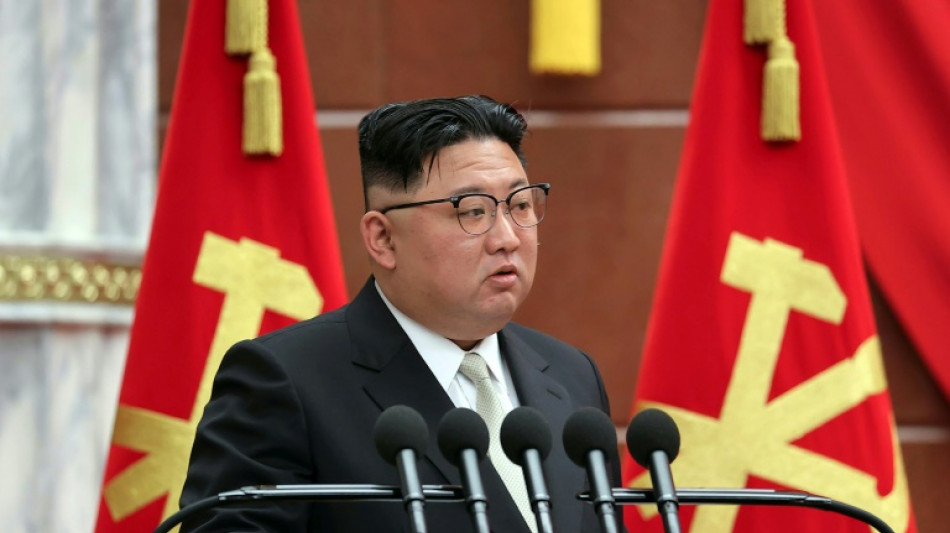
North Korea's Kim opens key meeting on agriculture / Photo: STR - KCNA VIA KNS/AFP

 British king reflects on colonial atrocities in Guyana

 Monaco taken off global money-laundering 'grey list'
 Tears, fear, anger: relatives of Spain train crash dead await fate
 Wall Street tech rout deepens on doubts over AI spending
 Relatives' anguish grows as Spain identifies train crash dead
 Markets lashed by tech rout as earnings fan AI fears
 Tech sell-off deepens as earnings fan AI fears

 BP net profit quadruples as Mideast war lifts oil prices
 Drugs giant AstraZeneca reveals higher profits, savings plan
 French economy 'headed for a wall' as GDP shrinks
 South Korea to prosecute students cheating with smart glasses
 Shock, vindication, regret: Scientists react to AI roiling life's work

 Britain's King Charles lands in ex-colony Guyana
 Dodging fuel price hikes, Damascus drivers turn to electric cars
North Korean leader Kim Jong Un has opened a key party meeting to discuss agricultural development, state media said Monday, following a report of "grave" food shortages in the isolated country.
Normally such meetings are convened only once or twice a year, but the plenary comes just two months after a previous one, which also focused on agricultural issues.
The unusual frequency of the meetings focused on agriculture has fuelled speculation that there may be serious food shortages in North Korea now.
Kim chaired the opening on Sunday of a plenary meeting of top ruling party officials to "analyse and review... the programme for the rural revolution in the new era, and decide on the immediate important tasks and the urgent tasks," the official Korean Central News Agency reported.
The participants "unanimously approved the agenda items and went into discussion" on the topic, the KCNA said without giving further details.
South Korea's unification ministry says there have been reports of starvation deaths in the North.
"We judge the food shortages there to be grave," ministry spokesman Koo Byoung-sam said last week, adding Pyongyang appeared to have requested food aid from the World Food Programme.
North Korea monitoring site 38 North said it judged the current food shortages in the country to be the worst in decades.
The Pyongyang regime was being forced to deal with "a complex humanitarian emergency that has food insecurity at its core", it said in a January 2023 assessment.
An analysis of rice and corn prices globally and in North Korea show "significant" price divergence since early 2021 -- meaning food is far more expensive in the North -- "signalling a breakdown" in supply, it added.
- Official denial -
But a recent commentary carried by North Korea's main state-run newspaper Rodong Sinmun said the country should continue to stick to the "self-sufficient economy" as part of its fight against "the imperialists".
"The imperialists, under the cloak of the so-called 'collaboration' and 'aid', are clamouring as if some countries in economic difficulties could not tide over crises without their support."
But such support are efforts to "make the countries their sources of raw materials and market after completely demolishing the barrier of their national economy", Rodong said.
Nuclear-armed North Korea, which is under multiple sets of sanctions over its weapons programmes, has long struggled to feed itself.
It is highly vulnerable to natural disasters including floods and drought due to a chronic lack of infrastructure, deforestation and decades of state mismanagement.
This has been compounded by a years-long self-imposed border closure since the start of the coronavirus pandemic, which has only recently been eased to allow some trade with neighbouring China.
The country has periodically been hit by famines, one of which in the 1990s killed hundreds of thousands of people -- some estimates range into millions.
A.Leibowitz--CPN