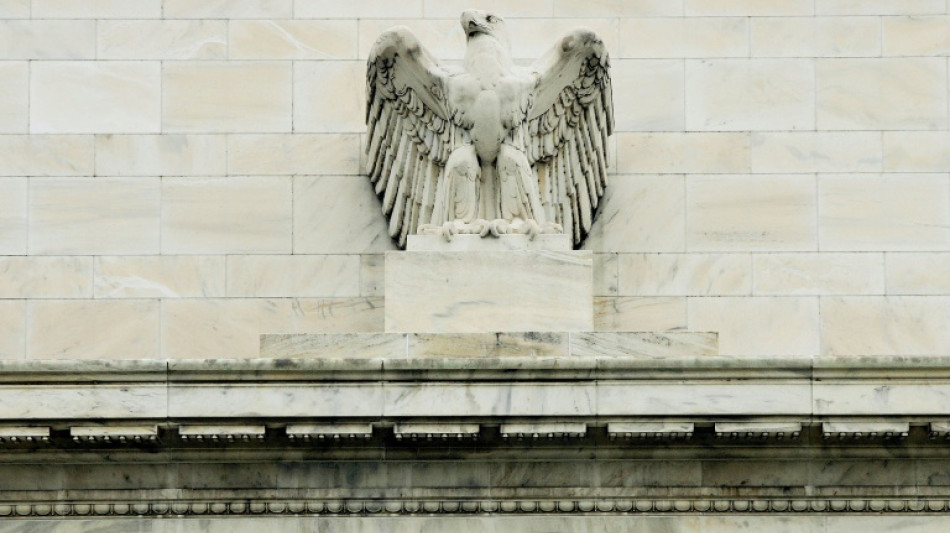
History says Fed can't tame inflation without recession: report / Photo: WIN MCNAMEE - Getty Images North America/Getty Images/File

 British king reflects on colonial atrocities in Guyana

 Monaco taken off global money-laundering 'grey list'

 Tears, fear, anger: relatives of Spain train crash dead await fate

 Wall Street tech rout deepens on doubts over AI spending

 Relatives' anguish grows as Spain identifies train crash dead

 Markets lashed by tech rout as earnings fan AI fears

 Tech sell-off deepens as earnings fan AI fears

 BP net profit quadruples as Mideast war lifts oil prices

 Drugs giant AstraZeneca reveals higher profits, savings plan

 French economy 'headed for a wall' as GDP shrinks

 South Korea to prosecute students cheating with smart glasses

 Shock, vindication, regret: Scientists react to AI roiling life's work

 Britain's King Charles lands in ex-colony Guyana

 Dodging fuel price hikes, Damascus drivers turn to electric cars

There is no recent precedent for a central bank successfully defeating inflation without "substantial economic sacrifice or recession," said a report presented Friday to Federal Reserve policymakers.
The report, prepared in connection with a seminar organized by the University of Chicago's Booth School of Business, came after fresh US pricing data suggested the Fed's aggressive moves thus far have been only partially successful.
The Booth analysis suggested a potentially rocky future for the US economy, which has thus far shown resilience despite aggressive Fed actions to counter inflation.
Citing historical "disinflation" cases dating back to 1950 in major economies, the report concluded that central banks "are likely to be hard pressed to achieve their disinflationary goals without significant sacrifice in economic activity."
The analysis, prepared by a team of academic and corporate economists, identified parallels between the current climate and that of the late 1970s when former Fed Chair Paul Volcker radically increased interest rates to counter soaring inflation.
As with the earlier period, the Fed in the recent episode also "fell behind the curve," the report said.
The Volcker case "shows how costly disinflation can be once a central bank has lost credibility for controlling inflation," said the report, which also recounted the bruising consequences, including more than 10 percent unemployment in the 1980s.
Recent robust US jobs and retail sales data do not show anything like that right now. But the Booth report predicted the Fed "will need to tighten policy significantly further to achieve its inflation objective by the end of 2025."
Philip Jefferson, a member of the Fed's Board of Governors, acknowledged the importance of looking at history, but highlighted the "unprecedented" nature of the pandemic that has made the current period distinct.
Economic models "while still useful in many respects, are going to have limited applicability," he said in prepared remarks.
Such tools "need to be used with careful interpretation and judgment when history does not speak to the current situation," Jefferson said.
"Sound decisionmaking requires that their findings be complemented with additional analytical tools, including careful scrutiny of real-time data."
A second Fed official, Loretta Mester, president of the Federal Bank of Cleveland, suggested the US central bank faces a challenging balancing act.
"The level of inflation matters and it's still too high," she said, while acknowledging later that the US central bank has a history of "overshooting a bit."
M.Anderson--CPN