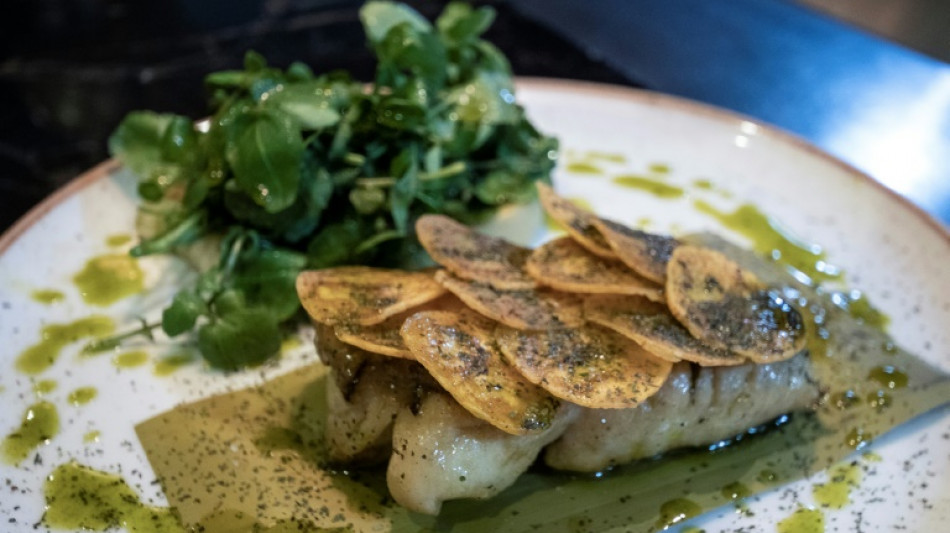
Costa Rican chef showcasing Indigenous cuisine / Photo: Ezequiel BECERRA - AFP

 British king reflects on colonial atrocities in Guyana

 Monaco taken off global money-laundering 'grey list'

 Tears, fear, anger: relatives of Spain train crash dead await fate

 Wall Street tech rout deepens on doubts over AI spending

 Relatives' anguish grows as Spain identifies train crash dead

 Markets lashed by tech rout as earnings fan AI fears

 Tech sell-off deepens as earnings fan AI fears

 BP net profit quadruples as Mideast war lifts oil prices

 Drugs giant AstraZeneca reveals higher profits, savings plan
 French economy 'headed for a wall' as GDP shrinks

 South Korea to prosecute students cheating with smart glasses

 Shock, vindication, regret: Scientists react to AI roiling life's work

 Britain's King Charles lands in ex-colony Guyana

 Dodging fuel price hikes, Damascus drivers turn to electric cars
The recipes are not written down, the ingredients local. At Sikwa restaurant in the Costa Rican capital, a deep-rooted respect for Indigenous culture is what determines the menu.
The establishment in San Jose is the brainchild of Chef Pablo Bonilla, who ten years ago decided to leave behind everything he had learned in his culinary studies.
For years, he immersed himself in the Indigenous cultures of his native country, living with eight different Indigenous groups in turn: the bribri, cabecar, ngobe, maleku, brunca, teribe, huetar and chorotega.
He learned everything he could about the ingredients they use and how to harvest and cook them.
The process, he said, meant "wiping my memory of everything I learnt, everything I studied about gastronomy and about Costa Rican cuisine.
"It was a realization that gastronomy means many things" other than just food -- an experience Bonilla told AFP he now wants to share with others.
"I think we still have a lot to learn from Indigenous communities," said the chef who is also inspired by preserving native cuisine.
- 'Something different' -
Bonilla and his team create generous dishes meant for sharing between diners, with ingredients from all over the Central American country.
They seek to replicate the original way of cooking, with a modern twist.
"It tastes like home cooking, it tastes like smoke, it tastes like firewood, it really tastes like what the ingredient should taste like," said the chef.
The pantry is sparse, as the restaurant tries to use only preservative-free food sourced directly from producers.
Bonilla buys Pacific fish almost daily, cocoa from the Caribbean coast, corn from the highlands of the northern border, and plantains from the southern jungle.
On the day AFP visited, the menu inspired by the available produce included a dish of eel cooked in banana leaves, a shrimp bisque and a ceviche of mangrove clam.
While one cook prepared a dish of corn, plantain, potatoes, pumpkin and carrots, another made a roasted plantain ice cream with cocoa.
Sourcing rare ingredients like these is "much more expensive," said Bonilla.
"Depending on the process and the product it can cost me up to four times more."
But it also means that as a chef, he has "something different" to offer his clientele. A main course on the menu costs between $10 and $14.
Bonilla's bet has paid off: in 2018, the year it opened, Sikwa was included on the New Worlder culinary site's list of best new restaurants.
In November, it made the World's 50 Best's list of top 100 restaurants in Latin America and the sixth best in Central America.
J.Bondarev--CPN