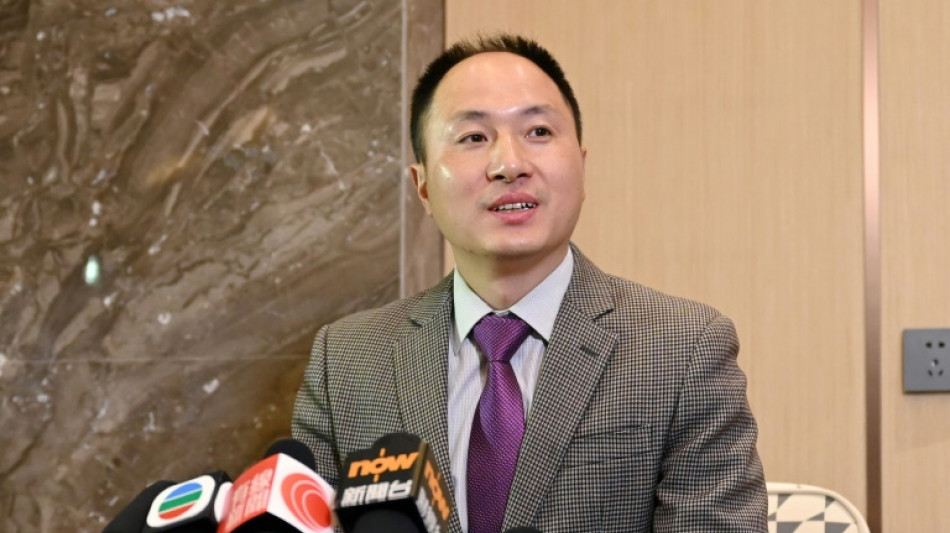
Hong Kong revokes visa of Chinese scientist jailed over gene editing / Photo: GREG BAKER - AFP

 British king reflects on colonial atrocities in Guyana
 Monaco taken off global money-laundering 'grey list'
 Tears, fear, anger: relatives of Spain train crash dead await fate
 Wall Street tech rout deepens on doubts over AI spending

 Relatives' anguish grows as Spain identifies train crash dead

 Markets lashed by tech rout as earnings fan AI fears

 Tech sell-off deepens as earnings fan AI fears
 BP net profit quadruples as Mideast war lifts oil prices

 Drugs giant AstraZeneca reveals higher profits, savings plan

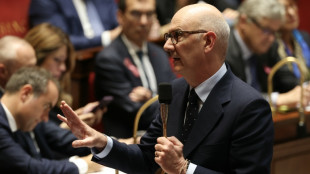 French economy 'headed for a wall' as GDP shrinks

 South Korea to prosecute students cheating with smart glasses

 Shock, vindication, regret: Scientists react to AI roiling life's work

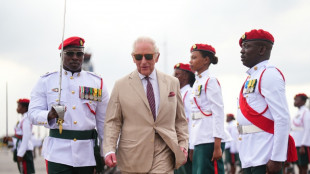 Britain's King Charles lands in ex-colony Guyana

 Dodging fuel price hikes, Damascus drivers turn to electric cars
 Lethbridge students learn how city transit and transportation systems work

 Horoscope for October 30, 2026: communication and patience shape the day
Authorities in Hong Kong said late Tuesday they had cancelled the work visa of a Chinese biophysicist who was jailed for creating the world's first gene-edited babies, throwing cold water on his plans to relocate his research to the city.
The initial granting of a visa to He Jiankui had raised hackles in the scientific community and cast a shadow over Hong Kong's new immigration scheme designed to attract top talent worldwide.
He was handed a prison term in 2019 for illegally experimenting on human embryos in a controversial exercise that saw twin girls born with genes he had altered to confer immunity to HIV.
The scientist -- who was released in April last year -- said earlier Tuesday that his Hong Kong visa had been approved and that he was seeking collaborators to further his work on gene therapy for rare diseases.
"I am currently contacting Hong Kong's universities, scientific research organisations and companies," the 39-year-old told journalists in Beijing.
"If there are definite and suitable opportunities, I will consider working in Hong Kong," he said.
But the Hong Kong government said late Tuesday that it had voided the visa of an individual who "made false statements" in the application, adding that a criminal investigation had been launched.
The statement did not name He, but referred to details of his case.
It added that future applicants under the visa scheme must declare if they had a criminal record -- a requirement that officials admitted did not exist when He submitted his forms.
Kiran Musunuru, a leading genetics professor at the University of Pennsylvania, earlier criticised Hong Kong's decision to grant He a visa as "appalling".
"He Jiankui is a convicted criminal" and "woefully incompetent as a scientist", he told AFP.
"Experimenting on children and causing them genetic damage, as he did, is in my view a form of child abuse."
The Chinese scientist stunned the scientific community in 2018 by announcing the birth of the genetically engineered twins. A third child who had undergone gene editing was born the following year.
After international condemnation, He, who was educated at Stanford University, was jailed in December 2019 by a Chinese court and fined three million yuan ($430,000).
The court said he had been "illegally carrying out human embryo gene-editing intended for reproduction", Chinese state media reported at the time.
Two of He's fellow researchers were also sentenced in 2019. Zhang Renli was handed a two-year jail term and fined one million yuan, while Qin Jinzhou was given 18 months, suspended for two years, and fined 500,000 yuan.
The trio had not obtained qualifications to work as doctors and knowingly violated China's regulations and ethical principles, according to the court verdict, news agency Xinhua said.
They acted "in the pursuit of personal fame and gain" and seriously "disrupted medical order", it added.
burs-je/hol/sst
H.Müller--CPN