Europe looks to geothermal energy as gas alternative / Photo: Christof STACHE - AFP

 Complaints upheld against Swiss TV commentary on Israeli bobsleigher

 Canada, EU launch new alliance with deals on Ukraine, minerals, AI
 EU and Canada to 'withstand shocks together' with new alliance

 'Life in the old dog': German economy grows more than expected

 Italy inflation surges to 5.4% as economy stalls

 US oil giants report profit surge again on Iran war
 Carmaker Audi cuts outlook again on China, US woes

 German economy logs 0.2% growth, faster than expected

 China denies spying on Nvidia's Jensen Huang
 BP net profit quadruples on higher oil prices

 Malawi's fuel shortages, record prices deepen economic crisis

 The Duskbloods delayed as Nintendo Switch 2 release moves to 2027

 Tech firms take fresh hit as earnings misses fan AI fears

 Nvidia's web of AI bets: smart strategy or bubble risk?

 DoorDash shares rise as Instacart slips following $17 billion takeover plan

 Amazon cloud business accelerates but shares drop on profit miss

 PI Industries plans Indian launch of Pioxaniliprole insecticide this rabi season
 Asian equities diverge after mixed technology earnings and Fed rate decision

 Kuwait traffic authority cautions against hazard lights while driving in rain
 Utah files criminal charges against prediction market Kalshi
 Kuwait National Guard official visits member injured during training
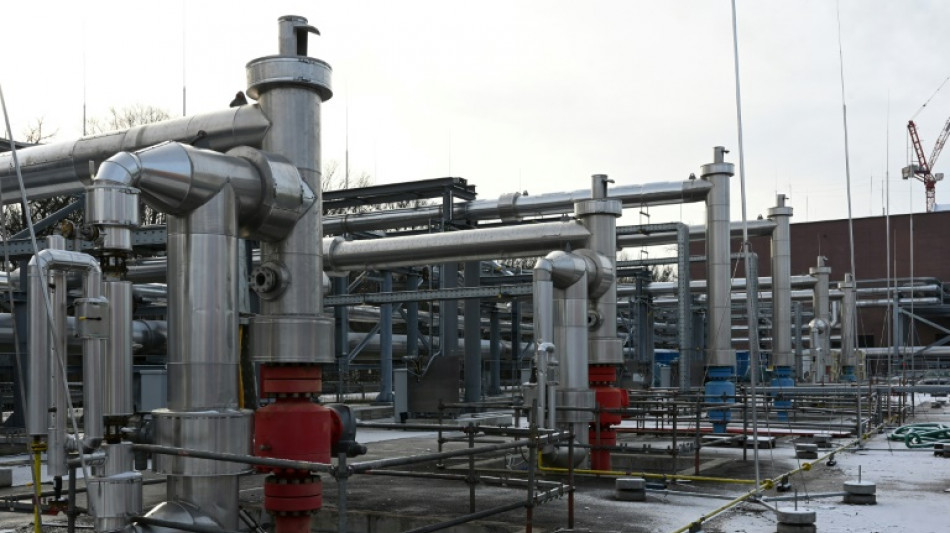
The heating plant in Munich's southern Sendling neighbourhood has been run for more than a century on gas, often imported from far away.
But increasingly, it is the hot waters from deep underground the station that provide the energy.
Tacked on to the side of the original 19th-century red-brick plant is a boxy new geothermal unit surrounded by a tangle of pipes.
Work on the new installation started in 2016 and it opened in 2021, before Russia launched its assault on Ukraine and shut the pipelines to Europe.
But the timely opening of the modern unit -- one of the largest of its kind in Europe -- is a happy coincidence for the city, which like the rest of the country is facing the challenge of making up for lost Russian gas supplies.
- 'Perfect location' -
Munich is pouring in one billion euros ($1.1 billion) through 2035 to develop the geothermal energy and make the city's heating carbon neutral.
"We're sitting on a gold mine," says Christian Peltl, director of geothermal energy at SWR, the operator of the plant in Sendling.
"Munich has the perfect geological location" in a region known for its thermal baths, Peltl says.
Everywhere in Europe, interest in geothermal projects has grown in recent years as officials search for ways to decarbonise their energy systems.
The conflict in Ukraine has reinforced the trend. Moscow's invasion last year brought Russian gas deliveries to Europe to a shuddering halt and triggered an alarming spike in energy costs across Europe.
After a heady peak, prices on the spot market have fallen in recent weeks. But the crisis has underscored the vulnerabilities of the continent in the area of energy.
Reliable and sustainable geothermal energy seems like the perfect alternative to gas.
Piping hot thermal waters are pumped up from three kilometres (1.9 miles) below the surface. The heat is transferred into the local network, which connects nearby homes to the plant, while the cooled thermal waters are sent back underground.
"There was really a boom in orders since the beginning of the (energy) crisis," says Peltl.
At the end of 2022, the German government published a plan to increase the production of geothermal energy tenfold by 2030 to 10 terawatt hours (Twh).
To reach the ambitious target, Germany, which uses gas for 50 percent of its heating, wants to start "at least 100 new geothermal projects".
Across the border in France, the government published a plan Thursday to increase the number of deep geothermal energy schemes by 40 percent by 2030.
In Hungary, the government issued a decree in October to expand use of the energy source.
The Italian government is also gearing up to support expansion, while in Denmark, the largest plant in the country is set to open in Aarhus in 2030, supplying 20 percent of the city's heating.
- 'Boom' -
Once fully operational, the new plant in Munich will be able to supply up to 80,000 local homes with warmth via a sprawling network of pipes.
The station is largely automated, with its operation controlled from a room in the older part of the edifice.
While geothermal energy is a boon to those who can access it, "it is only part of the solution", says Thomas Gilg, head of the Munich plant.
Not everywhere is suited to geothermal energy. Above all else, the energy drawn from below the surface has to be used locally.
"We must not fool ourselves. With this plant we cannot supply the whole of Munich," says Gilg.
Excavation works to install a plant in Strasbourg, France, were blamed for two minor earthquakes felt in the area at the end of 2020.
Nonetheless, the Sendling plant operators see the potential as "massive", according to Peltl.
According to the European Commission, geothermal energy could provide carbon-free heating for "up to 25 percent" of residents in the EU.
burs-fcz/sea/lth
X.Wong--CPN