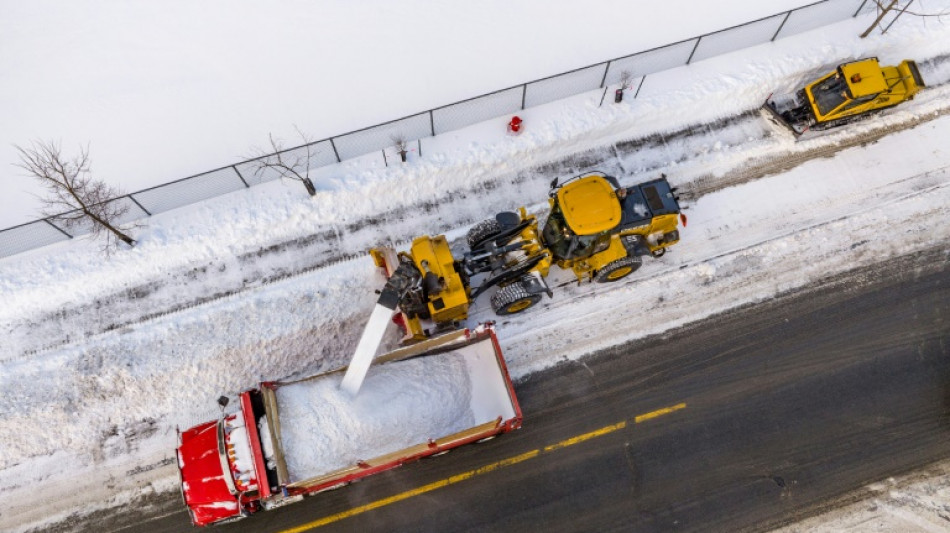
Montreal snow-clearing: good for traffic, bad for environment / Photo: Sebastien ST-JEAN - AFP

 EU and Canada to 'withstand shocks together' with new alliance

 'Life in the old dog': German economy grows more than expected

 Italy inflation surges to 5.4% as economy stalls

 US oil giants report profit surge again on Iran war

 Carmaker Audi cuts outlook again on China, US woes

 German economy logs 0.2% growth, faster than expected

 China denies spying on Nvidia's Jensen Huang

 BP net profit quadruples on higher oil prices

 Malawi's fuel shortages, record prices deepen economic crisis

 The Duskbloods delayed as Nintendo Switch 2 release moves to 2027

 Tech firms take fresh hit as earnings misses fan AI fears

 Nvidia's web of AI bets: smart strategy or bubble risk?

 DoorDash shares rise as Instacart slips following $17 billion takeover plan

 Amazon cloud business accelerates but shares drop on profit miss

 PI Industries plans Indian launch of Pioxaniliprole insecticide this rabi season

 Asian equities diverge after mixed technology earnings and Fed rate decision

 Kuwait traffic authority cautions against hazard lights while driving in rain

 Utah files criminal charges against prediction market Kalshi
 Kuwait National Guard official visits member injured during training

 CNN Global Perspectives prepares Doha debut with international speaker lineup

 Es’hailSat and Arabsat agree broader satellite and broadcasting cooperation

A choreographed ballet of massive trucks, snowplows and snowblowers takes over the streets of Montreal whenever it snows, an enormous logistical effort with a significant environmental cost.
Hundreds of snow-clearing vehicles are deployed across the frigid Canadian city for 100 or more days each year on average, dusting the road with salt and belching emissions into the air.
"The snow challenge in Montreal is colossal," says city spokesperson Philippe Sabourin.
If the city's streets and sidewalks were put end to end, they would total 10,000 kilometers (6,200 miles) or the equivalent of the distance from Montreal to Beijing, he said.
Some 3,000 employees and 2,200 vehicles go into action day and night every time it snows, helping make the streets passable.
In Montreal alone, the equivalent of 150,000 tons of salt is spread on roads and sidewalks over the winter.
"It has an impact on ecosystems," Florent Barbecot, a professor of hydrogeology at the University of Quebec in Montreal, told AFP.
"We have seen for a few years the level of salt which is rising a little bit everywhere in the environment."
Some of it stays on the roads, dries and evaporates when temperatures warm, "ending up in the atmosphere... which will affect future precipitation," he said.
The city recognizes that salt is bad for the environment, but despite ongoing research, no effective substitute has been found.
It is "a material that does us a great service," by lowering the freezing temperature of ice and melting icy patches, Sabourin explained.
With almost two meters (six feet) of snowfall in Montreal each year, the city simply cannot go without massive snow management.
- People 'not happy' -
As a substitute, "we tried coffee grinds, it smelled good, but it was not a success," Sabourin added.
Beetroot juice has also been tried, which is less corrosive than salt, "but it stained floors a lot, people were not happy," he said.
Until the late 1990s, snow soiled by waste and pollution was dumped directly into the St. Lawrence River, before the practice was banned.
Some of it is now poured into snow chutes connected to the sewer system.
But the majority (75 percent) is stored in quarries, where the snow is piled high. One mound on the city's south side stretches the width of several football fields and rises ten storeys high.
At the foot, trucks appear tiny in comparison as they dump snow, most of it looking more grey than white.
In a few months, the spring thaw will melt the snow, and waste and gravel will be separated from the water, which is treated before being discharged into the river.
- 'Societal choice' -
According to Barbecot, the city should simply use less salt, but that would require changing "the way we live" by limiting urban sprawl and driving less.
"That's a societal choice," he said.
In the streets, locals do not seem ready to embrace such a massive shift.
According to Charles Drolet, who was working behind the wheel of a city snowblower, residents mostly just want to see more frequent ploughing of streets.
For resident Francine Lalonde, salting roads and snow removal "is a necessary evil," despite the negative environmental impacts.
S.F.Lacroix--CPN