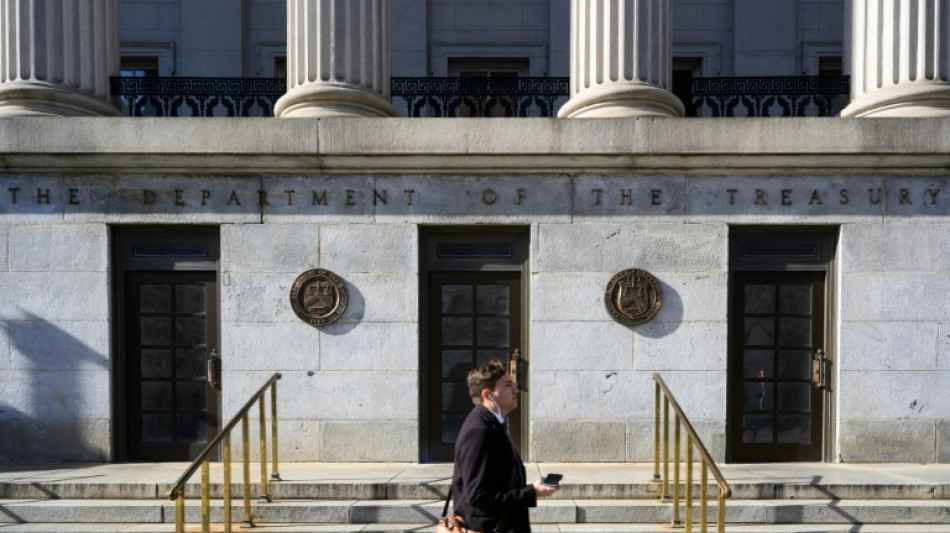
US takes 'extraordinary' steps to avoid looming default / Photo: Mandel NGAN - AFP/File

 US oil giants report profit surge again on Iran war

 Carmaker Audi cuts outlook again on China, US woes

 German economy logs 0.2% growth, faster than expected

 China denies spying on Nvidia's Jensen Huang
 BP net profit quadruples on higher oil prices

 Malawi's fuel shortages, record prices deepen economic crisis

 The Duskbloods delayed as Nintendo Switch 2 release moves to 2027

 Tech firms take fresh hit as earnings misses fan AI fears

 Nvidia's web of AI bets: smart strategy or bubble risk?

 DoorDash shares rise as Instacart slips following $17 billion takeover plan

 Amazon cloud business accelerates but shares drop on profit miss

 PI Industries plans Indian launch of Pioxaniliprole insecticide this rabi season

 Asian equities diverge after mixed technology earnings and Fed rate decision

 Kuwait traffic authority cautions against hazard lights while driving in rain
 Utah files criminal charges against prediction market Kalshi

 Kuwait National Guard official visits member injured during training

 CNN Global Perspectives prepares Doha debut with international speaker lineup

 Es’hailSat and Arabsat agree broader satellite and broadcasting cooperation

 ECB says has tools to calm markets as French debt worries rise

 IMF says engaging with Iraq on preparing new bailout program

 US economy posts strong growth, inflation stubbornly high in challenge to Trump
The US Treasury began taking measures Thursday to prevent a default on government debt, as Congress heads towards a high-stakes clash between Democrats and Republicans over raising the borrowing limit.
Such "extraordinary measures" can help reduce the amount of outstanding debt subject to the limit, currently set at $31.4 trillion, but the Treasury has warned that the tools would only help for a limited time -- likely not longer than six months.
"I respectfully urge Congress to act promptly to protect the full faith and credit of the United States," said Treasury Secretary Janet Yellen in a letter to Congressional leadership on Thursday.
She said last week that "failure to meet the government's obligations would cause irreparable harm to the US economy, the livelihoods of all Americans, and global financial stability."
A default would harm US credibility, and JPMorgan Chase Chief Executive Jamie Dimon cautioned Thursday that "we should never question the creditworthiness of the United States government."
"That is sacrosanct. It should never happen," he said in an interview with CNBC.
- 'Risky and dangerous' -
The world's biggest economy could face severe disruption with Republicans threatening to refuse the usual annual rubber stamping of a rise in the legal borrowing limit, and this could push the United States into default.
Far-right Republicans, who now hold key power in the party's narrow majority in the House, want Democratic President Joe Biden to agree to slash government spending.
They argue that radical cuts are needed to reduce borrowing, which Congress has generally agreed to increase each year -- raising the so-called debt ceiling.
But the White House has said such cuts would have to come from key social security and military spending programs, or involve major new taxes.
The White House also vowed that Biden would not negotiate with hardline Republicans over their "risky and dangerous" opposition to increasing the limit.
- 'Rancorous politics' -
For now, the Treasury Department said it would be unable to fully invest a portion of the Civil Service Retirement and Disability Fund, with a "debt issuance suspension period" to last until early June.
Treasury will also halt additional investments of amounts credited to the Postal Service Retiree Health Benefits Fund, Yellen said in announcing the latest actions.
As the debt ceiling approaches, Treasury will start to draw down its cash balances and turn to accounting techniques and tools to allow the government to continue its functions, said Mickey Levy of Berenberg Capital Markets.
But he believes the probability of a government default on its debt is close to zero.
"I think ultimately... there will be an agreement to raise the debt ceiling but between now and then, there's going to be a lot of debate and rancorous politics," Levy told AFP.
If things stand as they are however, spending will keep rising and increasing debt, he said, adding that a large part goes to entitlement programs such as social security and Medicare.
"The political appetite to really address these programs is just not there," he said.
D.Philippon--CPN