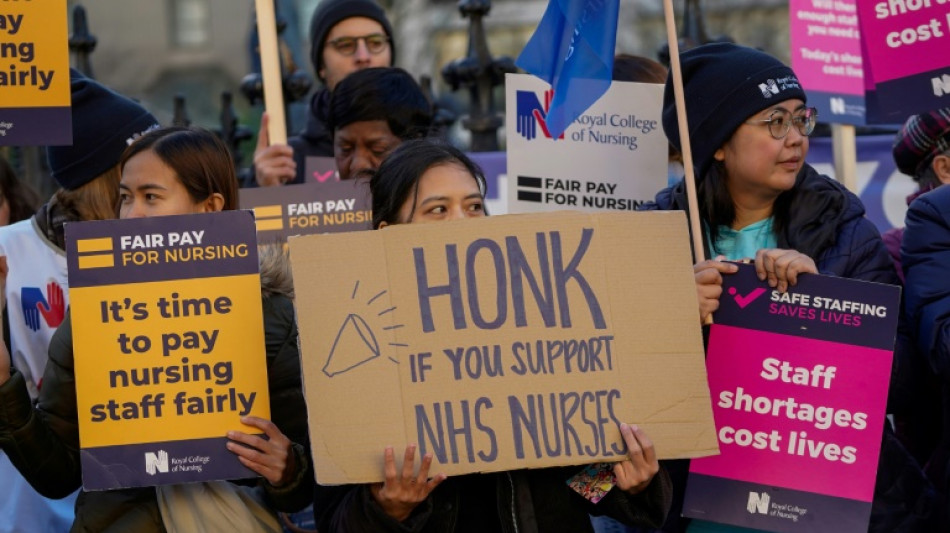
'No beds, not enough doctors': UK healthcare crisis laid bare / Photo: Niklas HALLE'N - AFP

 US oil giants report profit surge again on Iran war

 Carmaker Audi cuts outlook again on China, US woes

 German economy logs 0.2% growth, faster than expected

 China denies spying on Nvidia's Jensen Huang
 BP net profit quadruples on higher oil prices

 Malawi's fuel shortages, record prices deepen economic crisis

 The Duskbloods delayed as Nintendo Switch 2 release moves to 2027

 Tech firms take fresh hit as earnings misses fan AI fears

 Nvidia's web of AI bets: smart strategy or bubble risk?

 DoorDash shares rise as Instacart slips following $17 billion takeover plan

 Amazon cloud business accelerates but shares drop on profit miss

 PI Industries plans Indian launch of Pioxaniliprole insecticide this rabi season

 Asian equities diverge after mixed technology earnings and Fed rate decision

 Kuwait traffic authority cautions against hazard lights while driving in rain
 Utah files criminal charges against prediction market Kalshi
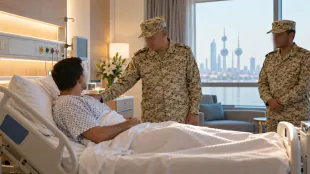 Kuwait National Guard official visits member injured during training

 CNN Global Perspectives prepares Doha debut with international speaker lineup

 Es’hailSat and Arabsat agree broader satellite and broadcasting cooperation

 ECB says has tools to calm markets as French debt worries rise

 IMF says engaging with Iraq on preparing new bailout program

 US economy posts strong growth, inflation stubbornly high in challenge to Trump

Five-year-old Yusuf Mahmud Nazir died from pneumonia after being sent home, despite a doctor describing his tonsillitis as the worst he had ever seen.
Martin Clark, 68, was driven to hospital by his family after they waited 45 minutes for an ambulance when he suffered chest pains at home. He later died after a cardiac arrest.
As nurses went on strike on Wednesday, with its focus on low pay, the extent of the crisis facing patients in the UK's state-run National Health Service (NHS) is being laid bare.
"We go to work every day as nurses, and we do our best, and our best isn't enough right now, and that's because our workload keeps increasing and our resources aren't matching that," Orla Dooley, an accident an emergency nurse, told AFP.
"It (the strike) is about people's mums who are at home in the community having heart attacks and not having treatment because there's no ambulances to go out to them.
"It's about your dad not having surgery for cancer, because there's no bed for him to go to after his operation.
"And it's about your granny dying on a ward by herself because there's no nurse to hold her hand because there just isn't enough nurses. That's what it's about."
- 'Suffering' -
The situation is being described as the worst crisis since the NHS was set up in 1948, with a particular focus on accident and emergency (A&E) but which also includes longer waiting times for other appointments and treatment.
According to NHS England, a record 54,532 people in December waited for more than 12 hours once arriving at A&E.
The average wait for an ambulance for category two patients -- which includes suspected strokes or heart attacks -- is more than 90 minutes. The target time is 18 minutes.
A&E doctor Waheed Arian told The Times this week he was once confronted with 14 ambulances lined up outside his hospital in Coventry, central England.
"I had to open up each ambulance and look inside and decide which patient could come in because we only had two beds," he said.
"They were all suffering, they should all have had a bed. The NHS is under such stress that we're being asked to do things that we shouldn't be doing."
In Rotherham, northern England, young Yusuf's uncle, Zaheer Ahmed, said they were told there were "no beds and not enough doctors" when they begged for him to be admitted.
"They kept saying to us, 'we've got one doctor. What do you want us to do? We've got no beds available," he told British media.
Clark's family in East Sussex, southern England, said he had been a fit man but they were left wondering if he could have survived if he had received prompt treatment.
"The NHS is broken," his widow Ann told the BBC. "Everybody is scared if they get ill. Where can they turn? Something needs to change."
- Excess deaths -
Ambulance workers, who launched a first round of strike action in December and are expected to walk out again in the coming weeks, blame the situation on delays on admissions outside A&E.
The government attributes the difficulties to the effects of the pandemic but an increase in excess deaths last year have also been partly blamed on the staffing crisis.
Whatever the reason, that is no consolation to Matthew Simpson, whose wife Teresa, 54, had diabetes and the muscle wasting disease myotonic dystrophy. She died after nearly 17 hours waiting for help.
Simpson, 47, from Hull, in northern England, said he called the emergency 999 number after she became confused.
Both fell asleep while waiting for paramedics but when Simpson woke up he found his wife lifeless.
Paramedics eventually arrived as he was attempting to resuscitate her.
"One hundred per cent I believe that if they got to my wife in six hours she would still be here," he told Sky News.
Darrel Wilson, 54, from Stockport, says nurses told him he would not have survived had his wife not driven him to hospital herself.
He called an ambulance one night in October at around 10:00 pm after suffering shortness of breath and chest pains.
His wife Debbie called 999 eight more times during the night before finally driving him to hospital just 20 minutes away the following morning.
Wilson said nurses told him he "wouldn't be alive" if he had waited for the ambulance.
A.Mykhailo--CPN