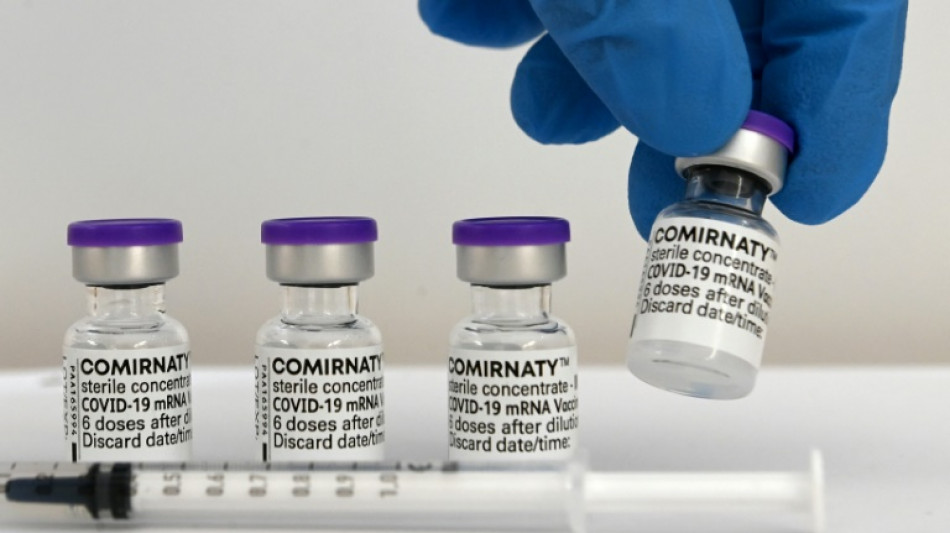
Pharma lobby blasts 'stupid' pandemic patent plans / Photo: Christof STACHE - AFP/File

 German economy logs 0.2% growth, faster than expected

 China denies spying on Nvidia's Jensen Huang
 BP net profit quadruples on higher oil prices

 Malawi's fuel shortages, record prices deepen economic crisis

 The Duskbloods delayed as Nintendo Switch 2 release moves to 2027

 Tech firms take fresh hit as earnings misses fan AI fears

 Nvidia's web of AI bets: smart strategy or bubble risk?

 DoorDash shares rise as Instacart slips following $17 billion takeover plan

 Amazon cloud business accelerates but shares drop on profit miss

 PI Industries plans Indian launch of Pioxaniliprole insecticide this rabi season

 Asian equities diverge after mixed technology earnings and Fed rate decision

 Kuwait traffic authority cautions against hazard lights while driving in rain
 Utah files criminal charges against prediction market Kalshi

 Kuwait National Guard official visits member injured during training

 CNN Global Perspectives prepares Doha debut with international speaker lineup

 Es’hailSat and Arabsat agree broader satellite and broadcasting cooperation

 ECB says has tools to calm markets as French debt worries rise
 IMF says engaging with Iraq on preparing new bailout program

 US economy posts strong growth, inflation stubbornly high in challenge to Trump
 French businessman takes over 2030 Winter Olympics amid leadership turmoil

 Stock markets diverge on corporate earnings, tech jitters

Stripping patent protection from Covid-19 treatments is a "mind-bogglingly stupid" idea, the head of a leading pharmaceutical lobby said Wednesday, warning that the move would put industry innovation at risk.
Thomas Cueni, director general of the International Federation of Pharmaceutical Manufacturers and Associations (IFPMA), said the industry was still working on more effective Covid vaccines and treatments.
But Cueni said manufacturers would not risk ploughing investment into potential products if their intellectual property (IP) rights could be stripped away.
Cueni told reporters it would be "seriously dangerous" to move from voluntary knowledge-sharing seen during the pandemic to a "coercive" situation.
He added that when knowledge and technology is shared, generic manufacturers were still reliant on close support from the patent holders.
At the World Health Organization, plans are being drawn up for what could be a legally binding treaty on future pandemic preparedness.
Meanwhile, World Trade Organization members are discussing broadening a temporary IP waiver for producing Covid vaccines, agreed in June 2022, to include tests and treatments.
"That debate should simply have been closed," Cueni said.
He said more than 800 potential Covid-19 treatments were being researched -- and of approved treatments, around two-thirds were pre-existing medicines that companies had tested to see if they worked against Covid.
If the patent on the Covid part of any medicine is removed, there is "no way... to protect the original part", he said.
"I have heard many companies say we would never have considered risking our core business and checking if it works" if they risked losing the protection that encouraged them to invest in at-risk research.
Therefore, an IP waiver "potentially undermining what worked so well in this pandemic is basically mind-bogglingly stupid", Cueni said.
He also said proposals to waive patents on tests were "ludicrous" as there was no generic market for diagnostics.
- Vaccine equity vow -
Cueni said IFPMA members were concerned about ensuring that what worked well in the Covid-19 response is not lost or compromised for future pandemic preparedness.
He said manufacturers needed fast, unhindered access to respond to emerging pathogens.
But he acknowledged that pharma firms needed to learn from "what didn't work well -- that is equitable roll-out" of vaccines.
"We need to make sure that dose-sharing is something we build in from day one," he said.
Cueni said there needed to be greater geographic diversity in manufacturing, with most vaccines being produced only in the United States, Europe, China and India.
"Even if that works, you will still need to open borders and remove trade barriers," he said, noting that supply chain problems could slow production.
And even then, "we need to work on country readiness because once we had not just sufficient supply of vaccines but an over-supply of vaccines, we still didn't see the jabs getting into the arms of people".
- Cost claim -
With the pandemic now entering its fourth year, Cueni said major manufacturers were busy working on improved jabs and treatments.
He hoped that future vaccines would offer longer-lasting protection.
"It would be nice if one jab per year would suffice," he said.
As for the profits made by the pharmaceutical industry during the pandemic, Cueni said: "When you look at how much Covid-19 cost the global economy, the cost of the treatments or the vaccines was just a tiny fraction of that."
J.Bondarev--CPN