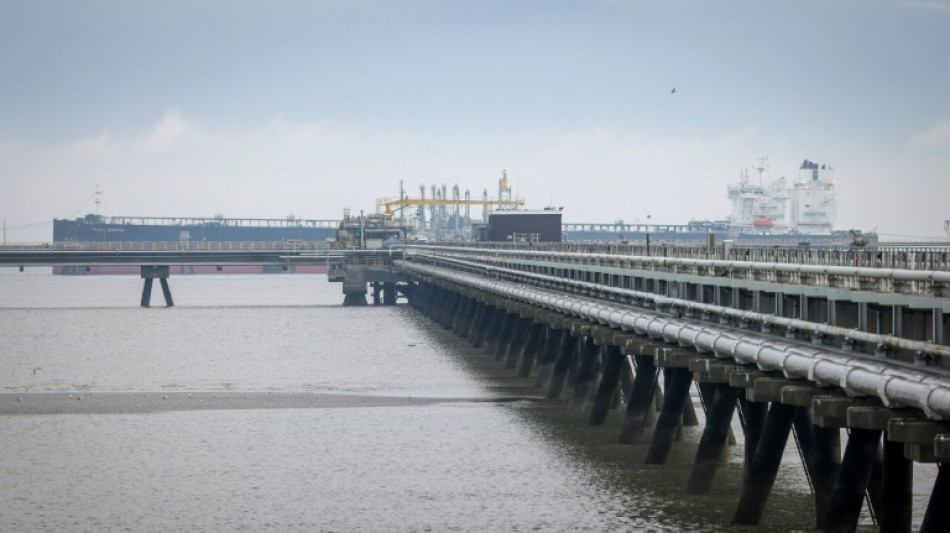
Germany to cut the ribbon on first LNG terminal / Photo: FOCKE STRANGMANN - AFP/File

 Malawi's fuel shortages, record prices deepen economic crisis

 The Duskbloods delayed as Nintendo Switch 2 release moves to 2027

 Tech firms take fresh hit as earnings misses fan AI fears
 Nvidia's web of AI bets: smart strategy or bubble risk?

 DoorDash shares rise as Instacart slips following $17 billion takeover plan

 Amazon cloud business accelerates but shares drop on profit miss

 PI Industries plans Indian launch of Pioxaniliprole insecticide this rabi season
 Asian equities diverge after mixed technology earnings and Fed rate decision

 Kuwait traffic authority cautions against hazard lights while driving in rain

 Utah files criminal charges against prediction market Kalshi
 Kuwait National Guard official visits member injured during training

 CNN Global Perspectives prepares Doha debut with international speaker lineup

 Es’hailSat and Arabsat agree broader satellite and broadcasting cooperation

 ECB says has tools to calm markets as French debt worries rise

 IMF says engaging with Iraq on preparing new bailout program
 US economy posts strong growth, inflation stubbornly high in challenge to Trump
 French businessman takes over 2030 Winter Olympics amid leadership turmoil
 Stock markets diverge on corporate earnings, tech jitters
 TotalEnergies profit hits record on high oil prices

Germany will on Saturday inaugurate its first liquefied natural gas (LNG) terminal, built in record time, as the country scrambles to adapt to life without Russian energy.
The rig in the North Sea port of Wilhelmshaven will be opened by Chancellor Olaf Scholz at a ceremony on board a specialist vessel known as an FSRU, named the Hoegh Esperanza.
The ship has already been stocked with gas from Nigeria that could supply 50,000 homes for a year, and the terminal is set to begin deliveries on December 22.
Germany plans to open four more government-funded LNG terminals over the next few months as well as a private terminal in the port of Lubmin.
Together, the terminals could deliver 30 billion cubic metres of gas a year from next year, or a third of Germany's total gas needs -- if Berlin can find enough LNG to service them.
LNG terminals allow for the import by sea of natural gas which has been chilled and turned into a liquid to make it easier to transport.
The FRSU stocks the LNG, then turns it back into a ready-to-use gas.
Until now, Germany had no LNG terminals and relied on cheap gas delivered through pipelines from Russia for 55 percent of its supply.
- Supply worries -
But since Russia's invasion of Ukraine, gas supplies to Germany have been throttled and Berlin has been forced to rely on LNG processed by Belgian, French and Dutch ports, paying a premium for transport costs.
The government decided to invest in building its own LNG terminals as quickly as possible and has spent billions of euros on hiring FSRUs to service them.
However, Germany has not yet signed a single major long-term contract to begin filling the terminals from January.
"The import capacity is there. But what worries me are the deliveries," Johan Lilliestam, a researcher at the University of Potsdam, told AFP.
A contract has been signed with Qatar for LNG to supply the Wilhelmshaven terminal, but deliveries are not set to begin until 2026.
Suppliers want long-term contracts, while the German government is not keen to be locked into multi-year gas deals as it wants the country to become climate-neutral by 2045.
"Companies need to know that the purchasing side in Germany will eventually diminish if we want to meet climate protection targets," economy minister Robert Habeck has said.
- Cold winter -
The country could initially be forced to buy LNG from the expensive spot markets, which would lead to higher prices for consumers.
The market could also be squeezed next year by renewed demand in China as it emerges from strict Covid-19 curbs, Andreas Schroeder, an expert at the ICIS energy research institute, told AFP.
"If Europe has been able to receive so much LNG in recent months, it is because Chinese demand was low," Schroeder said.
China recently signed a deal to buy gas from Qatar for 27 years -- the longest such deal in history, according to Doha.
Germany has also had a cold winter so far, with the gas tanks emptying faster than expected.
"Gas consumption is increasing. This is a risk, especially if the cold spell continues," said Klaus Mueller, the head of the country's Federal Network Agency regulatory body, in a recent interview.
As a result, there is a real risk that Germany could experience temporary supply disruptions next winter, according to Schroeder.
Gas usage is currently down 13 percent compared to last year, but the government wants that figure to be closer to 20 percent.
In Europe, the gap between supply and demand could reach 27 billion cubic metres in 2023, according to an IEA report -- equivalent to 6.5 percent of the EU's annual consumption.
J.Bondarev--CPN