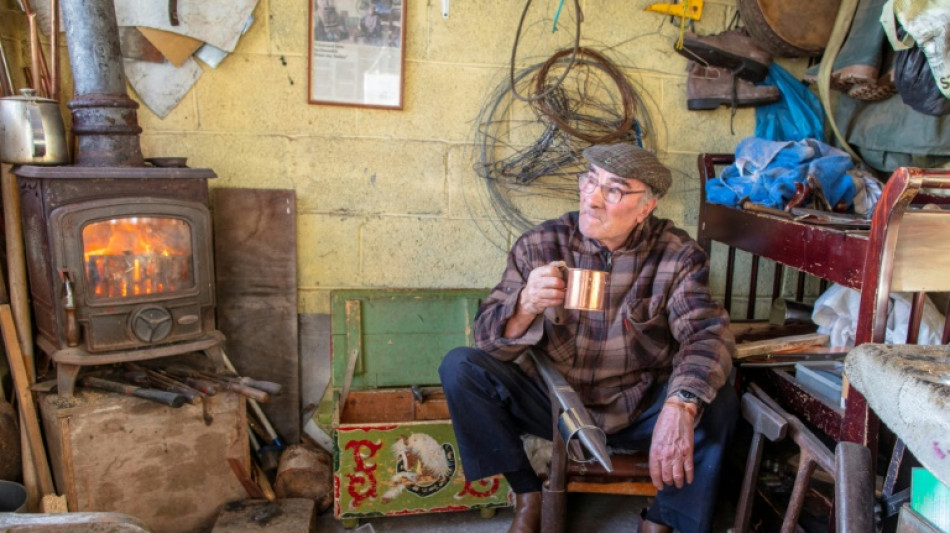
One of Ireland's last Traveller tinsmiths mourns lost way of life / Photo: Paul Faith - AFP

 The Duskbloods delayed as Nintendo Switch 2 release moves to 2027

 Tech firms take fresh hit as earnings misses fan AI fears
 Nvidia's web of AI bets: smart strategy or bubble risk?

 DoorDash shares rise as Instacart slips following $17 billion takeover plan

 Amazon cloud business accelerates but shares drop on profit miss

 PI Industries plans Indian launch of Pioxaniliprole insecticide this rabi season

 Asian equities diverge after mixed technology earnings and Fed rate decision

 Kuwait traffic authority cautions against hazard lights while driving in rain

 Utah files criminal charges against prediction market Kalshi
 Kuwait National Guard official visits member injured during training

 CNN Global Perspectives prepares Doha debut with international speaker lineup

 Es’hailSat and Arabsat agree broader satellite and broadcasting cooperation

 ECB says has tools to calm markets as French debt worries rise

 IMF says engaging with Iraq on preparing new bailout program

 US economy posts strong growth, inflation stubbornly high in challenge to Trump

 French businessman takes over 2030 Winter Olympics amid leadership turmoil
 Stock markets diverge on corporate earnings, tech jitters

 TotalEnergies profit hits record on high oil prices

 Afghanistan opium poppy cultivation surges despite Taliban govt ban: UN
Warmed by a wood-burning stove and thinking of the past, James Collins often works with tin late into the evening, the passing of time punctuated by the steady tap of his hammer.
Collins, 73, is one of Ireland's last remaining Traveller tinsmiths, a traditional craft passed from generation to generation which now has all but died out.
"My father done it and his father before him done it," Collins told AFP in his Dublin workshop.
"There was hundreds of tinsmiths. Nearly every Traveller was a tinsmith. There's only two tinsmiths that's left."
Collins grew up in a nomadic culture practised by Ireland's Traveller ethnic minority that is itself little more than a memory.
He was born in a tent by the side of the road in the Irish midlands in 1949.
In a time of deep deprivation even for Ireland's settled communities, Collins lived with his family on the road until his mid-twenties.
He learnt tinsmithing from his father when he was 14, swapping the buckets, mugs and the wire-handled cooking pots or billycans he made for food.
The family also offered casual labour on the land, working at the same locations seasonally.
"It was a good life but it was a hard life," Collins said. "You'd hate the winter time of the year with the cold, frost and snow.
"But you wouldn't pass much heed to it because you were brought up with it."
- Roots -
Collins set down roots in the 1970s, moving to a Traveller housing scheme in Avila Park in northwest Dublin where he raised a family.
Most Travellers living in the Republic of Ireland now live in a permanent location, according to European Union research.
Those who do travel tend to do so only in the summer.
When he arrived, Collins said the few houses on the estate were surrounded by fields on every side.
Now the scheme, a cramped cul-de-sac of four adjoining streets, is hemmed in by walls and fences topped with spikes and barbed wire.
The move gave Collins' children the chance to learn to read and write and have the formal education he never had.
In the 1970s the tin items Collins made were replaced with plastic and what little could be earned from the craft disappeared.
"I have five sons and none of them are interested in the tinsmithing because there's (no money) to be made out of it," he said.
Alone in his workshop with his father's antique tools, the tinsmith says the craft now is little more than a hobby and he thinks of the past often as a happier time.
"There's not a day that passes, it always goes through (my) mind. Because you knew so many settled people and settled people knew you," Collins said.
"We used to camp outside their gates and there was no problem or no hassle."
- Prejudice -
But discrimination against Travellers and friction with the settled communities is centuries old in Ireland, according to Collins' nephew Martin Collins, who is director of Pavee Point Traveller and Roma Centre.
"It's very well documented that Travellers continue to be... one of the most persecuted groups in Irish society," he explained.
According to census data, there were 30,987 Travellers in Ireland in 2016 representing 0.7 percent of the general population.
But despite recognition as a distinct ethnic minority since 2017, Travellers still face obstacles in virtually every area of life.
"(Travellers) experience discrimination and racism... in the education system in accessing employment and accessing accommodation, healthcare, and support," said Martin Collins.
EU research in 2019 showed Irish Travellers experience some of the worst deprivation and discrimination of any minority group in the bloc.
Martin Collins said that while state rhetoric was for pluralism, there remained a "subtext when it comes to Travellers defining my people as backward, as uncivilised".
- Mental health -
The challenge facing the community has been underlined in recent years by a growing mental health crisis.
A 2021 Irish parliament report showed suicide accounted for 11 percent of Traveller deaths -- seven times higher for Traveller men and six times higher for Traveller women than the general population.
Geraldine McDonnell, a mental health worker with Pavee Point, said the deaths touch every part of the tight-knit Traveller community.
"We see, unfortunately, a lot of families would have multiple suicides within that family."
Pavee Point has launched an online service to give Traveller-tailored mental health advice, especially to children.
But Martin Collins says discrimination is the root cause of the crisis.
"We need to create conditions where Travellers can be proud and confident of their Traveller identity."
M.Anderson--CPN