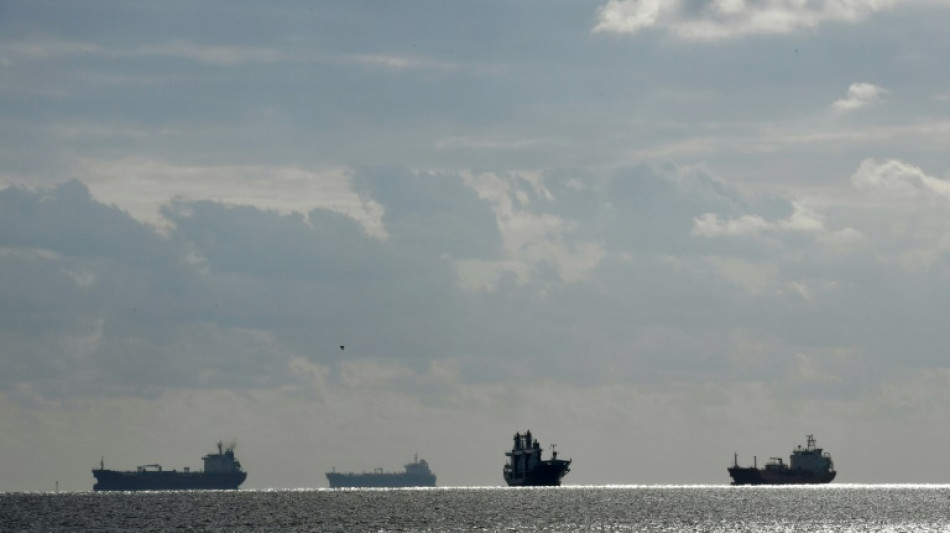
Russia oil embargo, price cap disrupts tankers / Photo: GERARD JULIEN - AFP/File

 The Duskbloods delayed as Nintendo Switch 2 release moves to 2027

 Tech firms take fresh hit as earnings misses fan AI fears

 Nvidia's web of AI bets: smart strategy or bubble risk?

 DoorDash shares rise as Instacart slips following $17 billion takeover plan

 Amazon cloud business accelerates but shares drop on profit miss

 PI Industries plans Indian launch of Pioxaniliprole insecticide this rabi season
 Asian equities diverge after mixed technology earnings and Fed rate decision

 Kuwait traffic authority cautions against hazard lights while driving in rain
 Utah files criminal charges against prediction market Kalshi

 Kuwait National Guard official visits member injured during training

 CNN Global Perspectives prepares Doha debut with international speaker lineup

 Es’hailSat and Arabsat agree broader satellite and broadcasting cooperation

 ECB says has tools to calm markets as French debt worries rise
 IMF says engaging with Iraq on preparing new bailout program
 US economy posts strong growth, inflation stubbornly high in challenge to Trump
 French businessman takes over 2030 Winter Olympics amid leadership turmoil

 Stock markets diverge on corporate earnings, tech jitters
 TotalEnergies profit hits record on high oil prices
 Afghanistan opium poppy cultivation surges despite Taliban govt ban: UN
The European Union embargo on Russia's oil and an international cap on the price of the country's crude is disrupting the maritime transport sector.
The EU on Monday enforced an embargo on Russian crude shipments, the bloc's latest sanction in retaliation for Moscow's invasion of Ukraine.
This week also saw the start of a $60 cap on a barrel of Russian crude, agreed by Western nations.
- Tanker traffic jam -
Aimed at depriving Russia of key income, the measures have also slowed transportation of its oil by sea.
This is because Turkey has started to request proof of insurance from tankers loaded with Russian crude, slowing their passage through the Bosphorus and Dardanelles straits and onto international markets.
The Financial Times has reported that Russia has assembled a "shadow fleet" of more than 100 vessels seeking to circumnavigate the Western sanctions regime.
These ships are reportedly using non-Western insurers and selling oil at higher prices to countries that have not subscribed to the new sanctions.
A 1936 treaty guarantees the freedom of navigation to merchant vessels passing through Turkey's two straits.
But it also gives Turkey the right to regulate security -- a provision it is now using to make sure the oil ships are insured against spillage and other accidents.
The London P&I Club, a leading provider of maritime protection and indemnity insurance, claims "the Turkish government's requirements go well beyond the general information that is contained in a confirmation of entry letter.
"It requires... (confirmation) that cover will not be prejudiced under any circumstances, including where there is a sanctions breach on the part of the assured."
Marcus Baker, global head of Marine & Cargo at insurance broker Marsh, said the price cap "adds another layer of complexity to an already pretty complex situation".
He also told AFP: "The slowdown that might happen because of this added administrative burden may have the desired effect that the G7 wanted anyway."
The price ceiling was agreed by the Group of Seven rich countries, which includes Britain, Japan and the United States, as well as the EU and Australia.
Meanwhile as much as 95 percent of the P&I insurance market is run by insurers in the EU and Britain, who suddenly can no longer insure cargoes of Russia oil sold for more than $60 per barrel.
The market price of a barrel of Russian Urals crude is around $65, suggesting the cap may have only a limited impact in the short term.
President Vladimir Putin on Friday warned that Russia could reduce crude production in response to the price limit.
- Avoiding ban -
"Moscow is already working on circumventing the ban on insurance by providing its own insurance to potential clients through its state-controlled Russian National Reinsurance Company," noted Edoardo Campanella, analyst at UniCredit Bank.
An executive at an oil shipping company, who wished to remain anonymous, said "it will take a week or two, I think at a minimum, to see how the market will function in light of the price cap".
They added: "There's a general view that there is enough shipping capacity in what can be called a 'Dark Fleet' or a sanctions-indifferent fleet so that Russia can sell its oil without regard to the price cap.
"This means to China, to India, potentially some to Brazil or other parts of the world. So it doesn't have to comply with the price cap. So there's enough capacity," the executive told AFP.
burs-tu-emb/bcp/rl
C.Smith--CPN