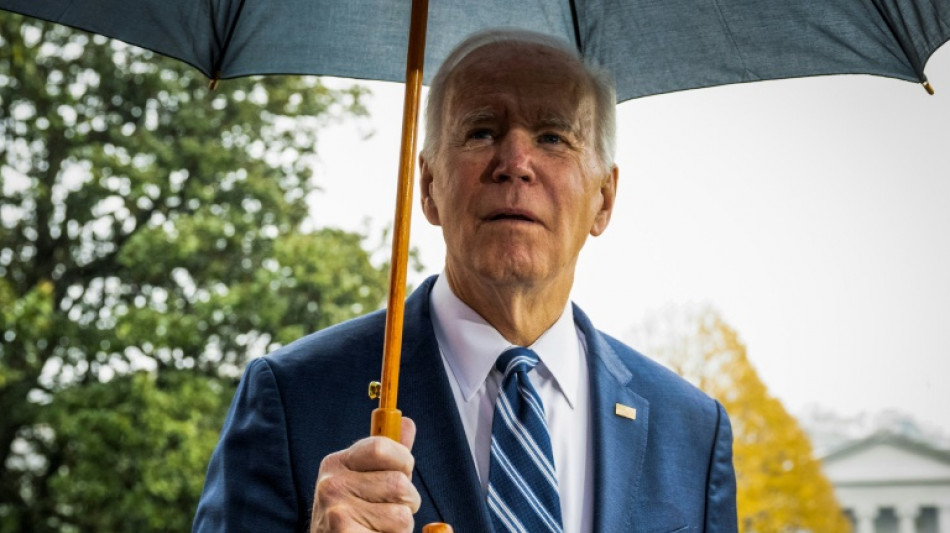
Biden celebrates giant semiconductor project in Arizona / Photo: SAUL LOEB - AFP

 Dodging fuel price hikes, Damascus drivers turn to electric cars
 Lethbridge students learn how city transit and transportation systems work

 Horoscope for October 30, 2026: communication and patience shape the day

 Inkle buys Finally bookkeeping unit and expands India-based workforce

 ISRO schedules NVS-03 navigation satellite launch for Friday

 'Star Trek', 'X-Men' star Patrick Stewart dead at 86

 Canada buying stake in AI firm Cohere to bolster tech sovereignty

 Grieving Spain demands answers for latest rail disaster

 Qatar prime minister tours Cityscape Qatar 2026

 Jazeera Paints showcases housing solutions at Build Your House 2026 in Qatar

 Google drags down Wall Street stocks

 Does White House ask AI to shape policy? Democrats want the receipts

 ECB holds rates steady after Lagarde says to quit early

 ECB chief Lagarde to step down early, triggering succession race

 VW says 'no time to lose' to slash costs after 5.8 billion euro loss

 Oil majors reap bumper profits as Mideast war drives prices

 Taiwan says Pakistan briefly closed airspace to Taiwanese flights

President Joe Biden flew Tuesday to Arizona to celebrate the mammoth expansion of a Taiwanese semiconductor plant, citing the project as proof that the United States is finally breaking dangerous dependency on foreign manufacturers for the vital component.
The project by TSMC, the world's biggest maker of leading-edge chips, would go a long way to meeting the US goal of ending reliance on factories based abroad -- particularly in Taiwan, which is under constant threat of being absorbed or even invaded by China.
TSMC, or Taiwan Semiconductor Manufacturing Company, announced it is building a second facility in Phoenix by 2026, ballooning its investment from $12 billion to $40 billion, with an eventual target of producing some 600,000 microchips a year.
About 10,000 high-tech jobs will be created once both plants are working, the company said.
The "major milestone" adds up to "the largest foreign direct investment in Arizona history and it's one of the largest in US history," White House National Economic Council Director Brian Deese told reporters.
Biden was set to speak at the TSMC site, accompanied by senior political figures and titans of the corporate world, including Apple CEO Tim Cook, TSMC's founder Morris Chang and Micron CEO Sanjay Mehrotra.
Deese said the array of executives reflects "that this is about more than just one groundbreaking, but how we build out this innovation ecosystem for semiconductors in the United States."
Biden will also seek to take political credit for the investment influx, pointing to the effect of his signature CHIPS Act, which sets aside almost $53 billion for subsidies and research in the semiconductors sector.
It's a message he'll be especially keen to spread in Arizona, which was long a Republican-dominated state but has turned into a battleground where the president's Democrats do increasingly well.
- Shifting center of gravity -
The White House is encouraging microchip manufacturing projects around the country in a strategic effort to shift the center of gravity of the global industry.
Most current US supply comes from overseas. Although the companies are largely based in reliable US allies in Asia, the sheer distance and, especially, the geopolitical tensions around Taiwan, have the government and companies like Apple nervous.
"Virtually every large tech firm, including automotive firms and any company that uses technology is sweating bullets that something's going to happen between Taiwan and China. And so there's a massive rush to shift manufacturing out of both countries," technology analyst Rob Enderle said.
The miniscule, hard-to-make gadgets are at the heart of almost every modern appliance, vehicle and advanced weapon.
But while sheer quantity matters, quality -- sophistication and small size -- is also increasingly important. Even typical smartphones require the higher-end semiconductors.
The new TSMC plant will produce state-of-the-art 3-nanometer chips, while the existing facility will start reducing the size of its current 5-nanometer chips to a more sophisticated 4 nanometers.
The twin plants "could meet the entire US demand for advanced chips when they're completed. That's the definition of supply chain resilience," Ronnie Chatterji, National Economic Council deputy director for industrial policy, told reporters.
Deese, one of Biden's most senior advisors, said the broader message is of a revitalized US industrial philosophy.
For almost four decades, the idea was "trickle down," where government would "get out the way" and cut taxes for big companies to attract investment, he said.
Instead, Biden's policy -- both through the CHIPS Act and the giant Inflation Reduction Act -- is using public money to attract, or "crowd in," private investment.
The goal is not to exclude "private companies, but in fact, encouraging private investment at historic scale," Deese said.
H.Cho--CPN